Karwa Chauth Solah Shringar: Items to Wear and Their Meaning
The 16 shringar items for Karwa Chauth explained: mangalsutra, chooda, bangles, bichiya and more, what each means and which pieces to wear today.
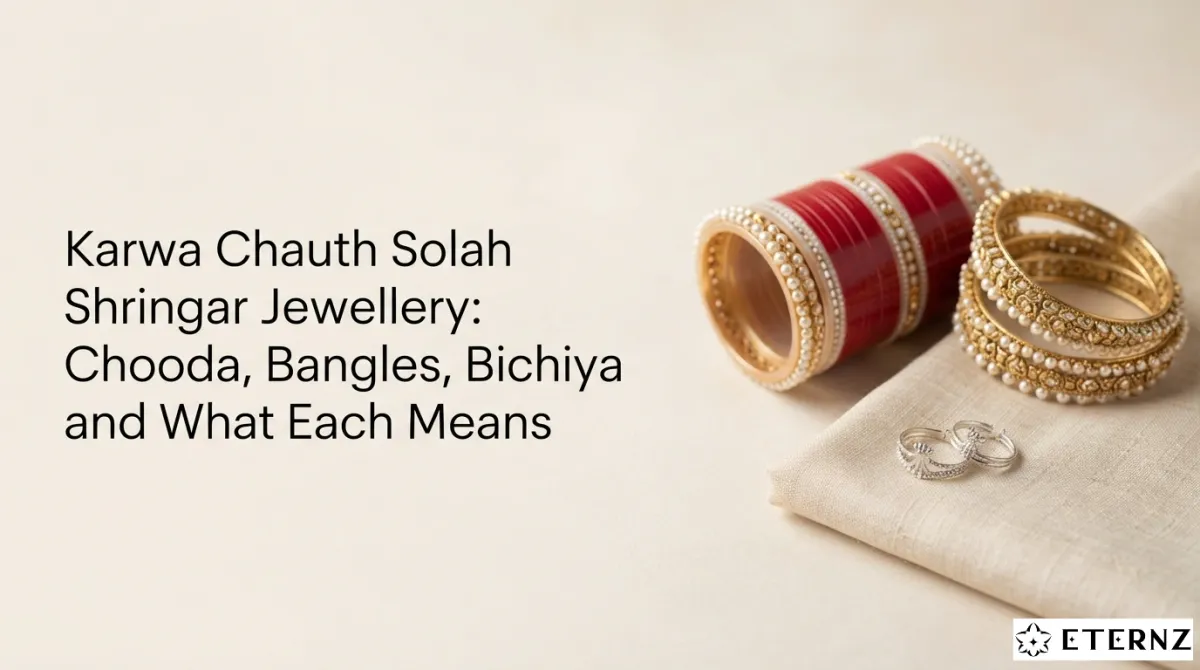
Karwa Chauth solah shringar jewellery is the set of ornaments a married woman wears as part of the "sixteen adornments" on the day of the fast. The jewellery pieces in most lists are the mangalsutra, bangles or chooda, maang tikka, nath, earrings, bajuband, rings, kamarbandh, payal and bichiya (toe rings). The rest of the 16 are things like sindoor, bindi, kajal and mehendi.
Below you will find one common 16 shringar list in a table, what each jewellery piece is believed to mean, and which four or five pieces are enough if you do not want to wear all 16.
Before we start, let me tell you about Eternz, a trusted jewelry marketplace featuring 400+ jewelry brands, with authenticity certification on every piece and fast, same-day delivery in major cities. First-time users can also save with ETERNZ5 for up to ₹50 off on ₹499+, ETERNZ10 for up to ₹100 off on ₹999+, or ETERNZ300 for up to ₹300 off on ₹2,500+, valid on both the app and website.
What Is Solah Shringar and Why Is It Done on Karwa Chauth?
Solah shringar means "sixteen adornments". "Solah" is sixteen and "shringar" is the act of dressing up and decorating yourself. It is the full bridal look, from the parting of the hair down to the toes.
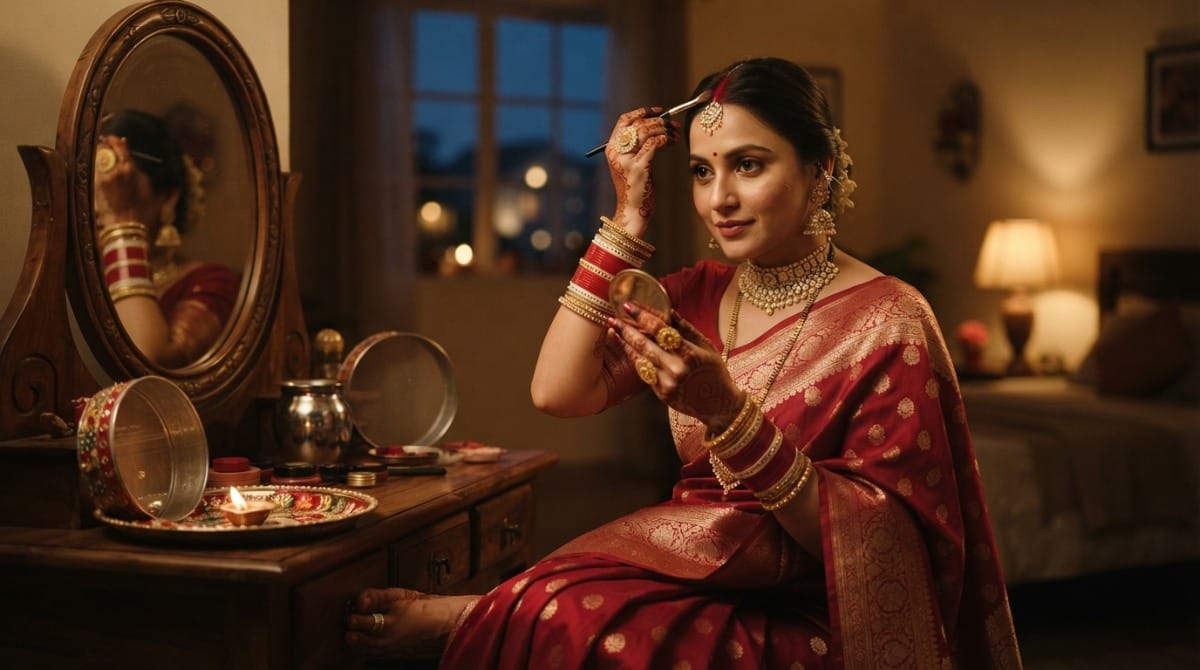
On Karwa Chauth, married women fast from sunrise to moonrise for their husband's long life. In the evening, before the puja, they dress in solah shringar, much like they did on their wedding day. In many families, dressing as a bride is a way of honouring the marriage.
There is also a link to the goddess. Many women see the solah shringar as an offering to Goddess Parvati (Gauri), who is worshipped in the Karwa Chauth puja as the ideal married woman. Some families also say the adornments please Karwa Mata, the goddess of the day. These are family beliefs, not fixed rules.
Quick fact: The number 16 is often linked to the 16 phases (kalas) of the moon in Indian tradition. Since the fast ends at moonrise, many find this fitting, though it is a popular explanation, not a written rule.
The 16 Shringar Items: One Common Solah Shringar List
There is no single official list. Punjabi, Rajasthani and UP families may each count the 16 a little differently, swapping items like perfume for haathphool or an aarsi ring. Here is one common list:
| # | Item | Where it is worn | What it is believed to mean |
|---|---|---|---|
| 1 | Sindoor | Hair parting | The main sign of a married woman |
| 2 | Bindi | Between the eyebrows | Married life and focus |
| 3 | Maang tikka | Hair parting, on the forehead | Sits where sindoor is applied; marks the bride |
| 4 | Kajal | Eyes | Beauty and protection from the evil eye |
| 5 | Nath | Nose | A bridal piece, linked to marriage |
| 6 | Karnphool (earrings) | Ears | "Flowers of the ear"; part of every festive look |
| 7 | Mangalsutra | Neck | The marriage necklace in many Hindu families |
| 8 | Mehendi | Hands and feet | Joy and love in the marriage |
| 9 | Chooda or bangles | Wrists | Married life and good fortune |
| 10 | Bajuband | Upper arm | Strength and grace |
| 11 | Rings | Fingers | The bond of marriage |
| 12 | Kamarbandh | Waist | Holds the saree and finishes the bridal look |
| 13 | Payal | Ankles | Grace; the sound marks a woman at home |
| 14 | Bichiya | Second toe of both feet | A sign of being married |
| 15 | Gajra | Hair bun | Freshness and festivity |
| 16 | Bridal outfit and itr (perfume) | Body | The complete bridal look |
Ten of these 16 are jewellery. That is why the jewellery takes up most of the planning, and why the next section goes through each piece in turn.
What Each Solah Shringar Jewellery Piece Means
Here are the pieces from head to toe.
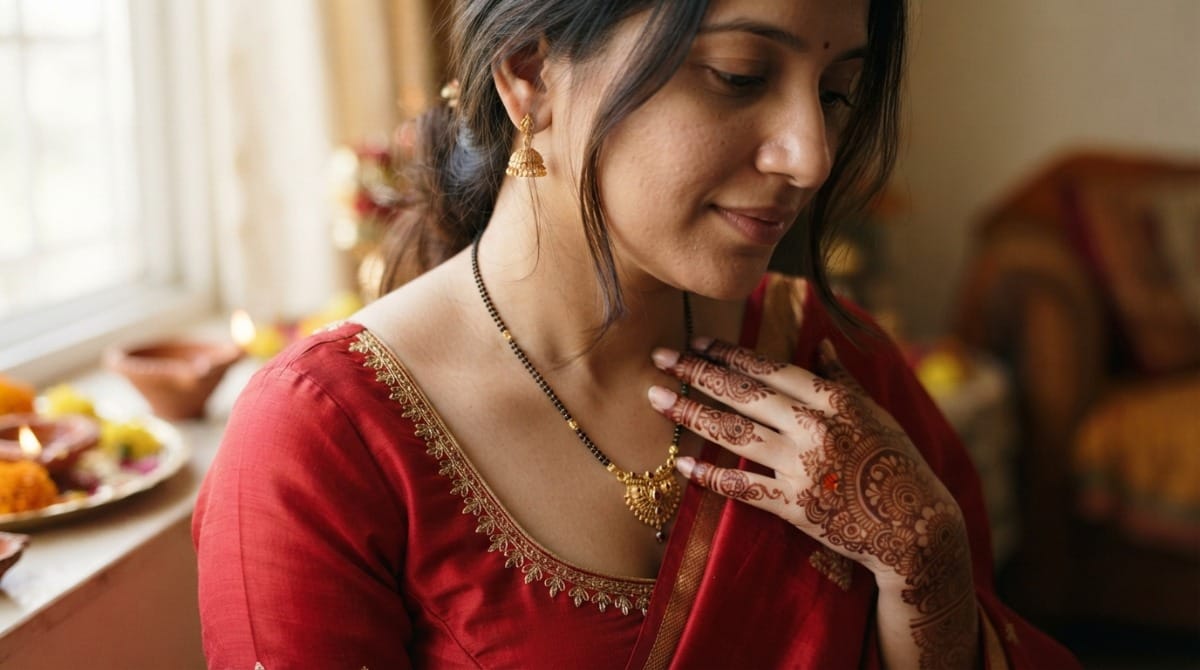
Mangalsutra: the marriage necklace
The mangalsutra is a black bead necklace, usually with a gold pendant, that the groom ties on the bride during the wedding. "Mangal" means auspicious and "sutra" means thread.
In many families, the black beads are believed to protect the marriage from the evil eye. Since Karwa Chauth is also about a long marriage, most women never skip it on this day. Designs today range from a heavy bridal pendant to a thin chain or even a bracelet mangalsutra. Our guide to popular mangalsutra designs shows the main styles. If you are thinking of one as a present, read is a mangalsutra a good Karwa Chauth gift.
Chooda and bangles: colour, metal and meaning
Bangles are on almost every solah shringar list. In many families, the sound of bangles at home is a sign of a happy married life, and bare wrists are avoided on Karwa Chauth.
- Red bangles: Red is the colour of marriage and of sindoor. It is believed to stand for love and good fortune.
- Green bangles: Green stands for new beginnings and growth, and green glass bangles are common in many Maharashtrian homes.
- Glass bangles: The most traditional choice. Many women buy a fresh set, as a full, unbroken set is considered lucky.
- Metal bangles: Gold or gold-toned bangles last longer and are often worn at each end of a glass stack.
The chooda is a set of red and ivory (or red and white) bangles that a Punjabi bride wears from her wedding day. In many Punjabi families, it is given by the bride's maternal uncle and worn for weeks or months after the wedding. A bride in her first year often wears her chooda on her first Karwa Chauth. Women who are past that year usually switch to regular bangles or a metal kada.
What about kaleere? Kaleere are the dangling gold or silver ornaments tied to the chooda on the wedding day. They belong to the wedding itself, so they are not usually part of Karwa Chauth shringar.
Quick tip: Before you order bangles online, measure the widest part of your hand with the thumb tucked in, and match it to the size guide on the product page. Glass bangles that are too tight can crack while you put them on.
Maang tikka and matha patti: the forehead pieces
The maang tikka hangs from a chain along the hair parting and rests on the forehead. It sits right where sindoor is applied, so in many families it is seen as a mark of the married woman.
A matha patti also runs along the hairline on both sides. It is more bridal and heavier, so most women keep it for the first Karwa Chauth.
Nath: the nose ring
The nath is a large nose ring, often with a chain that hooks into the hair or the ear. It is a classic bridal piece in many communities, especially in Maharashtra, Rajasthan and Uttar Pradesh.
A full nath can feel heavy by evening. Many women wear a small nose pin for most of the day and switch to the nath only for the puja. Our guide to nose piercing in India helps if you are thinking of getting one.
Karnphool: earrings and jhumkas
Karnphool means "ear flower". Today, any festive earrings count. Gold jhumkas are the most common choice, and chandbali earrings are popular on this night because of their half-moon shape.
If your earrings are heavy, an ear chain clipped into the hair takes some of the weight off the lobe.
Bajuband: the armlet
The bajuband is worn on the upper arm and is believed to stand for strength. It looks best with sleeveless or short-sleeve blouses.
Today the bajuband is the piece most women leave out. If you want one, look under arm cuffs, which are lighter and easier to adjust than a traditional bajuband.
Haathphool and rings, including the aarsi
The haathphool, or hand harness, joins a bracelet at the wrist to one or more rings with fine chains across the back of the hand. It shows off mehendi well, which is why it shows up in Karwa Chauth photos.
Rings stand for the bond of marriage, and most women simply wear their wedding or engagement ring. The aarsi is a special thumb ring with a small mirror on top, worn by brides in some Rajasthani and older North Indian traditions. It is rare today. If your ring size has changed since the wedding, our guide on how to measure ring size at home helps before you order a new one.
Kamarbandh: the waist belt
The kamarbandh is a chain or belt worn around the waist over the saree. It holds the pleats in place and finishes the bridal look. You will find these under waist accessories.
For a long seated puja, a light chain style is more comfortable than a wide, heavy belt.
Payal: the anklets
Payal are anklets, usually silver, often with small bells (ghungroo). The soft sound is believed to bring good energy into the home, and in many families the payal is a sign that the bride has come to her new house.
Silver is used because, in many North Indian families, gold is linked to Goddess Lakshmi and is not worn on the feet. Not sure whether a payal and an anklet are the same thing? Our guide on anklet vs payal explains the difference.
Bichiya: the toe rings
Bichiya are toe rings, worn in pairs on the second toe of both feet. In many Hindu families, especially in North India, they are one of the clearest signs that a woman is married.
Bichiya are traditionally silver, for the same reason as the payal. The idea that toe rings press a nerve linked to health is a popular belief without solid scientific proof.
- Fit: A good bichiya sits snug at the base of the toe and does not slide to the nail. See our list of adjustable toe rings.
- Style: Our complete toe ring guide covers the main designs, and this guide on how to wear anklets and toe rings together helps you match the two.
Quick fact: In many families, gold goes above the waist and silver on the feet. For more on this custom, read gold or silver jewellery for Karwa Chauth.
The Non-Jewellery Shringar Items, in Brief
The other six items finish the look, usually done at home on the day.
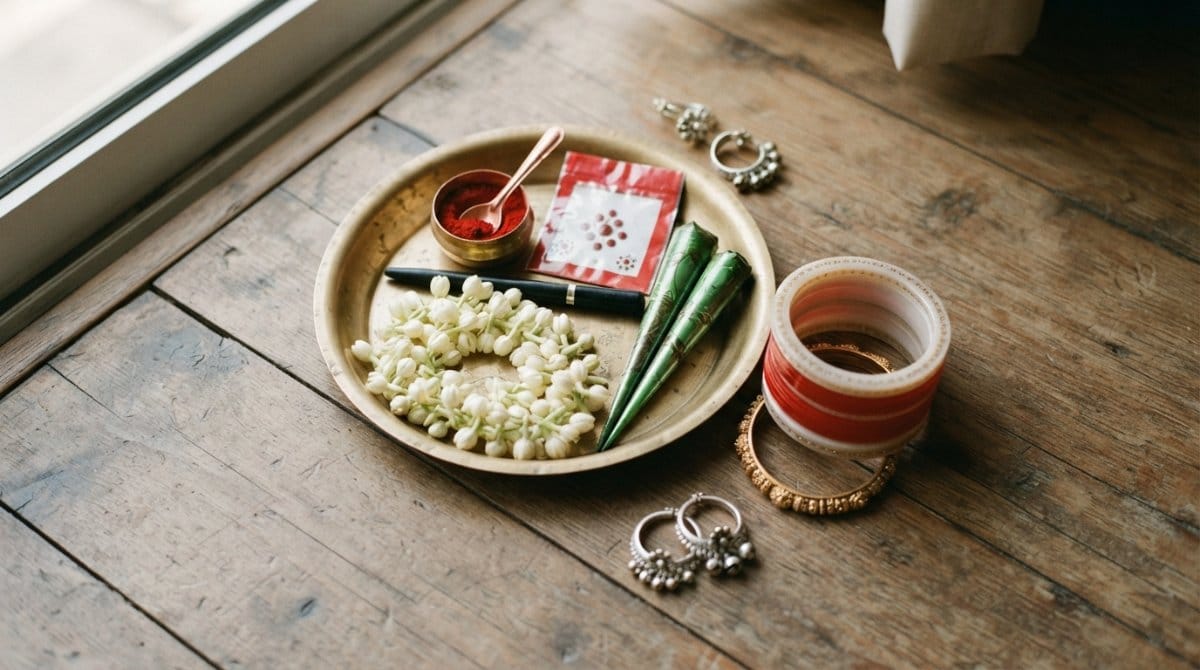
- Sindoor: Red powder in the hair parting. It is the main sign of a married woman in many Hindu families.
- Bindi: A red dot or design between the brows. It is believed to stand for married life and focus.
- Kajal: Kohl for the eyes, believed to protect from the evil eye.
- Mehendi and alta: Henna on the hands, usually done a day before. Alta is a red dye painted on the edges of the feet.
- Gajra: A string of fresh jasmine or other flowers for the hair bun. A hair pin helps keep it in place through the evening.
- Outfit and itr: A bright saree or lehenga in red, maroon or pink, plus a light perfume.
A hair chain around the bun also works in place of a gajra.
Which 4 or 5 Pieces to Wear If You Do Not Want All 16
Most women today skip the full bridal set, since the day means no food or water and often work too. A few pieces carry most of the meaning.
| Priority | Piece | Why it matters |
|---|---|---|
| 1 | Mangalsutra | The main sign of marriage in many families |
| 2 | Bangles or chooda | Rarely skipped on this day |
| 3 | Bichiya | A sign of being married, worn all day |
| 4 | Earrings | Finish any festive look |
| 5 | Maang tikka or payal | Add for the puja if you like |
With sindoor and a bindi, these cover what most families expect. Add the nath, haathphool or kamarbandh only for the puja and photos.
If you are going to the office on Karwa Chauth
- Wear all day: A short daily-wear mangalsutra, two to four bangles or a thin kada, small studs, toe rings and your wedding ring.
- Add in the evening: Jhumkas, a maang tikka, more bangles and a payal before the puja.
- Keep it quiet: Metal bangles make less noise at a desk than a full glass set.
How to Build Your Solah Shringar Jewellery Set Online
You do not need to buy everything at once. Start with what you are missing and build over a few festivals:
- Small budget: Glass or metal bangles, silver toe rings, silver anklets, a hair chain.
- Mid budget: A light gold or gold-plated mangalsutra, jhumkas, a maang tikka.
- Splurge: A solid gold mangalsutra, gold bangles, or a full bridal set with nath and haathphool.
Before you place the order, check these on each product page:
- Metal and purity. For gold, look for a BIS hallmark with a 6-digit HUID code and verify it in the free BIS Care app on arrival. For silver, look for a "925" stamp.
- Size. Use the size guide for bangles, rings and toe rings, or pick adjustable designs.
- Weight and photos. Check the stated weight and zoom into photos. Heavy pieces are hard to wear through a fast.
- Price breakup. For gold, see the split between metal, making charges and stones, and check the live price.
- Delivery date and return policy. Make sure the delivery date shown is well before the puja, and read the return policy in case the size is wrong.
If you are giving shringar items as part of sargi or baya, our guide to Karwa Chauth gifts for mother-in-law has ideas for both. To see how bridal jewellery is changing, read about Indian bridal jewellery trends. For the full day, see our Karwa Chauth jewellery guide.
Conclusion
Solah shringar is a family custom, not a checklist you must complete. The mangalsutra, bangles and bichiya carry the most meaning for most families, and you can add the rest as comfort allows. If you are starting your set, begin with a pair of silver toe rings and a light gold mangalsutra, and build from there.
Frequently Asked Questions
1. What is solah shringar on Karwa Chauth?
Solah shringar means "sixteen adornments". It is the full bridal look a married woman wears for the Karwa Chauth puja, including sindoor, bindi, mehendi and jewellery such as the mangalsutra, bangles and toe rings.
2. What are the 16 shringar items?
One common list is sindoor, bindi, maang tikka, kajal, nath, earrings, mangalsutra, mehendi, bangles, bajuband, rings, kamarbandh, payal, bichiya, gajra and the bridal outfit with perfume. Lists vary by region and family.
3. Which jewellery is part of the solah shringar?
The jewellery pieces are usually the mangalsutra, bangles or chooda, maang tikka, nath, earrings, bajuband, rings, kamarbandh, payal and bichiya. Some families also count the haathphool.
4. What is the meaning of bangles on Karwa Chauth?
Bangles are believed to stand for married life and good fortune. Red bangles are linked to love and marriage, and green bangles to new beginnings.
5. What is the meaning of bichiya?
Bichiya are toe rings worn on the second toe of both feet. In many Hindu families they are a sign that a woman is married. They are traditionally made of silver, since many families do not wear gold on the feet.
6. Can I wear my chooda on Karwa Chauth?
Yes. Many Punjabi brides wear their wedding chooda on their first Karwa Chauth if they are still within the period their family follows. After that, most women switch to regular bangles or a kada.
7. Do I have to wear all 16 shringar items on Karva Chauth?
No. Most women today wear the mangalsutra, bangles, toe rings, earrings and sindoor, and add a maang tikka or payal for the puja. Follow your family's custom and what feels comfortable.
8. Should toe rings and payal be gold or silver?
In many North Indian families, toe rings and payal are silver. The common belief is that gold is linked to Goddess Lakshmi and should not be worn on the feet.
9. What jewellery can a working woman wear on Karwa Chauth?
A short daily-wear mangalsutra, a few metal bangles, small studs, toe rings and a wedding ring are enough for the office. Add jhumkas, a maang tikka and a payal before the evening puja.
10. When is Karwa Chauth and when should I order shringar jewellery online?
Karwa Chauth falls on the fourth day after the full moon in the month of Kartik, usually in October or November, so check this year's date in a panchang. Order your jewellery at least a week before and check the delivery date shown on the product page.