Gold or Silver Jewellery for Karwa Chauth? Choose Wisely
Gold or silver for Karwa Chauth? What families believe, which pieces are gold or silver, how to pick by outfit and skin tone, and gold vs silver gifts.
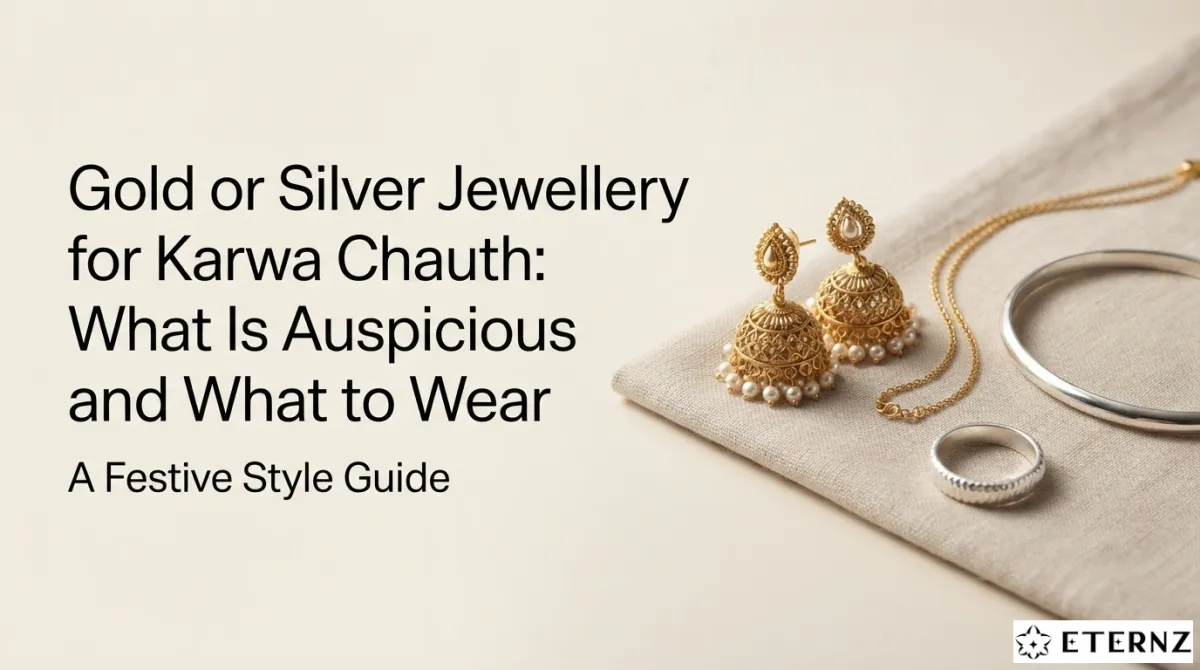
Should you wear gold or silver jewellery for Karwa Chauth? You can wear both, and most women do. In many families, gold goes above the waist (mangalsutra, bangles, earrings) and silver goes on the feet (payal and bichiya), so one Karwa Chauth look usually has both metals in it.
Karwa Chauth 2026 falls on Thursday, 29 October. This guide explains what families commonly believe about each metal, which pieces are usually gold or silver, how to choose by outfit and skin tone, and what to check when you buy either metal online.
Can You Wear Both Gold and Silver on Karwa Chauth?
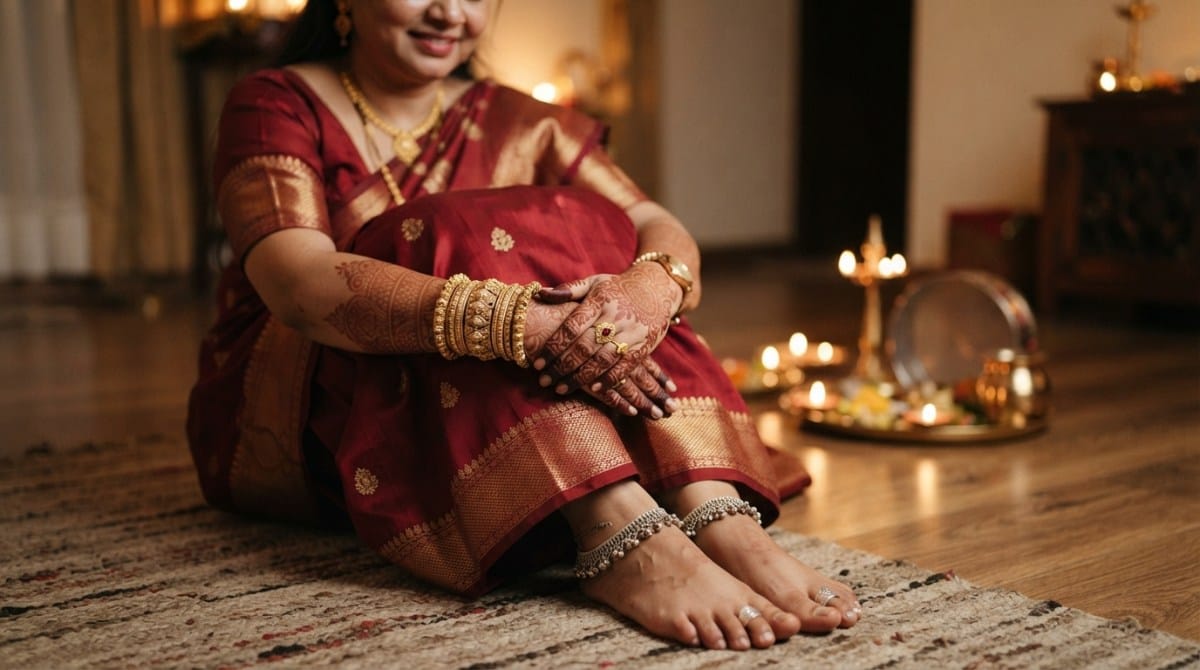
Yes. There is no common rule that says you must pick only one metal for the day. In fact, the traditional Karwa Chauth look in many North Indian homes already mixes them. The gold sits on your neck, ears, wrists and head, and the silver sits on your ankles and toes.
So the real question is not "gold or silver?" but "which piece in which metal?" That depends on three things:
- Your family's custom. Some families are strict about gold above the waist and silver below. Others don't mind either way.
- Your outfit. A red or maroon saree leans gold. A pastel or white-and-pink lehenga leans silver.
- Your budget and plans after the festival. If you want pieces you will wear every day, the metal you already wear daily is the safer pick.
If you only have silver, or only have gold, that is fine too. The fast and the puja are what matter. The jewellery is part of dressing up for it.
Quick tip: Not sure what your family follows? Ask your mother-in-law or an older woman in the family before you buy anything. A two-minute chat can save you from buying a gold payal that nobody will let you wear.
Why Many Families Wear Gold Above the Waist
Gold is the first metal most people think of for Karwa Chauth, and there is a reason behind it. In many Hindu families, gold is linked to Goddess Lakshmi, the goddess of wealth and good fortune. Because of this belief, gold is treated with respect and worn on the upper body.
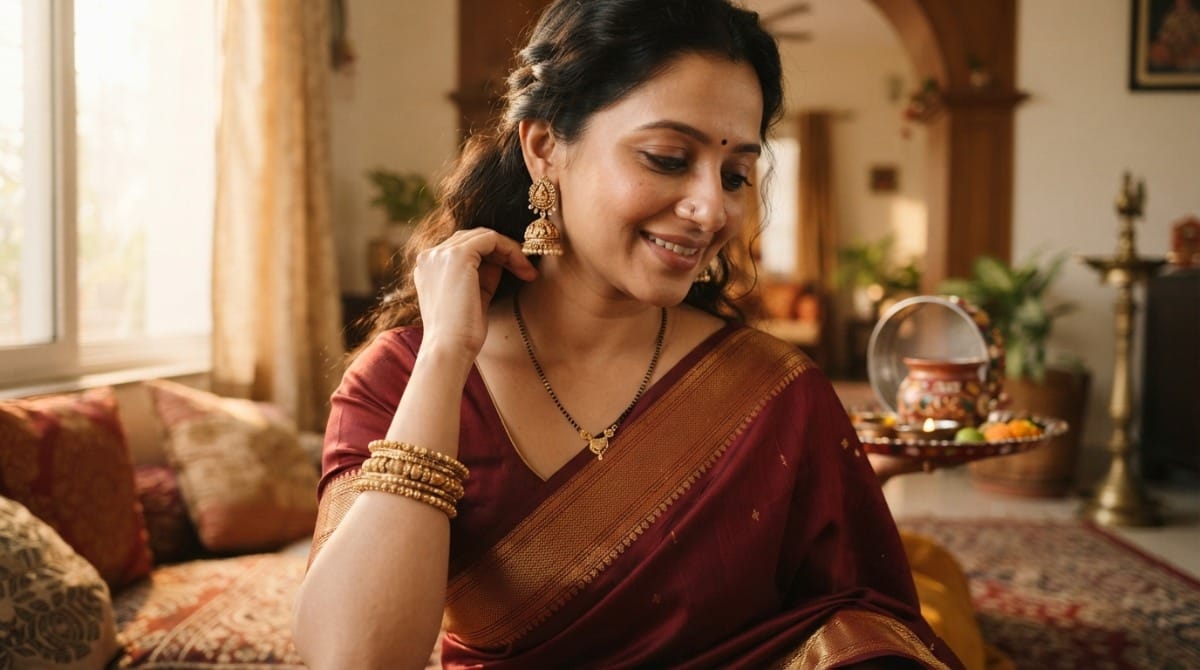
This is also why many families feel gold should not touch the feet. Wearing a symbol of Lakshmi on the feet is seen as disrespectful in these homes. It is a belief, not a law, and some families today do wear gold anklets. But it is common enough that you should know about it before you shop.
Gold also matches the look of the day. Karwa Chauth outfits are mostly red, maroon, orange and deep pink, and yellow gold sits well against these warm colours. Most bridal sets are gold or gold-toned for the same reason, and many women wear their wedding jewellery again on this evening.
The gold pieces most women wear on the day are:
- Mangalsutra. Usually a gold chain with black beads. See the gold mangalsutra range for light, daily-wear styles.
- Bangles. Gold bangles, often worn with red or green glass bangles or a chooda.
- Earrings. Gold earrings from small studs to jhumkas.
- Maang tikka and nose pin. A maang tikka in the hair parting, plus a gold nose pin or nath.
Is Silver Auspicious on Karwa Chauth?
Many families consider silver auspicious on Karwa Chauth, and you can wear it without worry. Silver is commonly seen as a pure, cooling metal in Indian homes. It also has a special link to this festival, which is the moon.
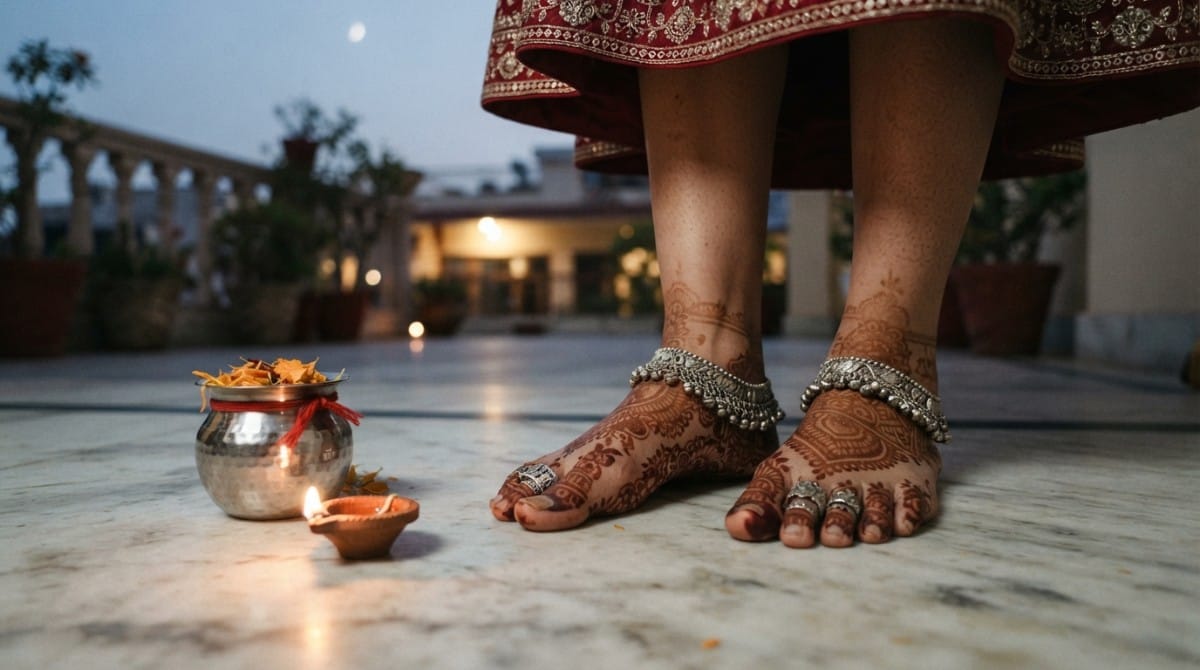
In Indian astrology, silver is linked to the moon (Chandra). Karwa Chauth is built around the moon: you fast all day and break the fast only after you see it rise. Because of this link, many women like wearing at least one silver piece on this day, and some families offer water to the moon from a silver karwa (pot) or glass. These are beliefs and customs, not proven facts, so follow what feels right to you and your family.
Why is silver worn on the feet?
This is one of the most common questions, and the answer comes from the gold belief above. Since many families keep gold for the upper body out of respect for Lakshmi, silver became the metal for the feet. That is why anklets (payal) and toe rings (bichiya) are silver in most North Indian homes.
There is also a practical side. Payal and bichiya touch the floor, rub against shoes and get wet often. Silver is cheaper than gold, so losing or bending a toe ring is less painful. Silver toe rings are also easy to resize by gently pressing them open or closed.
Quick fact: In many families, bichiya are worn on the second toe of both feet as a sign of being married, much like the mangalsutra. A woman may wear them every day, not just on Karwa Chauth.
If you need a new pair before the festival, our guide to the best toe rings for women covers sizes and styles. For payal, see the best silver anklets for women.
Which Karwa Chauth Jewellery Is Usually Gold and Which Is Silver?
Now that you know the beliefs, here is how they usually play out across your look, from head to toe. Use this as a starting point, then adjust for your family.
| Body area | Piece | Usually gold or silver? | Why |
|---|---|---|---|
| Head | Maang tikka, matha patti | Gold or gold-toned | Above the waist, matches bridal sets |
| Nose | Nose pin or nath | Gold, sometimes silver | Gold for bridal looks, silver nose pins for daily wear |
| Ears | Earrings, jhumkas, chandbalis | Either | Depends on outfit colour |
| Neck | Mangalsutra, necklace | Mostly gold | Mangalsutra is a sign of marriage and usually gold |
| Wrists | Bangles, chooda, kada | Gold with glass bangles; silver for modern looks | Gold for tradition, silver bangles with pastels |
| Fingers | Rings | Either | Wedding ring is often gold; silver rings suit stacking |
| Waist | Kamarbandh | Gold or gold-toned | Part of the bridal look |
| Ankles | Payal | Silver | Many families avoid gold on the feet |
| Toes | Bichiya | Silver | Same belief, plus easy to resize |
The middle of the body, ears and fingers, is where you have the most freedom. Those are the best places to bring in the metal that suits your outfit. For more on what to wear piece by piece, read what jewellery to wear on Karwa Chauth, and for the meaning of each of the 16 adornments, see our Karwa Chauth solah shringar jewellery guide.
How to Choose Gold or Silver by Outfit Colour and Skin Tone
Once your family's customs are covered, the free spots on your look (ears, neck, fingers) can follow your outfit and your skin. Start with the outfit, because it is the bigger block of colour.
| Outfit colour | Better metal | What to try |
|---|---|---|
| Red, maroon, deep orange | Yellow gold | A gold necklace or choker with gold jhumkas |
| Green, mustard, yellow | Yellow gold | Temple style or gold with green stones |
| Pink, peach, coral | Rose gold or gold | Rose gold earrings and rings |
| Pastels, ivory, light blue | Silver | Silver earrings with pearls or white stones |
| Purple, navy, wine | Either | Silver for a cool look, gold for a warm one |
Next, look at your skin's undertone. This is the colour under the surface of your skin, and it decides which metal makes your face look brighter.
- Warm undertone. The veins on your wrist look greenish, and gold looks better on you than silver. Lean towards yellow gold and rose gold.
- Cool undertone. Your veins look bluish or purple, and silver looks brighter on you. Lean towards silver and white gold.
- Neutral undertone. You can't tell, and both metals look fine. You are free to follow the outfit.
Our guide on how to match jewellery to your skin tone explains this in more detail, with photos.
Gold or Silver as a Karwa Chauth Gift: Which Is Better?
Many people searching this topic are not choosing for themselves. They are a husband choosing a gift, or a daughter-in-law putting jewellery in the baya. Both metals make good gifts. The right one depends on budget, how she will wear it and how much care she is happy to give it.
| Gold gift | Silver gift | |
|---|---|---|
| Budget level | Mid to splurge | Small to mid |
| Best pieces | Studs, light mangalsutra, thin bangle, pendant | Payal, bichiya, earrings, rings, idol or coin |
| Daily wear | Very good; does not tarnish | Good, but needs wiping and dry storage |
| Value over time | Holds value as a metal | Holds some value, much less than gold |
| Care needed | Low | Medium (tarnish) |
| Best for | A first Karwa Chauth, a keepsake gift | A practical gift, a modern style, a mother-in-law's puja room |
Here is a simple way to decide:
- Pick gold if you want a keepsake she will keep for years, or if this is her first Karwa Chauth. Small gold studs or a light mangalsutra are easy wins. Read our guide on the mangalsutra for Karwa Chauth if that is on your list.
- Pick silver if your budget is small, she likes modern designs, or the gift is for the feet. A pair of payal is one of the most fitting silver gifts for this day, because of the moon link.
- Pick silver for the puja room. For a mother-in-law, silver idols and coins are a common baya gift in many families.
- Can't decide? Browse the gold and silver collection side by side and compare styles at your budget level.
For 25 more ideas, see our Karwa Chauth gift ideas for your wife. And if you want a deeper look at which metal works as a long-term buy, our gold vs silver buying guide covers that well, even though it was written for Akshaya Tritiya.
Gold and Silver Purity Explained in Simple Words
When you shop online, you will see words like 22K, 18K, 925 and vermeil on the product page. Here is what each one means, so you know what you are paying for.
Gold purity: 22K, 18K and 14K
The "K" stands for karat. It tells you how much of the metal is pure gold. The rest is other metals mixed in to make it stronger.
| Purity | Pure gold | Feel | Good for |
|---|---|---|---|
| 22K | 91.6% | Soft, rich yellow | Traditional bangles, bridal sets |
| 18K | 75% | Stronger, holds stones well | Daily-wear earrings, light mangalsutra, diamond pieces |
| 14K | 58.5% | Strongest, paler colour | Rings and pieces that take knocks every day |
Higher karat means richer colour but a softer metal that bends and scratches more easily. That is why many daily-wear pieces are 18K or 14K. Our 24K vs 22K vs 18K vs 14K gold guide goes deeper.
Silver: 925 sterling vs silver-plated
- 925 sterling silver is 92.5% pure silver mixed with a little copper for strength. It is real silver and should carry a "925" stamp. Our post on sterling silver vs 925 silver explains why the two names mean the same thing.
- Silver-plated jewellery is a cheaper base metal with a thin coat of silver on top. It looks similar at first, but the coat wears off over time.
The middle option: gold-plated and gold vermeil
If you love the look of gold but your budget is small, there are two in-between choices:
- Gold-plated means a thin layer of gold over a base metal. It looks good for a festival, but the colour can fade with regular wear.
- Gold vermeil means a thicker layer of gold over 925 sterling silver. Because the base is real silver, it lasts longer than plain plating and is kinder to sensitive skin.
Read gold vermeil vs gold-plated for the full difference, and gold-plated vs sterling silver for daily wear if you plan to wear the piece every day after the festival.
How to Mix Gold and Silver in One Karwa Chauth Look
Since most women wear both metals anyway, it helps to know how to make them look planned rather than random. A few simple rules do the job.
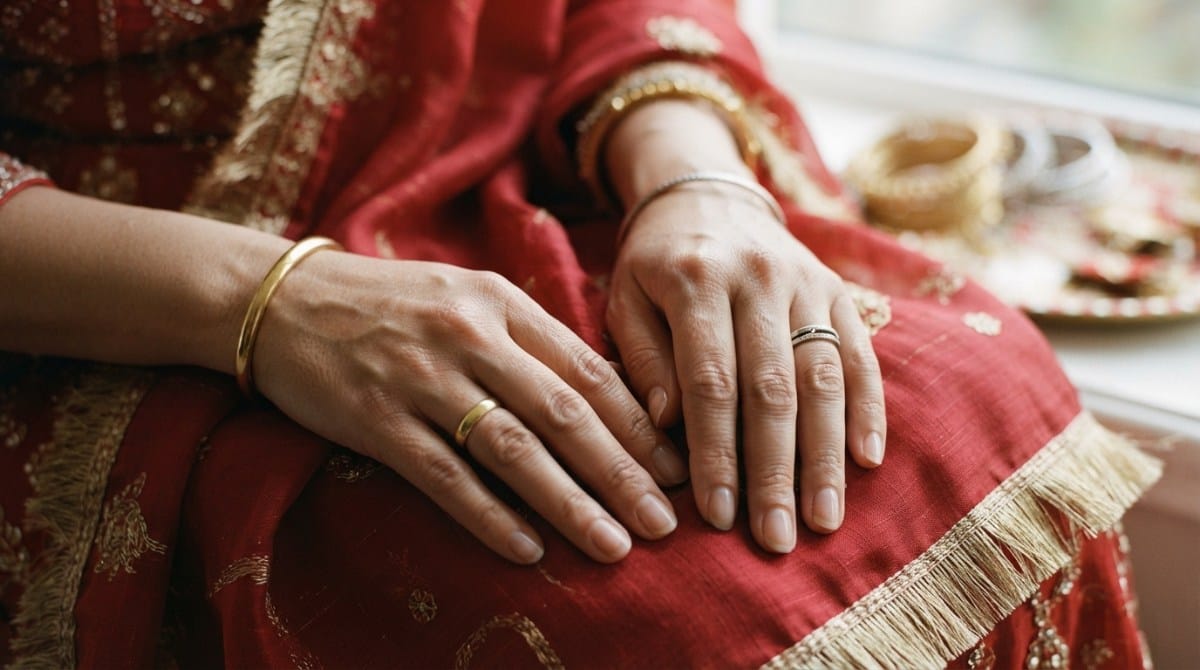
- Keep the top half mostly one metal. If your mangalsutra and bangles are gold, keep your earrings and maang tikka gold too. Mixing metals right next to your face can look busy.
- Let the feet be the silver zone. Silver payal and bichiya won't clash with gold above, because there is a whole outfit between them.
- Use rings to bridge the two. A gold wedding ring with one or two thin silver rings on the other hand ties the look together.
- Try a two-tone piece. Bangles or earrings with both gold and silver tones, or rose gold, sit nicely between the two.
- Match the stone, not just the metal. If your gold set has red stones, a silver ring with a red stone links back to it.
Our post on how to mix and match jewellery has more ideas you can use well after Karwa Chauth.
How to Buy Gold or Silver Jewellery Online Before 29 October
With the metal and pieces chosen, the last step is ordering in time and making sure what arrives is real. Check these on every product page before you buy:
- Delivery date. Look at the delivery date shown on the product page. Aim to order at least a week before 29 October, so you have time to sort out any size or quality problem.
- Metal and purity. The page should clearly say 22K, 18K, 14K, 925 sterling, gold vermeil or plated. If it doesn't, ask the seller or pick another piece.
- Price breakup. For gold and silver, a clear page shows the metal rate, metal weight, making charges and GST separately. This lets you compare two pieces fairly and see how much you are paying for the metal itself. Prices change with daily metal rates, so check the live price on the product page.
- Size guide. Bangles, rings and toe rings must fit. Measure an old piece at home and match it to the size guide.
- Photos and video. Zoom in on every photo. Look for the hallmark or stamp in the pictures if it is shown.
- Return and exchange policy. Read it before you order, not after.
When the parcel arrives, check it straight away:
- Gold: Look for the BIS hallmark with a 6-digit HUID code. Type the code into the free BIS Care app to see the purity and other details.
- Silver: Look for the "925" stamp, usually inside a ring or on the clasp of a chain or payal.
Quick tip: Hallmark stamps are tiny. Use your phone camera's zoom to read the HUID code, then enter it in the BIS Care app while the box is still open.
For more checks, read is it safe to buy jewellery online in India.
How to Care for Gold and Silver After the Festival
The day after Karwa Chauth, your jewellery has been through mehendi, sindoor, sweat, perfume and a long evening outdoors. A little care now keeps it ready for Diwali and beyond.
For gold:
- Wipe each piece with a soft, dry cloth before putting it away.
- If there is sindoor or mehendi stuck in the design, soak it for a few minutes in lukewarm water with a drop of mild soap, then dry fully.
- Store pieces separately so harder stones don't scratch softer gold.
For silver:
- Silver darkens (tarnishes) when it reacts with air, moisture and sulphur. Payal and bichiya tarnish fastest because they touch floors and water.
- Wipe them dry after wearing, and store them in a zip bag or airtight box with a silica gel packet.
- Keep perfume, hair spray and cleaning liquids away from silver.
If your silver has already turned dark, our sterling silver tarnish care guide shows how to clean it safely at home.
Quick tip: Silver you wear often tends to stay brighter than silver left lying out, because daily rubbing keeps polishing the surface. When you do store it, use an airtight pouch so it darkens more slowly.
Conclusion
For Karwa Chauth, you don't have to choose between gold and silver. Follow the custom many families keep, gold above the waist and silver on the feet, then let your outfit and skin tone decide the free spots like ears and fingers. If you are filling a gap before 29 October, a pair of silver payal or bichiya is the simplest buy. Start with light chain anklets in silver, or go back to our Karwa Chauth jewellery guide for the full plan.
Frequently Asked Questions
1. Should I wear gold or silver jewellery on Karwa Chauth?
You can wear both, and most women do. In many families, gold is worn above the waist, like the mangalsutra, bangles and earrings, and silver is worn on the feet, like payal and bichiya. Follow your family's custom if it differs.
2. Is silver auspicious on Karwa Chauth?
Many families consider silver auspicious on Karwa Chauth. In Indian astrology, silver is linked to the moon, and the fast ends at moonrise, so many women like to wear some silver on this day. This is a belief and custom rather than a fixed rule.
3. Can we wear silver on Karwa Chauth?
Yes. Silver payal and bichiya are a traditional part of the look in many North Indian homes. You can also wear silver earrings, rings or bangles, especially with pastel or light outfits.
4. Why is silver worn on the feet and not gold?
In many Hindu families, gold is linked to Goddess Lakshmi, so wearing it on the feet is seen as disrespectful. Silver became the metal for payal and toe rings instead. Some families do not follow this belief, so customs vary.
5. Can I wear gold payal on Karwa Chauth?
Many families avoid gold on the feet because of the Lakshmi belief, so silver payal is the safer choice. If your family has no such custom, you can wear what you like. When in doubt, ask an elder in the family.
6. Is gold or silver a better Karwa Chauth gift for my wife?
Gold is better for a keepsake or a first Karwa Chauth gift, since it holds value and needs little care. Silver suits a small budget, modern tastes and gifts for the feet like payal. Look at the metal she already wears daily and match it.
7. Which gold purity is best for daily-wear Karwa Chauth jewellery?
18K gold is a good balance for daily wear, because it is stronger than 22K and holds stones well. 22K suits traditional bangles and bridal sets. 14K is the strongest and works well for rings worn every day.
8. How do I know if silver jewellery bought online is real?
Real sterling silver usually carries a "925" stamp, often inside a ring or near the clasp. Check that the product page says 925 sterling silver, not silver-plated. Read the return policy before you order in case the piece is not as described.
9. Can I mix gold and silver jewellery in one Karwa Chauth look?
Yes. Keep your face and neck mostly in one metal, wear silver on the feet, and use rings or a two-tone piece to link the two. This makes the mix look planned rather than random.
10. How do I check gold hallmarks on jewellery bought for Karva Chauth?
Look for the BIS hallmark with a 6-digit HUID code on the piece. Enter the code in the free BIS Care app to check its purity and details. Do this as soon as the parcel arrives, so you have time to raise a problem before the festival.