
Left or Right Leg for an Anklet? What It Means in India
Wondering if an anklet on the left leg means something? Learn the real meaning, the Indian payal tradition, and easy tips to choose the right leg.
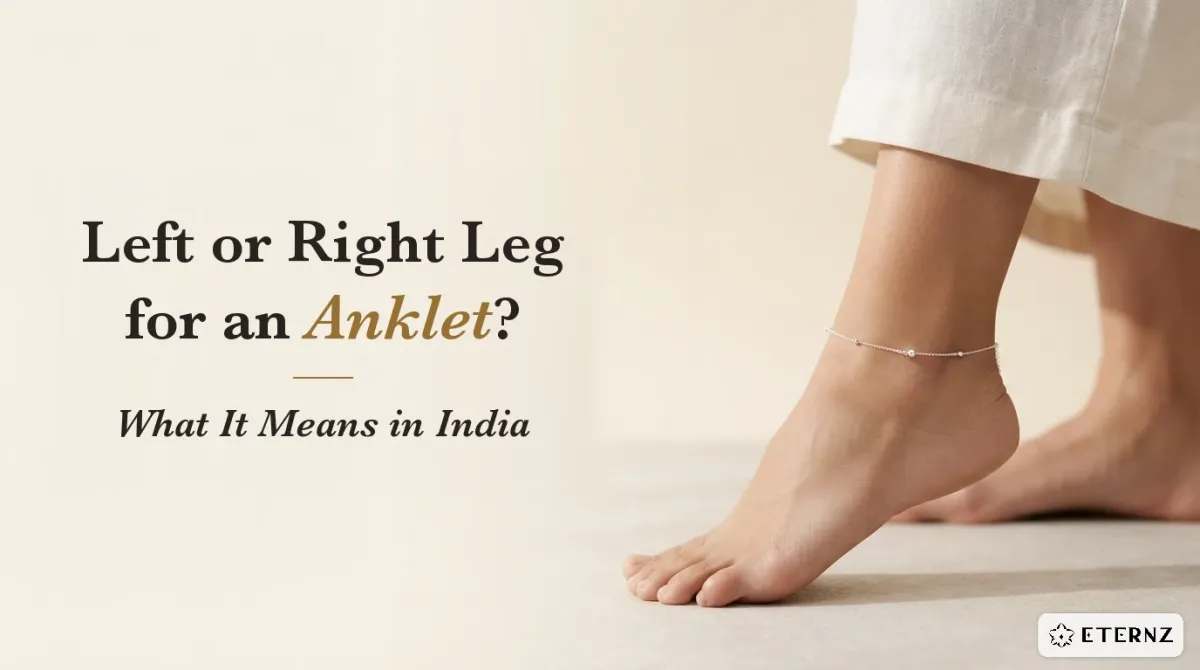
You can wear an anklet on either leg, because there is no fixed rule today. Traditional Indian payals are worn on both feet as a matching pair. For a single fashion anklet, most people choose the leg where it shows best and gets in the way least, which for many turns out to be the left.
So the real question is not "which leg is correct?" but "which leg is right for me?" Here is how to decide, from what tradition says to what your sandals and your daily routine say.
Before we start, let me tell you about Eternz, a trusted jewellery marketplace featuring 400+ jewellery brands, with authenticity certification on every piece and fast, same-day delivery in major cities. First-time users can also save with ETERNZ5 for up to ₹50 off on ₹499+, ETERNZ10 for up to ₹100 off on ₹999+, or ETERNZ300 for up to ₹300 off on ₹2,500+, valid on both the app and website.
Is There a Right or Wrong Leg to Wear an Anklet On?
No. Walk through any college campus, office or wedding in India and you'll see anklets on left legs, right legs and both, and none of them are wrong.
The idea of a "correct" leg comes from two places: old Western myths that gave each side a secret meaning, and regional traditions that link anklets to marriage or protection. Neither is a rule that applies to everyone. Today, the leg you choose is a style and comfort decision, unless your own family or community follows a specific custom.
What Does an Anklet on the Left Leg vs Right Leg Mean?
Different cultures have given each side different meanings over time, and many of these stories contradict each other. Here is what you'll come across, and how seriously to take it:
| Belief | Left leg | Right leg | How common is it today? |
|---|---|---|---|
| Western myth (1970s to 1990s) | Single, or in some versions "taken" | Married, or the reverse | Rarely followed, and versions often contradict |
| Regional Indian customs | Linked to marriage in some families | Linked to marriage in some other families | Varies by family and region, not a national rule |
| Black thread (kala dhaaga) for protection | Commonly tied by women | Commonly tied by men | Still widely followed as a folk belief |
| Modern fashion | Most popular for a single anklet | Equally fine | Personal choice |
The left leg is the more common choice for a single fashion anklet today. That's mostly because many people are right-footed, so the left ankle stays out of the way and the anklet stays safe.
Good to know: The black thread anklet is the one place where many Indian families still care about the side. The popular belief is left leg for women and right leg for men, worn to ward off nazar (the evil eye).
Payal vs Single Anklet: Why Indian Women Wear Anklets on Both Feet
In India, the anklet came long before the fashion trend. A payal, also called pajeb or jhanjhar, is traditionally worn on both feet as a pair, especially by married women and brides. Many brides receive their first heavy silver payals as part of their wedding jewellery, often alongside bichiya (toe rings).
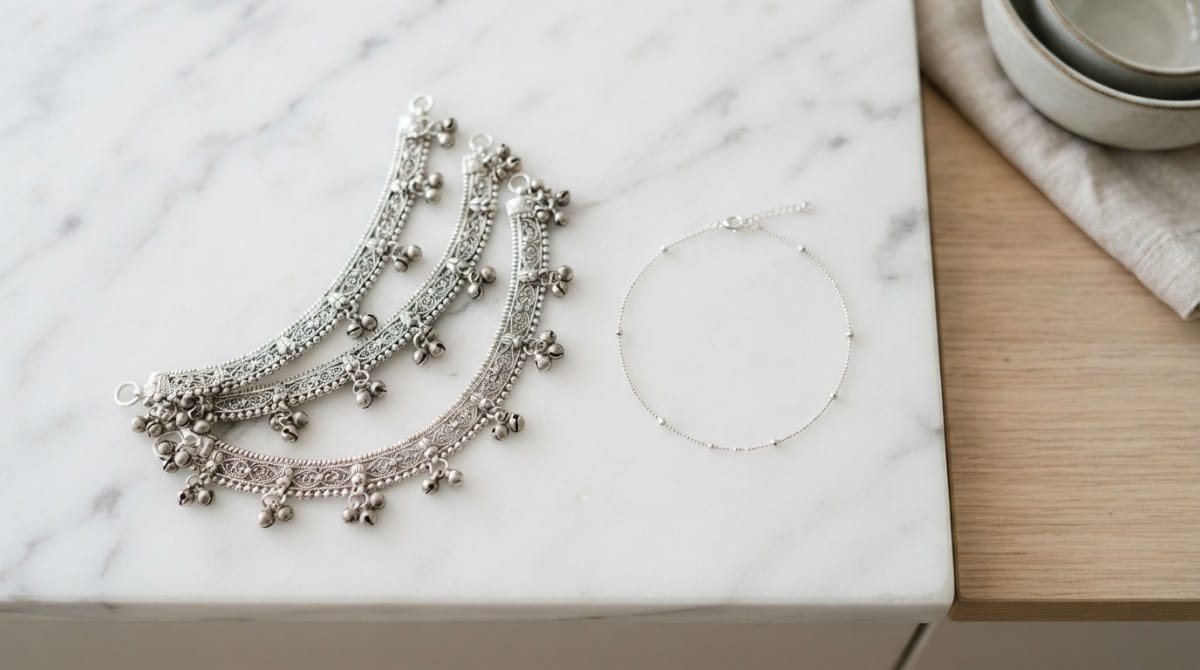
A few things make the payal different from a single fashion anklet:
- It is always a pair. Tradition sees the two feet as a balanced set, so one payal on its own isn't the custom.
- The sound matters. The soft chhan-chhan of ghungroo bells has long been seen as auspicious, and in old joint-family homes it quietly told everyone a woman was nearby.
- It is usually silver. Payals and toe rings are traditionally made in silver, not gold, for the reason in the box below.
A modern single anklet is more like a bracelet for your foot: one delicate chain, worn for style, often with western outfits. If you want to know how the two compare in design and styling, our guide on anklet vs payal differences breaks it down.
Did you know? Many Hindu families avoid wearing gold below the waist, because gold is linked to Goddess Lakshmi and placing it on the feet is seen as disrespectful. That's why traditional payals and toe rings are almost always silver.
How to Choose Which Leg to Wear Your Anklet On
If tradition doesn't decide it for you, let your body, your shoes and your day decide. These six checks make the choice easy:
- Go with comfort first. Most people wear an anklet on their non-dominant leg. If you're right-footed, your right foot does more work, from climbing stairs to kicking off chappals, so the left ankle keeps the anklet safer.
- Think about how you travel. If you drive a car, your right foot works the accelerator and brake all day, and a chain or ghungroo can rub against the pedals. Riding a motorcycle? The rear brake pedal is on the right too, so the left leg is the calmer choice.
- Look at your footwear. Sandals with a single ankle strap on one side, or a buckle that rubs, can tangle with an anklet. Wear it on the leg where your shoes sit cleanly below it.
- Follow your outfit. With a side-slit kurta, a slit skirt or a dress with an uneven hem, wear the anklet on the side that shows more skin. It looks planned, not random.
- Frame what you love. A small ankle tattoo, a pretty pedicure or even a favourite toe ring looks lovely with an anklet beside it.
- Check the gym and sports. If you run, play badminton or do yoga barefoot, an anklet can catch or slip. Take it off, or wear it on the leg that moves less in your sport.
Easy way to remember: Wear it where it shows, not where it snags.
Not sure which style to start with? A slim chain anklet works with almost everything, while charm anklets add a little movement and personality.
Can You Wear Anklets on Both Legs?
Yes, and there are two ways to do it, depending on the look you want.
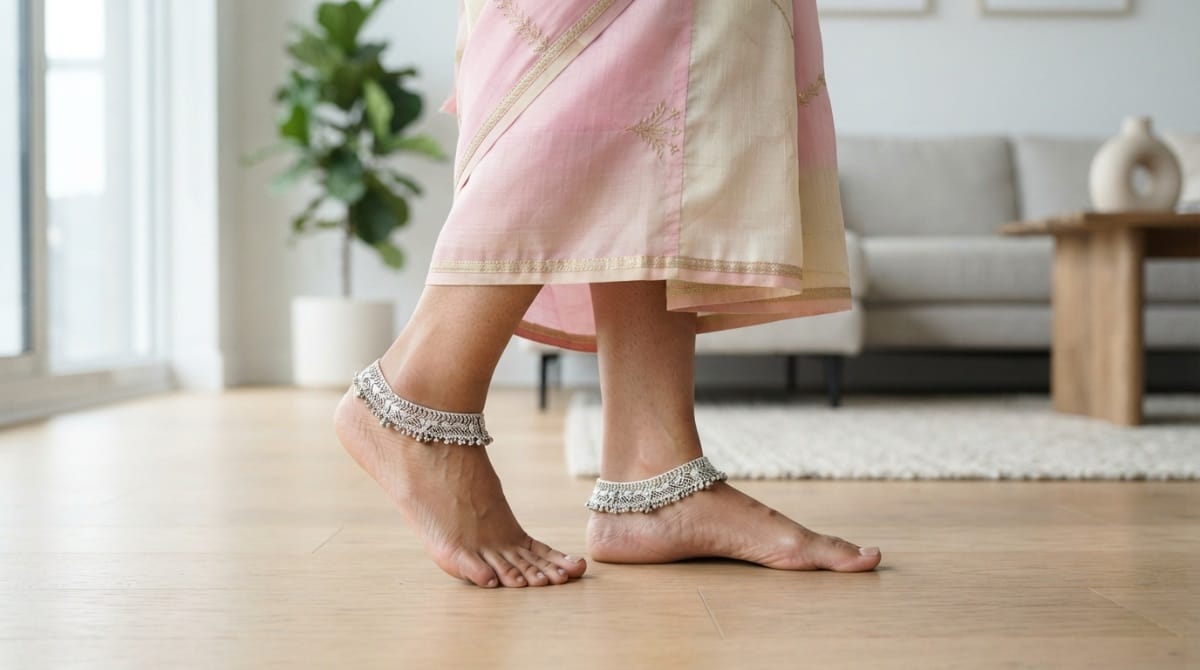
- The matching pair: Two identical anklets, one on each foot. This is the payal way and looks best with sarees, lehengas, anarkalis and festive wear, where both ankles peep out under the hem.
- The mismatched set: A different anklet on each leg, for example a thin chain on one and a beaded anklet on the other. This feels casual and modern, great with shorts, palazzos and beach outfits.
You can also stack two or three anklets on one leg and keep the other bare. Mix a fine chain with a slightly bolder piece, and keep the metals in the same family so they look like a set. For more ideas, see our tips on how to style the perfect anklet stack.
Quick tip: If you wear payals with bells on both feet, keep the second leg's anklet bell-free when you stack. Two sets of ghungroo can get noisy in an office or a quiet temple.
How to Wear an Anklet So It Sits Right
Choosing the leg is only half of it. Where and how the anklet sits decides whether it looks graceful or keeps sliding into your shoe.
- Placement: It should rest just above the ankle bone, at the narrowest part of your leg, not down on the top of your foot.
- Fit: You should be able to slide one finger between the anklet and your skin. Tighter will dig in, looser will slip over your heel.
- Measuring: Wrap a string around your ankle just above the bone, measure it, and add about 2.5 cm (1 inch) for a gentle drape. An adjustable extender chain helps if you're between sizes.
- Skin, not stockings: Anklets look best on bare skin. Over socks or opaque tights, they tend to disappear.
- Night-time: Take off anklets with bells or charms before sleeping, since they can catch on bedsheets.
Browse the full range of anklets, from everyday chains to bold statement anklets for festive days.
Conclusion
The best leg for your anklet is the one where it feels comfortable, stays out of your way and shows off the look you want. Wear payals on both feet for the traditional feel, or a single chain on the left for an easy everyday touch. However you wear it, an anklet is one of the few pieces you hear as much as you see, so let it make every step feel a little lighter. If you're picking your first one, a simple chain anklet is the easiest place to start.
Frequently Asked Questions
1. Which leg should a girl wear an anklet on?
A girl can wear an anklet on either leg. For a single fashion anklet, the left leg is the most popular choice because it stays out of the way for right-footed people. Traditional payals are worn on both feet.
2. What does an anklet on the left leg mean?
Today it usually means nothing more than a style choice. Some old Western myths linked the left ankle to being single or taken, but the versions contradict each other and are rarely followed now.
3. What does an anklet on the right leg mean?
In modern fashion, nothing in particular. Some regional customs link the right ankle to marriage, but this varies by family and region, and it isn't a rule across India.
4. Can unmarried girls wear anklets?
Yes. Anklets are worn by girls and women of every age today. Some traditional families save heavy payals with bells for married women, but simple chain anklets are worn by everyone.
5. Which leg should a black thread be tied on?
By popular belief, women tie a black thread on the left leg and men on the right leg. It is worn to protect against nazar (the evil eye), and many people add a small evil eye charm to it.
6. Can men wear anklets?
Yes. Men in India often wear a black thread or a simple silver chain on the ankle. A plain, slightly thicker chain or a beaded anklet looks clean and masculine.
7. Why are anklets made of silver and not gold in India?
Many Hindu families avoid wearing gold below the waist because gold is linked to Goddess Lakshmi. That's why traditional payals and toe rings are made in silver, though gold-toned fashion anklets are common today.
8. Is it okay to wear an anklet every day?
Yes, especially a light chain anklet without bells or big charms. Take it off before swimming, heavy workouts or sleeping if it has charms that can catch.
9. How should an anklet fit?
It should sit just above your ankle bone with room for one finger between the chain and your skin. If it slides over your heel, it's too loose, and if it leaves a mark, it's too tight.