Earrings Size Guide: Find the Right Size for Every Style
Find the right earring size for every style. Covers studs in mm, hoops by inner diameter, drop length, gauge, Indian earring sizing, weight, and face shape tips.
TL;DR
- Earring size is not one number. It means different things for different styles: diameter for studs, inner diameter for hoops, length in centimetres for drops, and gauge thickness for the post.
- The right size is determined by five factors in this order: earring type, face shape, body frame, hair length, and occasion.
- Stud sizes range from 3mm (minimal) to 10mm (statement). The most universally flattering everyday stud sits between 5mm and 7mm.
- Hoop sizes are measured by inner diameter. Huggies sit under 12mm. Small hoops are 12–20mm. Medium hoops are 20–40mm. Large hoops are 40mm and above.
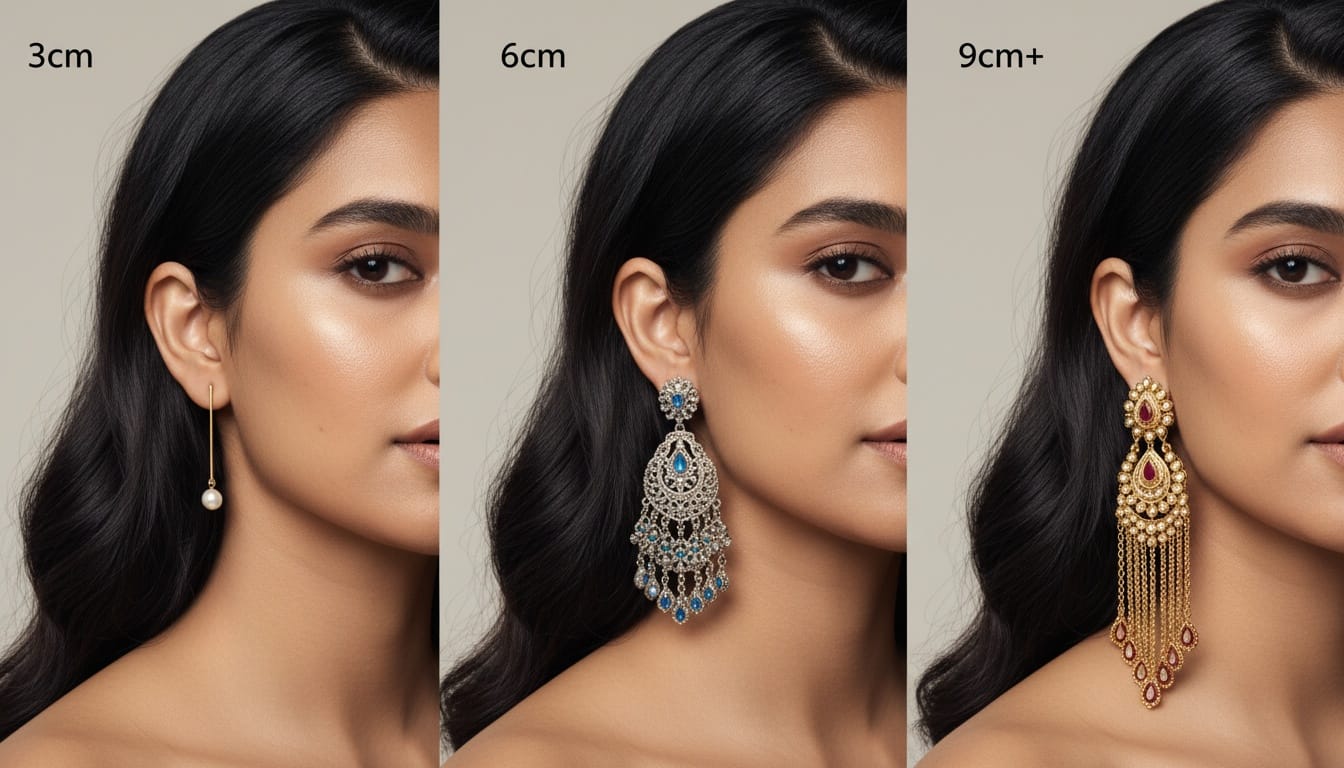
- Drop and dangle earring length is measured from the bottom of the earring finding to the tip. 3–5cm is office-appropriate. 6–9cm reads as statement.
- Indian earrings like jhumkas and chandbalis do not follow western sizing conventions. Weight and visual scale matter more than millimetre measurements.
- Standard earring post gauge for lobe piercings is 20G (0.8mm). Knowing yours prevents online shopping mistakes.
What We Cover
- What earring size actually means, by type
- How to measure your own ear before buying online
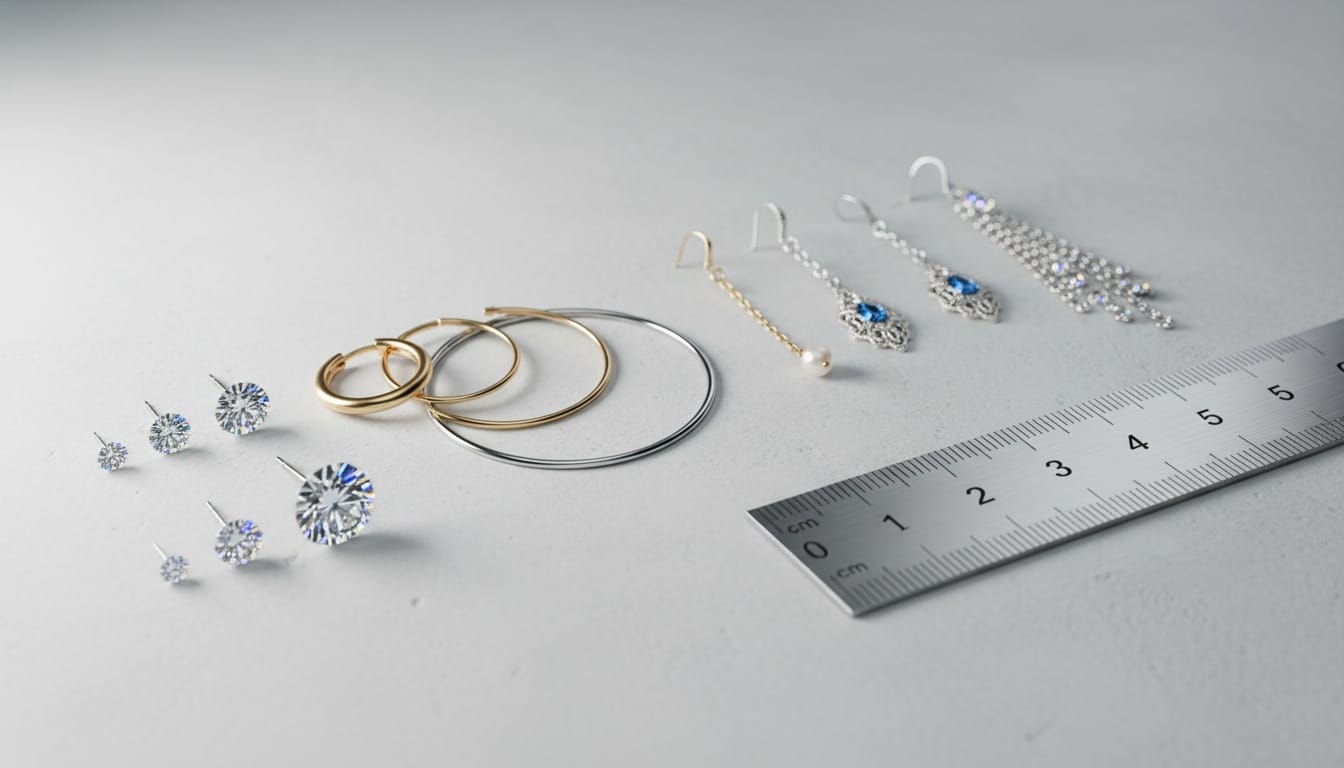
- Stud earring size guide with mm breakdown
- Hoop earring size guide with inner diameter chart
- Drop and dangle earring length guide
- Indian earring sizing: jhumkas, chandbalis, and statement sets
- How face shape, body frame, and hair affect size choice
- Earring weight: the sizing factor everyone ignores
- Common online shopping size mistakes and how to avoid them
- A size decision framework before you buy
- FAQs based on real search queries
Earring size affects proportion, comfort, and how well the earring actually suits the person wearing it. Choosing by style alone without considering size often leads to earrings that look beautiful in photos but feel wrong on the face. The solution is simple: know what each size measurement means for each style, know your own ear dimensions, and apply the five-factor filter before every purchase.
You find a pair you love online. They look stunning in the product photo. They arrive, you put them on, and something is off. They are either smaller than you expected and look lost against your face, or larger than expected and feel heavy and disproportionate.
This happens almost every time size is not factored into the buying decision. And it happens constantly because earring size is not a single, consistent measurement across all styles. A stud is measured in millimetres of diameter. A hoop is measured by inner diameter. A drop earring is measured by length. The post is measured in gauge. Each needs to be understood separately.
This guide breaks all of it down clearly, type by type, so that every earring you buy online or in store lands exactly as expected.
If you want a broader understanding of materials, styling, and trends, read our complete guide to earring types, styles, trends, and care.
What Earring Size Actually Means, By Type?
Before going into specific sizes, it is important to understand that "size" means something different depending on the earring style you are shopping for.
- Studs: Size refers to the diameter of the front decorative element in millimetres. A 5mm stud means the face of the earring is 5mm across.
- Hoops: Size refers to the inner diameter of the loop in millimetres. This is the measurement of the open space inside the circle, not the total outer width. A 25mm hoop has 25mm of inner space. Inner diameter determines how the hoop hangs and how far it drops below the earlobe.
- Drop and dangle earrings: Size refers to the total length from the bottom of the earring finding (the post or hook the earring hangs from) to the lowest point of the earring, measured in centimetres.
- Earring posts (gauge): The post that passes through the piercing is measured in gauge. This is a thickness measurement, not a length or width. Standard lobe piercings use 20G (0.8mm). This number matters when buying earrings online to ensure the post fits your piercing comfortably.
Knowing which measurement applies to which style before you start shopping eliminates the most common source of earring purchase disappointment.
How to Measure Your Own Ear Before Buying Online
This step takes under two minutes and saves significantly more time in returns and disappointments. Do it once and keep the measurements noted on your phone.
- Lobe length: Measure from the piercing hole to the bottom edge of your earlobe. This measurement tells you how much of a drop earring will hang below your lobe versus rest on it. Average lobe length is approximately 1.5–2cm.
- Lobe width: Measure the width of your earlobe at its widest point. This tells you how a stud of a given diameter will sit: a 10mm stud on a 12mm lobe will almost entirely cover the lobe. A 5mm stud on the same lobe will sit centrally with visible lobe around it.
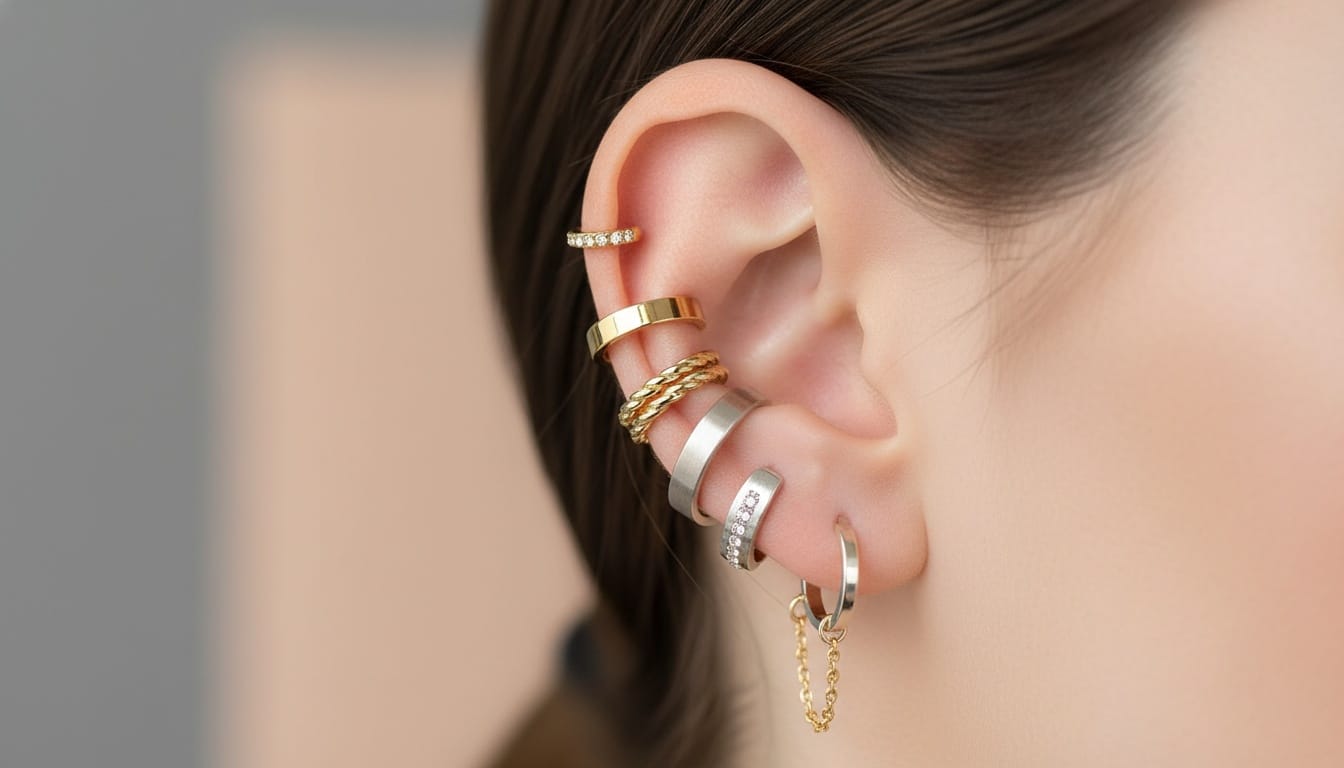
- Ear height: For those building curated ear stacks or considering climber earrings, measure from the lobe piercing to the top of the ear. This tells you how far a climber can travel before reaching the cartilage fold.
- How to measure: Use a millimetre ruler held flat against the ear. Take measurements in front of a mirror with good lighting. Measure both ears since they are often not perfectly symmetrical.
Stud Earring Size Guide
Stud sizes are measured in millimetres across the diameter of the front decorative piece.
| Size | Measurement | Visual Effect | Best For |
|---|---|---|---|
| Extra small | 3–4mm | Very subtle, barely visible | Second or third piercings, cartilage studs, minimalist daily wear |
| Small | 5–6mm | Clean and understated | Office wear, professional settings, everyday wear on smaller faces |
| Medium | 7–8mm | Noticeable but proportionate | Most everyday and social occasions, the most universally flattering range |
| Large | 9–10mm | Confident and clear statement | Evening events, larger faces, outfits that need one strong accent |
| Oversized | 11mm+ | Deliberate statement | Fashion-forward occasions, specific editorial styling |
The everyday sweet spot: For most faces and most occasions, a 6–7mm stud hits the ideal balance between presence and proportion. It is visible enough to look intentional and small enough to not overpower.
For diamond studs specifically: Diamond stud size is often listed in carat weight rather than millimetre diameter, since cut affects how the carat weight translates to physical size. As a reference point: a 0.25ct round diamond stud is approximately 4mm in diameter. A 0.5ct sits around 5mm. A 1.0ct, which is considered the most popular everyday fine jewelry size, sits around 6.5mm.
Face size and stud proportion: Smaller faces look best with studs between 4–6mm. Larger faces carry 7–10mm studs more comfortably. A stud that covers more than two-thirds of the visible earlobe starts to look disproportionate on smaller ears.
If you are still exploring silhouettes, here is a breakdown of the different types of earrings and how each style works.
Hoop Earring Size Guide
Hoops are measured by inner diameter in millimetres. This measurement determines how the hoop sits on the ear and how far below the lobe it drops.
| Size Category | Inner Diameter | Drop Below Lobe | Best For |
|---|---|---|---|
| Huggie | Under 12mm | None — hugs the lobe | Daily wear, curated ear stacking, professional settings |
| Extra small | 12–16mm | 2–4mm | Subtle everyday hoops, second piercings, cartilage hoops |
| Small | 16–25mm | 4–8mm | Casual daily wear, office, relaxed social occasions |
| Medium | 25–40mm | 8–15mm | Versatile social and smart casual wear, the most universally flattering size range |
| Large | 40–60mm | 15–25mm | Statement casual, evening, fashion-forward looks |
| Oversized | 60mm+ | Shoulder-approaching | Bold fashion statements, events, editorial styling |
The rule with inner diameter: A 25mm inner diameter hoop sits roughly 25mm below the lobe at its lowest point. A 40mm hoop drops approximately 40mm. Use this to estimate how far the earring will sit relative to your jawline and shoulder.
Hoop thickness also matters: A 2mm tube hoop at 30mm diameter reads very differently from a 5mm tube hoop at the same diameter. Thicker tube hoops add visual weight and presence. Thinner wire hoops at the same size feel lighter and more delicate. Always check both the diameter and the tube thickness in the product listing.
Face shape and hoop size:
- Round face: Medium to large hoops that extend below the jawline create vertical length. Avoid very small circular hoops that mirror the face's roundness.
- Square face: Medium rounded hoops soften the jaw. Avoid very geometric or angular hoop shapes.
- Oval face: Most sizes work. Use occasion as the deciding filter.
- Heart-shaped face: Small to medium hoops that do not extend beyond the widest point of the forehead. Large dramatic hoops can over-emphasise the wider upper face.
- Long face: Wider hoops add horizontal balance. Very large, elongated hoops can lengthen the face further.
Neck length and hoops: Longer necks carry large hoops more comfortably because there is more space between the ear and the shoulder. For shorter necks, keep hoops under 40mm to avoid earrings that brush the shoulder or appear disproportionate.
Drop and Dangle Earring Length Guide
Drop and dangle earring length is measured from the bottom of the earring finding (the hook, post, or lever back) to the lowest point of the earring. This measurement is in centimetres.
| Length | Measurement | Where It Sits | Best For |
|---|---|---|---|
| Very short drop | 1–2cm | Just below the lobe | Office, professional settings, minimal styling |
| Short drop | 2–3cm | Mid-lobe to chin-distant | Smart casual, daily elevated wear |
| Medium drop | 3–5cm | Below chin level | Social occasions, dinner, moderate statement |
| Long drop | 5–7cm | Collarbone approaching | Evening events, festive occasions, weddings as a guest |
| Statement drop | 7–9cm | Near or at collarbone | Formal events, strong statement styling |
| Shoulder grazer | 9cm+ | At or beyond the shoulder | Bridal, high fashion, maximum drama |
Lobe length affects total visual drop: If your lobe is longer than average (over 2cm), earrings will sit lower on your face than the same pair on someone with a shorter lobe. This is worth factoring in when buying long drops online. A 7cm earring on a 2.5cm lobe will hang 4.5cm below the lobe. The same earring on a 1.5cm lobe hangs 5.5cm below it.
The face length factor: Long, statement drops visually elongate the face. For already long or rectangular faces, keep drops under 5cm to avoid extending the face's length further. For round or square faces, longer drops in the 5–7cm range add flattering vertical length.
Occasion and drop length: The more formal the occasion, the longer the drop can go without reading as excessive. A 7cm drop at a wedding is appropriate. The same earring at a Tuesday morning meeting is not. Match drop length to event formality, not just personal preference.
Earring Post Gauge: The Measurement Most Shoppers Ignore
The post is the thin metal rod that passes through the piercing. It is measured in gauge (G). Lower gauge numbers mean thicker posts.
| Gauge | Post Thickness | Common Use |
|---|---|---|
| 22G | 0.6mm | Very fine posts, delicate fashion earrings |
| 20G | 0.8mm | Standard lobe piercing, most everyday earrings |
| 18G | 1.0mm | Standard fine jewelry earrings, many gold and silver pieces |
| 16G | 1.2mm | Cartilage piercings, some helix and tragus jewelry |
| 14G | 1.6mm | Industrial, daith, and stretched lobe piercings |
What this means for you when shopping online: If your piercing was done at a standard salon or piercing studio, it is almost certainly a 20G or 18G piercing. Most earrings sold at mainstream jewelry stores are designed for 18G or 20G piercings. If you are buying earrings with very fine posts (22G), confirm your piercing has not naturally tightened, as these posts can be difficult to insert into older, slightly narrowed piercings.
Post length also matters: Standard post length for stud earrings is 10–12mm. If you have thicker earlobes (common in some individuals), look for earrings with longer posts (12–14mm) so the backing sits comfortably behind the lobe without pressing against the skin.
Indian Earring Sizes: A Different Framework
Western size conventions, millimetre diameters, and centimetre drop lengths do not translate cleanly to Indian earring styles. Jhumkas, chandbalis, and polki sets are sized and evaluated differently.
For Indian earrings, the relevant size factors are:
1. Diameter of the top element (kamane): For jhumkas, this is the width of the dome at the top. A small everyday jhumka typically has a kamane of 15–20mm. A medium festive jhumka sits at 25–35mm. Bridal or heavy ceremonial jhumkas can reach 40–50mm.
2. Total drop length: Measured from the top of the finding to the lowest bead or drop chain. Short jhumkas sit at 3–4cm total length. Medium jhumkas sit at 4–6cm. Long jhumkas with jhale (bead drops at the base) can reach 8–10cm.
3. Weight: This is the most important practical sizing factor for Indian earrings and the one most sellers fail to mention. Heavy Indian earring sets are one of the most common causes of earring-related ear discomfort and lobe stretching. As a general guide: under 10 grams per earring is lightweight and comfortable for all-day wear. 10–20 grams per earring is manageable for a few hours. Over 20 grams per earring should be reserved for short-duration events like ceremonies and photo sessions.
4. Visual scale relative to outfit: Indian earrings are sized not just against the face but against the richness of the outfit. A heavily embroidered Banarasi lehenga calls for a larger, bolder earring than a cotton kurti, even if the face and neckline are identical. Scaling the earring's visual richness to the outfit's richness is the primary Indian earring sizing principle.
5. Chandbali sizing: Chandbalis are measured by their total width (the width of the crescent) and their drop length. A small chandbali is approximately 4–5cm wide. A standard festive chandbali sits at 5–7cm. Bridal chandbalis can reach 8–10cm in width and carry additional drop chains below.
To make sure the proportions work with your outfit, learn how to choose earrings that match your neckline.
Earring Weight: The Sizing Factor Everyone Ignores
Weight is a size dimension. It determines how long you can comfortably wear an earring and what physical impact it has on the earlobe over time.
Most product listings mention weight only for fine jewelry, but it is relevant for every earring category.
Why weight matters:
Heavy earrings stretch the piercing over time. Long-term wear of earrings above 15 grams per ear accelerates this process. Very heavy earrings can cause the lobe to thin and the piercing to migrate downward, eventually leading to the piercing tearing through the lower edge of the lobe in severe cases.
Weight categories and their practical implications:
| Weight Per Earring | Wearability | Notes |
|---|---|---|
| Under 5 grams | All-day, every day | Ideal for daily wear, no fatigue |
| 5–10 grams | Full day with minimal fatigue | Comfortable for most occasions |
| 10–15 grams | 4–6 hours comfortably | Office hours or event duration |
| 15–20 grams | 2–4 hours | Ceremonies, dinners, short events |
| Over 20 grams | 1–2 hours maximum | Photo sessions, short ceremonies only |
How to reduce earring weight discomfort: Use earring lifters or lobe supports that attach behind the lobe and distribute the earring's weight across a broader surface area. These are widely available and particularly useful for heavy Indian earring sets.
Lightweight alternatives without sacrificing size: Many contemporary Indian jewelers now build large-scale earrings on lightweight resin, acrylic, or hollow metal frames. These look identical to heavier traditional pieces in photographs but weigh a fraction of the original. This is worth specifically searching for when buying large jhumkas or bahubali earrings.
The Five-Factor Size Filter
Apply these five factors in order before every earring purchase. They work together to narrow the field from hundreds of options to a clear, proportionate choice.
Factor 1: Earring Type
Different types use different size measurements. Identify the type first, then apply the correct measurement system for that type.
Factor 2: Face Shape
- Round face → longer drops, larger hoops that extend below the jaw, slim danglers. Avoid wide circular shapes.
- Square face → medium rounded hoops, soft drops. Avoid angular geometric shapes.
- Oval face → most sizes work. Decide by occasion.
- Heart face → smaller to medium sizes at the top, wider at the bottom. Avoid large top-heavy pieces.
- Long face → shorter drops, wider hoops. Avoid very long vertical pieces.
Factor 3: Body Frame
This factor is rarely mentioned in earring guides and it makes a meaningful difference. A very large chandelier on a petite frame can look overwhelmingly out of proportion even if the face shape technically suits the style. Petite frames are generally better served by earrings under 5cm in length. Taller or larger frames carry longer, heavier earrings with more natural ease.
Factor 4: Hair Length
- Short or tied up hair → full ear visibility, go bolder and larger.
- Long open hair → earrings need to either be large enough to peek through, or you need to pull hair behind one ear.
- Mid-length hair → medium sizes in the 4–6cm range sit best.
Factor 5: Occasion
- Daily and office → small to medium sizes across all types. Nothing that fatigues the ear.
- Festive and social → medium to large. Room for more visual presence.
- Bridal and formal → largest appropriate size for the face shape and frame, worn for a defined duration.
Common Online Shopping Size Mistakes
These are the most frequent earring size errors when buying online, and how to avoid each one.
Mistake 1: Judging size from the product photo alone
Product photos are taken on models with specific lobe sizes, under specific lighting, and often with zoom or angle that makes the earring look different in scale than it actually is. Always look for the millimetre or centimetre measurement in the product listing and compare it to your own measurements.
Mistake 2: Confusing outer diameter with inner diameter for hoops
Product listings sometimes state total diameter (including the metal of the hoop itself) rather than inner diameter. A 30mm hoop with a 4mm tube thickness has an inner diameter of only 22mm. When in doubt, ask the seller which measurement is listed.
Mistake 3: Not checking post gauge
If you have older, well-established piercings, they may have tightened slightly over time. Very fine 22G posts can be difficult to insert into a naturally narrowed 18G piercing. Check the gauge listed and cross-reference with your known piercing size.
Mistake 4: Ignoring weight for statement and Indian earrings
Buyers are often surprised by how heavy large earrings feel. If weight is not listed in the product description, look for customer reviews that mention comfort. Weight information is more reliably listed for fine jewelry than for fashion or Indian earrings, where it is often omitted entirely.
Mistake 5: Buying drop earrings without accounting for lobe length
A 5cm drop earring on a 1cm lobe hangs 4cm below the lobe. The same earring on a 2cm lobe hangs only 3cm below it. If you have longer lobes, buy drop earrings slightly shorter than you would otherwise to achieve the same visual drop.
Quick Size Reference: All Earring Types at a Glance
| Earring Type | Size Measurement | Small | Medium | Large |
|---|---|---|---|---|
| Stud | Diameter in mm | 3–5mm | 6–8mm | 9–12mm |
| Hoop | Inner diameter in mm | 12–20mm | 20–40mm | 40mm+ |
| Huggie | Inner diameter in mm | Under 10mm | 10–14mm | 14–18mm |
| Drop | Total length in cm | 1–3cm | 3–6cm | 6–9cm |
| Dangle / Chandelier | Total length in cm | 3–5cm | 5–8cm | 8cm+ |
| Jhumka (Indian) | Kamane diameter | 15–20mm | 25–35mm | 35–50mm |
| Chandbali (Indian) | Crescent width | 4–5cm | 5–7cm | 7–10cm |
Decision Framework: Find Your Size Before You Shop
Use this before buying any pair of earrings online or in store.
Step 1: Know your measurements
Lobe length, lobe width, and piercing gauge. These three numbers take two minutes to note down and prevent most size mistakes.
Step 2: Apply the right size metric for the earring type
Stud → diameter. Hoop → inner diameter. Drop → length. Post → gauge. Do not apply one metric to another type.
Step 3: Filter by face shape
Cross-reference your face shape with the size range it suits. Let this narrow your options before you browse.
Step 4: Check the weight (especially for Indian earrings and statement pieces)
If weight is listed, use the wearability table above. If it is not listed, check reviews for comfort feedback or contact the seller.
Step 5: Match size to occasion duration
Heavier, larger earrings for shorter events. Lighter, smaller sizes for all-day wear. Duration matters as much as the occasion itself.
If you want to browse earrings with accurate size specifications across multiple brands and styles, Eternz brings together 300+ jewelry brands including Giva, Palmonas, and Kushal's, in one place, with a wide range of sizes across every style and occasion.
Conclusion
Size is not an afterthought in earring selection. It is a core part of whether an earring looks right, feels comfortable, and suits the person wearing it. The same design in two different sizes can look completely different on the same face.
Knowing what measurement applies to each earring type, understanding your own ear dimensions, and running the five-factor filter before every purchase converts earring shopping from a guessing game into a confident, informed decision.
Measure once. Note it down. Apply the right metric for the type you are buying. Check the weight for anything large or Indian. Match the size to the occasion and the duration. Do all five of those things and the earrings that arrive will look exactly like you expected them to.
FAQs
1. What size earring is best for everyday wear?
For studs, a 6–7mm diameter is the most universally flattering everyday size. For hoops, a small to medium size between 16–30mm inner diameter works across most settings and face shapes. For drops, anything between 2–4cm sits well in daily and professional contexts without being excessive.
2. How do I measure earring size at home?
Use a millimetre ruler held flat against the ear. Measure lobe length (piercing to bottom edge of lobe), lobe width (widest point of lobe), and if buying hoops, reference the inner diameter from the product listing and compare it to how far below your lobe you want the hoop to sit.
3. What is the standard earring post gauge?
The standard gauge for most lobe piercings is 20G (0.8mm). Many fine jewelry earrings use 18G (1.0mm) posts. Cartilage and helix piercings typically use 16G (1.2mm). If you are unsure of your gauge, 18G or 20G earrings will fit the vast majority of standard lobe piercings.
4. How do I know if a hoop earring will fit my ear?
Look at the inner diameter measurement in the product listing. For a hoop to pass through the lobe piercing and sit below it comfortably, the inner diameter should be at least 10–12mm. Huggies (under 12mm inner diameter) sit snugly against the lobe without hanging below it.
5. What earring size suits a round face?
Drop and dangle earrings in the 4–7cm range add vertical length and flatter round faces. For hoops, choose sizes that hang below the jaw (35mm inner diameter and above) rather than circular hoops that sit at cheek level. Avoid small, round studs that mirror the face's rounded shape.
6. How heavy should earrings be for comfortable all-day wear?
Under 5 grams per earring is ideal for daily wear with no fatigue. Up to 10 grams is manageable for a full day. Above 15 grams per earring, wear duration should be limited to 4–6 hours to avoid lobe strain. For heavy Indian earring sets, use lobe supports or earring lifters to distribute the weight.
7. What size jhumka is right for festive occasions?
A medium jhumka with a kamane (dome top) diameter of 25–35mm and a total length of 4–6cm is appropriate for most Indian festive occasions. For weddings and bridal wear, scale up to 35–50mm kamane width and 6–8cm total length. Always check the weight: above 15 grams per earring, wear duration should be limited to ceremony and photo session durations only.