The Complete Guide to Gold Hallmarking in India
How gold hallmarking works in India: the 3 BIS marks, HUID, purity grades, where it is mandatory, exemptions, and how to verify a hallmark in BIS Care.
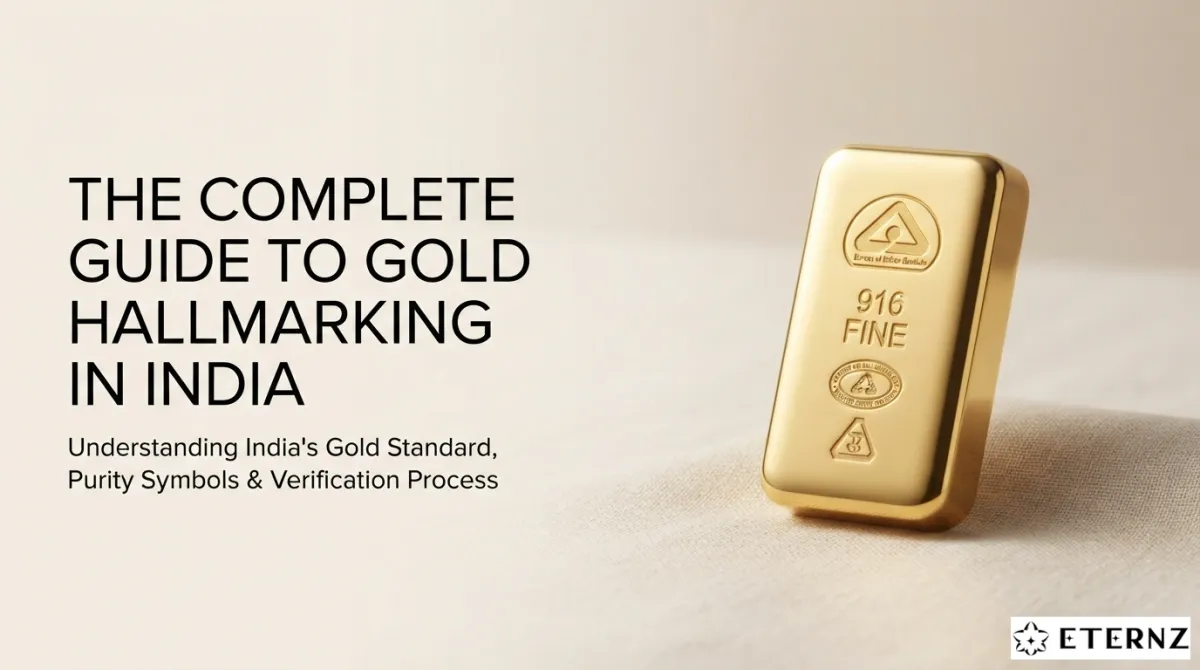
Gold hallmarking in India is the official purity certificate for gold jewellery, given by the Bureau of Indian Standards (BIS). A valid gold hallmark today has three marks: the BIS logo, the purity grade (for example 22K916), and a 6-character HUID code. You can check any HUID for free in the BIS Care app, which shows the purity, the type of item and the jeweller who registered it.
Hallmarking is compulsory for gold jewellery sold by registered jewellers in 392 districts, and it is the single best way to know you are paying for the gold you are actually getting.
Before we start, let me tell you about Eternz, a trusted jewelry marketplace featuring 400+ jewelry brands, with authenticity certification on every piece and fast, same-day delivery in major cities. First-time users can also save with ETERNZ5 for up to ₹50 off on ₹499+, ETERNZ10 for up to ₹100 off on ₹999+, or ETERNZ300 for up to ₹300 off on ₹2,500+, valid on both the app and website.
Gold Hallmarking in India: Key Facts at a Glance
| Fact | Detail |
|---|---|
| Who runs it | Bureau of Indian Standards (BIS), under the Ministry of Consumer Affairs |
| Indian standard for gold | IS 1417 |
| Mandatory since | 23 June 2021 (first 256 districts) |
| Districts covered now | 392 (latest order dated 3 August 2026) |
| Marks on a gold hallmark | 3: BIS logo, purity grade, 6-character HUID |
| HUID-only sales required from | 1 April 2023 |
| Gold grades in the scheme | 9K, 14K, 18K, 20K, 22K, 23K, 24KS |
| Registered jewellers | 2,36,624 (as on 15 Oct 2026) |
| Assaying and Hallmarking Centres | 1,565 (as on 15 Oct 2026) |
| Gold items hallmarked with HUID | Over 65 crore since July 2021 |
| Silver hallmarking with HUID | Started 1 September 2025 (voluntary) |
| How to verify | "Verify HUID" in the free BIS Care app |
What Is Gold Hallmarking?
Hallmarking is the official testing and recording of how much pure gold a piece contains. A BIS-recognised Assaying and Hallmarking Centre (AHC) tests the item, and if it meets the claimed purity, the centre laser-marks the hallmark on it.

Why does this matter? You can't tell gold purity by looking at it or holding it. Indian jewellery often has many soldered joints made of lower-purity gold, and a thin layer of high-purity gold can hide a weaker metal underneath. Without a lab test, a 22K piece and an 18K piece can look almost the same. Hallmarking moves that test away from the seller and into an independent, government-recognised lab.
How it works in practice:
- A BIS-registered jeweller sends the finished jewellery to an AHC.
- The AHC tests a sample. The centre first checks it with an XRF machine, then confirms purity with a fire assay.
- If the purity matches the claim, the AHC laser-marks the BIS logo, purity grade and a unique HUID.
- Each item's details are uploaded to the BIS system, which is what the BIS Care app reads from.
BIS has run a voluntary hallmarking scheme since 2000. It became mandatory for gold jewellery and artefacts in phases from June 2021.
How to Read a Gold Hallmark: The 3 Marks
Look closely at the inside of a ring, the clasp of a chain or the hook of an earring. A magnifier helps, because the marks are tiny.
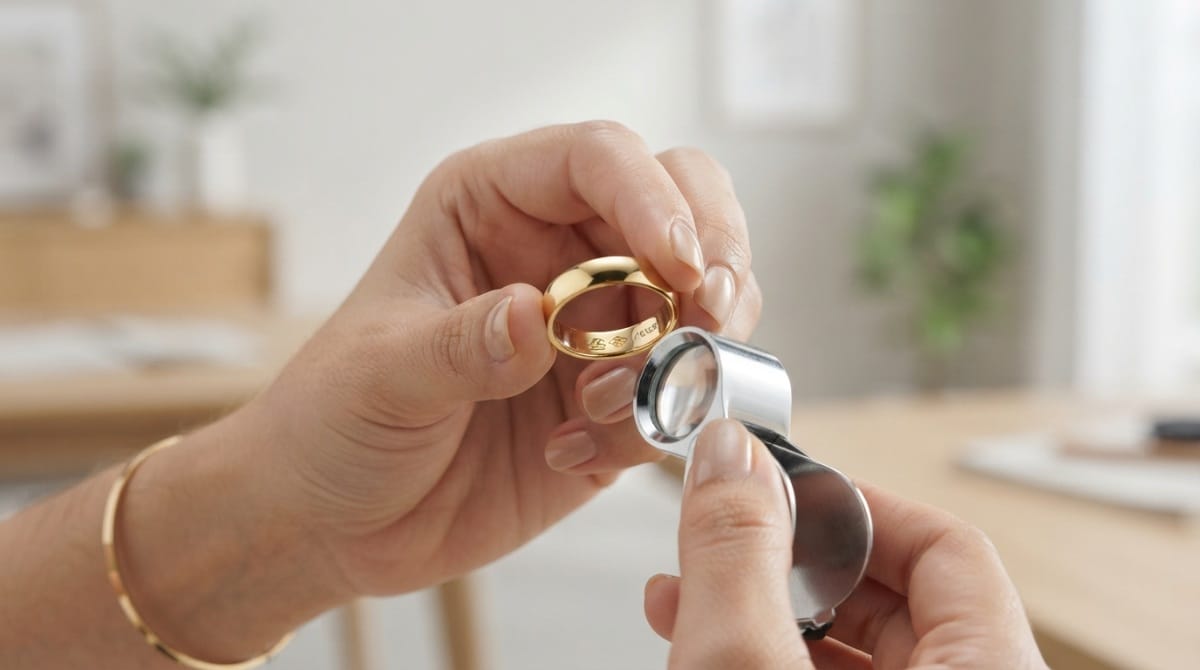
| Mark | What it looks like | What it tells you |
|---|---|---|
| 1. BIS Standard Mark | The BIS logo | The piece was hallmarked under the BIS scheme |
| 2. Purity grade | Carat and fineness, such as 22K916 or 18K750 | How much pure gold the piece contains |
| 3. HUID | A 6-character code of letters and numbers, such as AB12C3 | A unique ID for this one piece, which you can verify online |
What "22K916" means: 22 carat, and 916 parts of pure gold in every 1,000 parts of metal. So the piece is 91.6% gold. The rest is other metals, which make the gold strong enough to wear.
The jeweller may also add their own brand mark, but that is not part of the official hallmark.
The old 4-mark hallmark
Jewellery hallmarked before 1 July 2021 carries an older hallmark with four marks: the BIS mark, the purity, the hallmarking centre's mark and the jeweller's mark. There is no HUID on these pieces.
If you own jewellery with the old hallmark, it is still valid. BIS says a hallmark stays valid for the whole life of the jewellery. More on old jewellery further down.
What Is HUID and Why Does It Matter?
HUID stands for Hallmark Unique Identification. It is a 6-character alphanumeric code given to every single hallmarked item. No two pieces share the same HUID.
The HUID system began on 1 July 2021. From 1 April 2023, BIS-registered jewellers can only sell gold jewellery that carries a HUID hallmark. Older stock without a HUID has to be re-hallmarked before it can be sold.
Why the HUID is a big step up from the old system:
- It links the piece to a record. The code connects to details of the item, the jeweller and the centre that tested it.
- You can check it yourself. Anyone can enter the code in the BIS Care app. You don't need to trust the seller's word.
- It makes copying harder. A fake hallmark with a made-up HUID will not match a real record, or will match a different item.
- It now shows a photo and weight. Since 8 June 2026, BIS captures photographs and the weight of hallmarked gold items, and this is visible in the BIS Care app. You can compare the photo with the piece in your hand.
Quick fact: Since HUID began in July 2021, over 65 crore gold jewellery items have been hallmarked with a HUID, as per BIS data as on 15 October 2026.
Gold Purity Grades: What Each Carat Means
BIS hallmarks gold only in fixed purity grades. A piece is marked with the grade it meets. Here is what each grade means:
| Grade on hallmark | Fineness | Pure gold content | Where you usually see it |
|---|---|---|---|
| 24KS | 995 | 99.5% | Very little jewellery, as it is too soft |
| 23K | 958 | 95.8% | Some traditional jewellery |
| 22K | 916 | 91.6% | Most traditional Indian gold jewellery |
| 20K | 833 | 83.3% | Some traditional and regional designs |
| 18K | 750 | 75% | Diamond and stone-set jewellery, daily wear |
| 14K | 585 | 58.5% | Lightweight, modern and daily-wear pieces |
| 9K | 375 | 37.5% | A lower grade that BIS lists as voluntary, so it is rarely seen |
BIS currently lists these seven grades for gold hallmarking. The six grades from 14K to 24KS are the long-standing core grades. 9K is a voluntary grade, so you will see it far less.
What about 24K 999 gold? The 999 fineness is used for gold bars and coins, not jewellery. For jewellery, the highest grade is 24KS (995).
Not sure which purity suits you? Our guide to 24K vs 22K vs 18K vs 14K gold compares them for daily wear, stones and long-term value. In short, 22K is the usual choice for gold bangles and a traditional gold mangalsutra, while 18K and 14K are common for stone-set gold rings and gold earrings, because the harder metal holds stones better.
Is Hallmarking Mandatory Everywhere in India?
Not yet. Mandatory hallmarking applies to gold jewellery and artefacts sold in the districts listed in the government's Hallmarking Order. The list has grown in eight phases since 2021:
| Phase | Order date | Districts added | Total districts |
|---|---|---|---|
| 1 | 23 June 2021 | 256 | 256 |
| 2 | 4 April 2022 | 32 | 288 |
| 3 | 6 September 2023 | 55 | 343 |
| 4 | 5 November 2024 | 18 | 361 |
| 5 | 31 July 2025 | 12 | 373 |
| 6 | 2 March 2026 | 7 | 380 |
| 7 | 28 April 2026 | 5 | 385 |
| 8 | 3 August 2026 | 7 | 392 |
The latest phase added Jhargram (West Bengal), Angul (Odisha), Bhandara (Maharashtra), Udham Singh Nagar (Uttarakhand), Panipat (Haryana), and Bhind and Vidisha (Madhya Pradesh). The full district list is on the BIS website under "Mandatory Hallmarking Order".
What this means for you:
- In a covered district, a BIS-registered jeweller must sell only HUID-hallmarked gold jewellery, unless the item falls under an exemption.
- Outside the covered districts, hallmarking is not compulsory, but registered jewellers there can still sell hallmarked pieces.
- Either way, you can insist on a hallmarked piece. It costs the jeweller very little and protects you a lot.
What Is Not Covered: Hallmarking Exemptions
Some items don't need a hallmark under the mandatory order. These are the main exemptions listed by BIS:
- Items weighing less than 2 grams. They can still be hallmarked if the jeweller chooses.
- Kundan, polki and jadau jewellery.
- Gold bullion in any form, including bars, plates, wire and coins.
- Jewellers with annual turnover up to 40 lakh rupees.
- Gold watches and fountain pens.
- Gold thread.
- Items for export made to a foreign buyer's specification, and items for export and re-import.
- Jewellery for international exhibitions and government-approved domestic B2B exhibitions.
- Medical, dental, veterinary, scientific or industrial items.
- Unfinished items meant for further manufacturing.
So a small nose pin under 2 grams or a polki set may legally be sold without a hallmark. That doesn't make it fake. It just means you have less official proof of purity, so buy such pieces from sellers whose purity details and invoices you trust.
Are Gold Coins and Bars Hallmarked?
Gold coins and bars are outside the mandatory hallmarking order. Hallmarking them is voluntary, and only BIS-licensed refineries and mints can do it, in 999 or 995 fineness.
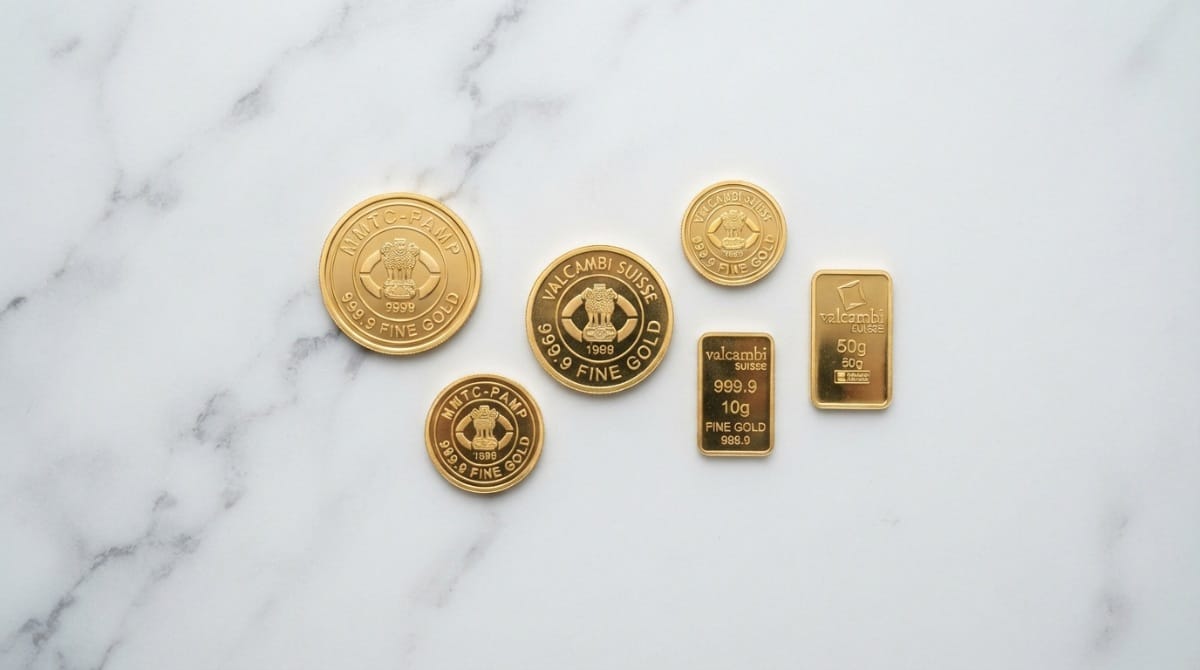
Coins from BIS-licensed refineries and mints carry a BIS hallmark. So when you buy gold coins or gold bars, look for:
- the BIS logo and the fineness (999 or 995) stamped on the coin or bar,
- the name of the refinery or mint,
- sealed, tamper-proof packaging, often with a certificate,
- a clear weight and purity on the invoice.
This matters most around Dhanteras, when coin buying peaks. World Gold Council data shows bars and coins have become a bigger share of India's festive-season gold demand, as our look at what people buy on Dhanteras and Diwali explains, and why Indians buy gold on Dhanteras covers the tradition behind it. If you are planning a purchase this festive season, read is Dhanteras 2026 a good time to buy gold or silver for what to weigh up first, and browse gold idols and coins for hallmarked options.
Silver Hallmarking: What Changed in 2025
Silver hallmarking has existed as a voluntary scheme since 2005. On 1 September 2025, BIS made it HUID-based, under the new silver standard IS 2112:2025.
The key rules for silver now:
- It is still voluntary. A jeweller doesn't have to hallmark silver.
- But if silver is hallmarked, it must carry a HUID. The old silver hallmark without a code is no longer used for new items.
- The silver hallmark has three parts: the BIS mark with the word "SILVER", the purity grade, and the 6-character HUID.
- There are eight purity grades: 800, 835, 900, 925, 958, 970, 990 and 999. The number is parts of pure silver per 1,000.
The two most common hallmarked silver grades are 925, also called sterling silver (92.5% pure silver), and 800. Over 90 lakh silver items had been HUID-hallmarked by 15 October 2026. BIS data from December 2025 showed payal (anklets) as the largest category of hallmarked silver by weight. So if you are buying silver anklets or silver idols and coins, ask whether they are hallmarked and check the HUID the same way you would for gold.
How to Verify a HUID on the BIS Care App
This is the most useful check you can do, and it takes about a minute.
- Download the BIS Care app. It is free on Android and iPhone and available in 12 languages.
- Open the app and tap "Verify HUID".
- Type in the 6-character HUID from the piece or the product details.
- Read the result.
What the app shows:
- the purity of the item,
- the type of article (ring, chain, bangle and so on),
- the date it was hallmarked,
- the jeweller's BIS registration number,
- the hallmarking centre's details,
- and, for items hallmarked since 8 June 2026, a photo and the recorded weight.
What to compare: the purity should match the mark on the piece and the invoice. The article type should match what you bought. If there is a photo, it should look like your piece, and the weight should be close to the weight on your invoice. If anything doesn't match, don't accept the piece, and raise it with the seller.
Quick tip: Check the HUID before you pay if you can see it on the product page or in store, and again when the piece arrives. A mismatch is much easier to fix before the sale is closed.
How to Spot a Fake Hallmark
Fake hallmarks do exist. BIS raids in 2025 and 2026 have reported jewellery with spurious BIS marks, missing HUIDs, and even laser machines used to stamp counterfeit hallmarks. Here is how to protect yourself:
- Count the marks. A modern gold hallmark has three: BIS logo, purity grade and HUID. If the HUID is missing on a recently made piece, be careful.
- Verify the HUID. A made-up code will not show up in BIS Care, or it will show a different item, purity or jeweller.
- Match the jeweller. The registration number in the app should belong to the seller, or to the brand that made the piece.
- Look at the marking. Real hallmarks are neat, laser-engraved and readable under a magnifier. Smudged, uneven or stamped-on marks are a warning sign.
- Ask for the store tools. BIS asks registered stores to keep a 10X magnifier and a weighing scale for customers, so you can read the hallmark and check the weight yourself.
- Get it re-tested if in doubt. Any BIS-recognised hallmarking centre can test a hallmarked piece for you.
Buying Hallmarked Gold Online: What to Check
Look for the same hallmark and invoice details online that you would expect in a store. Online, you just need to do a few checks on the product page and when the parcel arrives. If you want a wider checklist, read our guide on whether it is safe to buy jewellery online in India.
Before you order:
- The product details should state the purity (for example 22K or 18K) and say the item is BIS hallmarked.
- Check the net gold weight, and look for a price breakup showing the gold value and making charges separately.
- If the HUID is shown, verify it in BIS Care before you buy.
- Read the return and exchange policy, in case the purity or weight doesn't match.
On your invoice, BIS rules require:
- a description of each item,
- the net weight of the gold,
- the purity in carat and fineness,
- the hallmarking charges,
- a note that you can get the purity checked at any BIS-recognised hallmarking centre.
Putting the HUID on the invoice is not compulsory yet, so ask for it. It makes later checks and resale easier.
When the parcel arrives: find the three marks on the piece, verify the HUID in BIS Care, and match the purity, article type and weight with your invoice. Do this before you wear it or remove the tags.
Old Jewellery: Is Your Old Hallmark Still Valid?
Yes. BIS has clearly said that a hallmark remains valid for the entire life of the jewellery. Your old 4-mark hallmarked pieces from before 2021 are still genuine hallmarked jewellery.
What you can do with old jewellery:
- Sell or exchange it. You can sell old hallmarked or non-hallmarked jewellery to a jeweller. The new HUID rules are for jewellers selling, not for you as an owner.
- Get it tested. You can get old or non-hallmarked jewellery tested at a BIS-recognised hallmarking centre. You will get a test report with the purity.
- Ask about hallmarking. Only BIS-registered jewellers can submit items to a hallmarking centre. If you want an old piece hallmarked, ask a registered jeweller whether they will submit it.
Jewellers who want to resell old stock with the old hallmark must first get it re-hallmarked with a HUID.
What Are Your Rights If the Purity Is Short?
If a hallmarked piece turns out to be lower in purity than its mark, the law is on your side. Under Rule 49 of the BIS Rules, 2018, the jeweller who sold it must pay you compensation of two times the difference in value caused by the purity shortfall, for the weight of the item, plus the testing charges.
How to complain:
- through the BIS Care app (it has a complaint option),
- on BIS's online portal at manakonline.in,
- by email to [email protected],
- or at a BIS regional or branch office.
Keep your invoice, the HUID, and the test report from the hallmarking centre. These three documents make your complaint easy to prove. Jewellers who sell under-purity hallmarked gold also face penalties under the BIS Act, and BIS can cancel their registration.
Conclusion
A gold hallmark is only as useful as the check you do on it. Look for the three marks, verify the HUID in BIS Care, and match the purity and weight with your invoice. It takes a minute and protects a purchase you may keep for decades. When you shop for gold necklaces or any gold piece online, choose listings that clearly state the hallmark and purity, and verify the HUID when it arrives.
Frequently Asked Questions
1. What is gold hallmarking in India?
Gold hallmarking is the official certification of gold purity by the Bureau of Indian Standards (BIS). A BIS-recognised centre tests the piece and laser-marks the BIS logo, purity grade and a unique 6-character HUID on it.
2. What are the 3 marks on hallmarked gold?
A gold hallmark has three marks: the BIS Standard Mark (logo), the purity grade in carat and fineness (such as 22K916), and a 6-character alphanumeric HUID. Jewellery hallmarked before July 2021 has an older 4-mark hallmark without a HUID.
3. What does 22K916 mean on gold?
It means the gold is 22 carat and contains 916 parts of pure gold per 1,000, or 91.6% gold. The rest is other metals, which make the jewellery strong enough to wear.
4. How do I check a HUID number?
Download the free BIS Care app, tap "Verify HUID" and enter the 6-character code. The app shows the purity, article type, hallmarking date, jeweller's registration number and the hallmarking centre, and for items hallmarked since June 2026, a photo and weight.
5. Is gold hallmarking mandatory in India?
Yes, for gold jewellery and artefacts sold by BIS-registered jewellers in the 392 districts covered by the Hallmarking Order, as of August 2026. Some items are exempt, such as pieces under 2 grams, kundan, polki and jadau jewellery, and gold bullion and coins.
6. Is my old hallmarked jewellery without HUID still valid?
Yes. BIS says a hallmark is valid for the entire life of the jewellery, so old 4-mark hallmarks remain valid. You can keep, sell or exchange such jewellery. Only jewellers must re-hallmark old stock with a HUID before selling it.
7. Are gold coins hallmarked in India?
Gold coins and bars are exempt from mandatory hallmarking. Hallmarking them is voluntary and done only by BIS-licensed refineries and mints in 999 or 995 fineness. Look for the BIS logo, fineness and the refiner's or mint's name on the coin.
8. Is silver hallmarking mandatory in India?
No, silver hallmarking is voluntary. But since 1 September 2025, any silver item that is hallmarked must carry a 6-character HUID, along with the BIS mark with the word "SILVER" and a purity grade such as 925.
9. What can I do if hallmarked gold has lower purity than marked?
Under Rule 49 of the BIS Rules, 2018, the selling jeweller must pay two times the difference in value caused by the purity shortfall, plus testing charges. You can complain through the BIS Care app, manakonline.in, or [email protected].
10. Can jewellery under 2 grams be hallmarked?
Yes. Items under 2 grams are exempt from mandatory hallmarking, so a seller doesn't have to hallmark them, but they can be hallmarked voluntarily. If a small piece is hallmarked, verify its HUID the same way.