Lab Grown vs Natural Diamonds in India: 2026 Buyer's Guide (Save Lakhs)
Why spend ₹5 lakhs when you can get the same sparkle for ₹50,000? This guide reveals how lab grown diamonds save Indian buyers lakhs of rupees. Compare prices, understand the resale market, and discover if they're good for astrology and weddings.
The Great Indian Diamond Shift is here, and it is saving buyers lakhs of rupees.
Buying a diamond in India is not just about shopping; it is an emotion. Whether it is for an engagement, a wedding, or a special Dhanteras purchase, we all want that perfect sparkle. But lately, you might have heard a new buzzword in the market: Lab Grown Diamonds (LGDs).
Suddenly, huge solitaires that used to cost as much as a luxury car are available for the price of a high-end smartphone. But are they real? Do they shine the same? And most importantly for us Indians, do they have resale value?
In this article, we cover:
- What are lab grown diamonds?
- Are lab grown diamonds fake?
- Lab grown vs natural diamonds: key differences
- Lab grown diamond prices vs natural diamonds
- Do lab grown diamonds have resale value in India?
- Are lab grown diamonds good for astrology?
- How are lab grown diamonds made?
- How to buy lab grown diamonds smartly in India
- Where to buy trusted lab grown diamond jewelry
- Conclusion: which diamond should you choose?

This guide answers every single question you have, in very easy and simple way. For more on the latest shifts in the Indian jewelry scene, read our 2025 Jewelry Trends in Review: Lab-Grown Dominance in India.
What Are Lab Grown Diamonds?
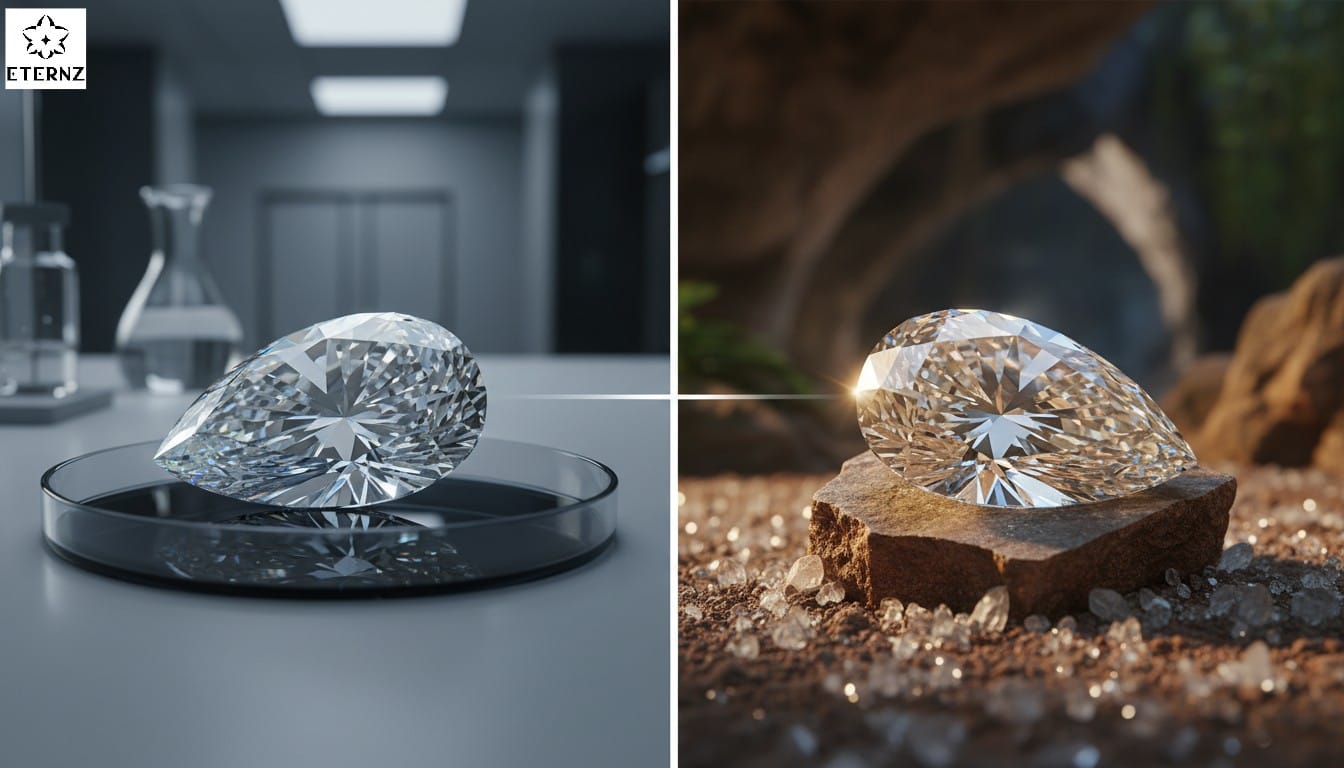
Lab grown diamonds are 100% real diamonds. They are not fakes, and they are not cubic zirconia. They are chemically, physically, and optically identical to mined diamonds, but they are created in a lab instead of under the earth.
Think of it like ice. You can find ice in a frozen lake (natural), or you can make ice in your freezer (lab-grown). Both are frozen water. Both will cool your drink exactly the same way. The only difference is where they come from.
Actually, the Indian government heavily supports this industry. Surat in Gujarat is now one of the world's biggest hubs for growing and polishing these diamonds!
For a deeper dive into what makes them identical yet smarter, check out Lab-Grown Diamonds: Your Complete Guide to Smarter Shopping.
Are Lab Grown Diamonds "Fake"?
No. If you take a lab grown diamond to a jeweller and they test it with a standard diamond tester pen, it will beep positive for "Diamond."
Because they are made of pure carbon (just like natural ones), they are the hardest material on earth. They score a 10 on the Mohs hardness scale. They will not scratch, get cloudy, or lose their shine over time.
Quick Check:
- Cubic Zirconia (CZ): Fake. Scratches easily. Cheap.
- Moissanite: A different stone entirely. Shines differently.
- Lab Grown Diamond: Real diamond. Lasts forever.
Confused about these alternatives? See Diamond vs. Moissanite vs. Lab-Grown Diamonds: Know the Difference Before You Buy.
Lab Grown vs Natural Diamonds: The Main Differences
To the naked eye, there is zero difference. The only real differences are the price tag and the origin.
Let’s break this down into the things that matter most to you.
1. The Price Difference
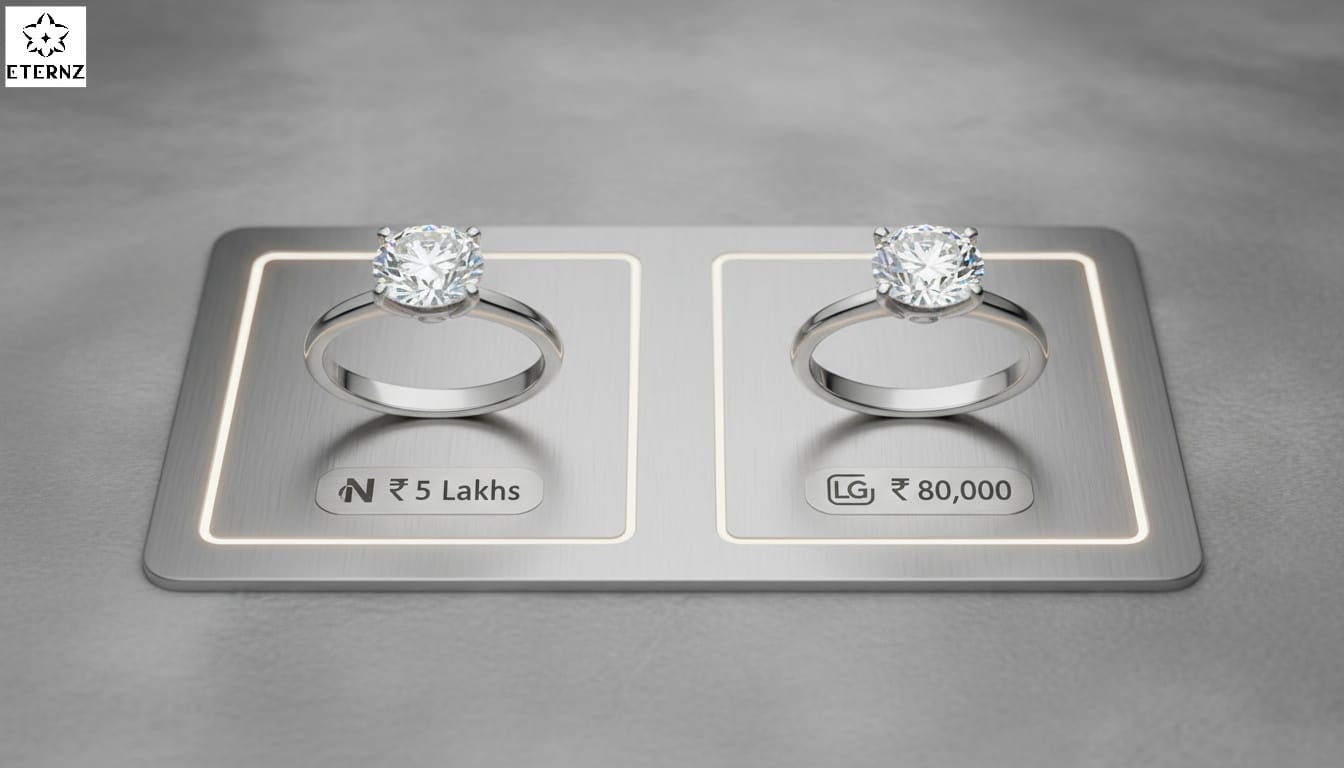
Lab grown diamonds are roughly 70% to 90% cheaper than natural diamonds. This allows you to buy a much bigger stone for your budget.
In India, we love "value for money." Natural diamonds are expensive because they are rare and hard to mine. Lab diamonds are cheaper because technology has made them easier to produce.
2. Appearance and Shine
They look exactly the same. Even expert gemologists cannot tell them apart without using a special heavy-duty machine.
If you put a 1-carat natural diamond ring next to a 1-carat lab diamond ring, your friends and family will never know the difference. They both have the same "fire" (rainbow sparkles) and "brilliance" (white sparkles).
3. Environmental Impact
Lab grown diamonds are generally more eco-friendly. They do not require digging massive holes in the earth (mining), which destroys forests and displaces wildlife.
For the full picture on how this fits into 2026 trends, explore Top 10 Indian Jewelry Trends for 2026: Lab-Grown, Neo-Heritage & More.
Price Breakdown: 1 Carat Lab Grown Diamond vs. Natural or Mined Diamond in India (2026 Estimates)
You can save lakhs of rupees by choosing lab grown. Below is a realistic price comparison for the Indian market.
| Feature | Natural Diamond (1 Carat) | Lab Grown Diamond (1 Carat) |
|---|---|---|
| Price (Approx.) |
₹2.5 Lakhs - ₹5 Lakhs
(Higher Investment)
|
₹50,000 - ₹1.5 Lakhs
(More Affordable)
|
| Look |
✨
Shiny & Transparent
|
✨
Shiny & Transparent
|
| Durability |
Forever (10/10 Hardness)
★★★★★
10/10
|
Forever (10/10 Hardness)
★★★★★
10/10
|
| Resale Value |
50% - 80% of current value
Good Resale
|
Low / Exchange Only
Limited Resale
|
| Environmental Impact |
High energy & water usage
(Mining required)
|
Lower carbon footprint
(Eco-friendly option)
|
| Certification |
GIA, IGI, HRD
Standard grading
|
IGI, GIA, SGL
Same grading scale
|
Many buyers are amazed at how far their budget stretches. With ₹1 lakh, instead of settling for a small stud earring, they can now afford a stunning 1-carat solitaire ring that looks impressively large and elegant!
Browse solitaire diamond studs and earrings to see the sparkle for yourself.
Do Lab Grown Diamonds Have Resale Value in India?
Currently, lab grown diamonds have very low to zero resale value in the open market. You should buy them for wearing, not as a financial investment.
This is the "catch."
- Natural Diamonds: If you buy one for ₹1 Lakh today, you might get ₹60,000 to ₹80,000 back if you sell it later (depending on gold and diamond market rates).
- Lab Grown Diamonds: If you try to sell it back to a random jeweller, they might not buy it, or they might offer very little cash.
However, many modern brands now offer Buyback or Exchange Policies (like 80% exchange value). Always ask the jeweller: "If I want to exchange this later, what is your policy?"
Is Lab Grown Diamonds Good for Astrology?
This is a hot debate. Traditional astrologers often say "No," but many modern experts say "Yes" because the chemical composition is identical.
- The Traditional View: Some astrologers believe a diamond needs "Bhoo Tatva" (Earth Element) to work. Since natural diamonds spend millions of years underground absorbing earth's energy, they prefer mined stones for Venus (Shukra) remedies.
- The Modern View: Science tells us that a diamond is pure carbon. Since lab diamonds are also pure carbon and crystal clear, many modern gem therapists believe they transmit light and energy exactly the same way.
My Advice: If you are buying strictly for a rigorous astrological remedy, consult your family Panditji first. If you are buying for fashion, love, or weddings, lab grown is perfect.
How Lab Grown Diamonds Are Made?
Scientists take a tiny "seed" of a diamond and place it in a machine that mimics the earth's crushing force.
There are two ways they do this:
- HPHT (High Pressure High Temperature): Imagine a giant press that crushes the seed with extreme heat, just like the earth does.
- CVD (Chemical Vapor Deposition): This is like 3D printing with gas. They put the seed in a chamber and fill it with carbon-rich gas. The gas sticks to the seed layer by layer until a diamond forms.
So, you know what? Both methods create a real diamond. You don't need to worry about which method was used as long as it is certified.
How to Buy Lab Grown Diamonds Smartly in India
Never buy a diamond (natural or lab) without a certificate.
In India, trust is everything. To ensure you are not getting cheated, follow these three rules:
- Look for IGI or GIA Certification: These are international labs that grade diamonds. If a jeweller tries to sell you a stone without this paper, walk away.
- Check the 4Cs:
- Cut: This makes it sparkle. Go for "Excellent" or "Ideal" cut.
- Color: Go for G or H grade (looks white to the eye but saves money).
- Clarity: VS1 or VS2 is perfect (no visible spots).
- Carat: The weight/size.
Where to Buy Trusted Diamond Jewellery?
For the best mix of variety, trust, and technology, Eternz is a top recommendation for Indian buyers.
Finding a jeweller who is transparent about Lab Grown Diamonds can be tricky. You don't want to go to a traditional shop that frowns upon them, and you don't want a shady online seller.
Why choose Eternz?
- Massive Variety: They curate jewellery from 250+ trusted brands.
- 100% Authentic: Every piece comes with proper certification.
- Try Before You Buy: They have a cool Virtual Try-on feature so you can see how earrings or necklaces look on you via your phone camera.
- Fast Delivery: If you are in a rush for a gift, they offer Same Day Delivery in major cities like Bengaluru, Delhi, Noida, Mumbai, and more.

Use the code "WELCOME10" to get a sweet discount on your first order!
Conclusion: Which Should You Choose?
- Choose Natural Diamond IF: You view jewellery as a financial investment, you are a staunch traditionalist, or you have an unlimited budget.
- Choose Lab Grown Diamond IF: You want a bigger, brighter stone, you want to save money for other wedding expenses (like the honeymoon!), or you care about eco-friendly choices.
The world has changed. A diamond is no longer defined by how much earth was dug up to find it, but by the love it represents. Whether grown in a lab or mined from the ground, the sparkle remains forever.
For timeless diamond essentials like solitaire studs that pair perfectly with lab-grown options, see 2026's Top 5 Timeless Indian Jewelry Every Woman Should Own. If you're planning a wedding or party look, also check Top 5 Indian Bridal Jewelry Trends Dominating 2026 Weddings for more inspiration.
Happy Shopping!
Frequently Asked Questions
1. Are lab grown diamonds real diamonds?
Yes. Lab grown diamonds are 100 percent real diamonds. They are chemically, physically, and optically identical to mined diamonds, made of pure carbon, and rank 10 on the Mohs hardness scale.
2. What are the main differences between lab grown and natural diamonds for Indian buyers?
The key differences are price and origin. Lab grown diamonds are typically 70 to 90 percent more affordable and are created in controlled laboratories, while natural diamonds are mined from the earth. Visually, both look identical to the naked eye.
3. Do lab grown diamonds have resale value in India?
At present, lab grown diamonds have low to negligible resale value in the open Indian market compared to natural diamonds. They are best purchased for wearing and enjoyment rather than as long term financial assets, though some brands offer buyback or exchange options.
4. Are lab grown diamonds more eco friendly than natural diamonds?
Yes. Lab grown diamonds are generally considered more environmentally responsible because they avoid large scale mining, which can disrupt ecosystems and natural habitats.
5. How can Indian buyers ensure they are purchasing a trusted lab grown diamond?
Buyers should always look for IGI or GIA certification, review the 4Cs with emphasis on an excellent cut and G or H color, and request product videos or virtual try on features when shopping online.