Lab Diamonds vs Moissanite: 5 Key Differences Every Indian Buyer Should Know
Confused between lab diamonds vs moissanite for your engagement ring or bridal jewellery in India? Learn 5 key differences in sparkle, durability, price, resale value, and symbolism so you can choose smartly and confidently.
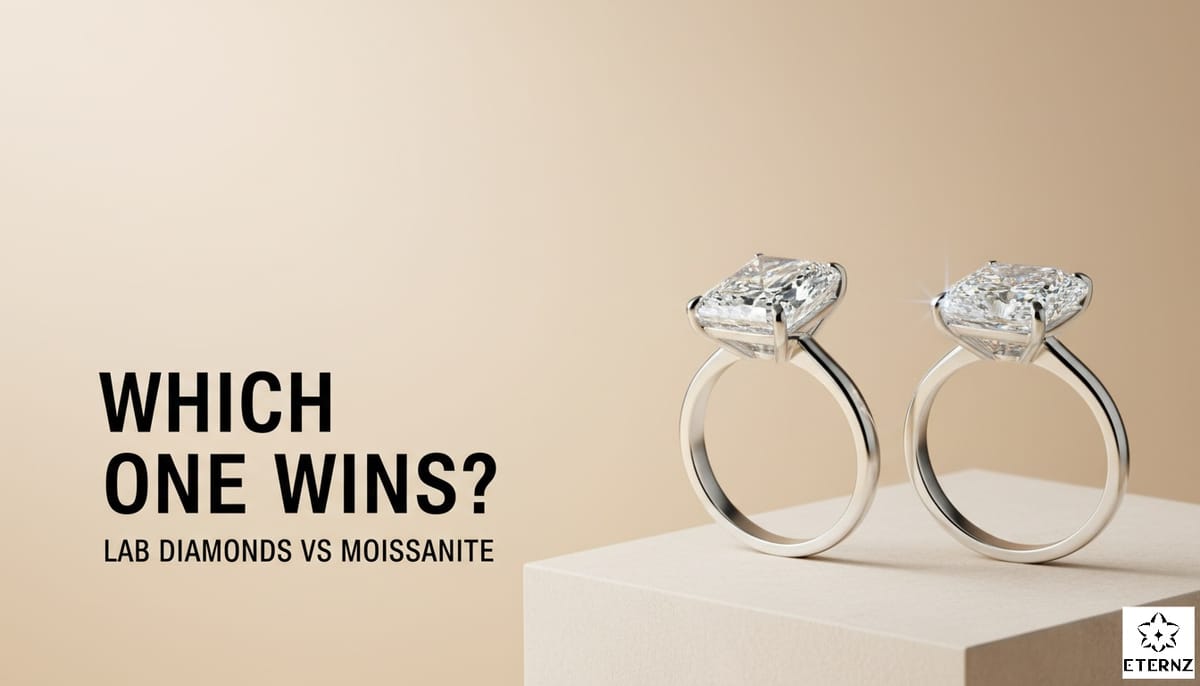
If you are scrolling through Instagram jewellers, WhatsApp catalogues, and brand websites thinking, "Yaar, lab diamond loon ya moissanite," you are not alone. Indian buyers today want maximum sparkle, minimum guilt, and full paisa vasool.
Both lab grown diamonds and moissanite offer serious sparkle without the traditional mined diamond price tag. Lab grown diamonds are real diamonds made in a lab, while moissanite is a different gemstone that only looks similar at first glance. Yet their look, feel, long term value, and even the way people judge them in shaadi functions can be quite different.
Let us break down Lab Diamonds vs Moissanite: 5 Key Differences in a simple, no drama, Indian context, so you can pick the stone that actually suits your lifestyle, budget, and values.
What Exactly Are Lab Diamonds And Moissanite?
Before we jump into the differences, it helps to know what you are really looking at when a jeweller shows you two glittering stones side by side.
What is a lab grown diamond?
A lab grown diamond is a real diamond created using advanced technology that replicates the natural conditions inside the earth. It is made of pure carbon and has the same crystal structure, hardness, and optical properties as a mined diamond.
- It scores 10 on the Mohs hardness scale, just like natural diamonds.
- It shows the same white brilliance and sparkle that most of us associate with classic diamond jewellery.
- It can be certified by respected labs and graded on the same 4 Cs cut, colour, clarity, carat as natural diamonds.
In short, lab grown diamonds are diamonds. The origin changes, not the substance.
What is moissanite?
Moissanite is a different gemstone made from silicon carbide. It was first discovered in a meteor crater, which is why you will often hear brands call it "space diamond," but commercially it is grown in labs.
- It scores around 9.25 on the Mohs hardness scale, which means it is extremely durable, though slightly softer than a diamond.
- It has a higher refractive index than diamond, so it throws more rainbow coloured flashes, often called "fire."
- It is usually much cheaper than both mined and lab grown diamonds.
So while lab diamonds and moissanite might look similar from a distance, they are totally different materials with their own personality.
Key Difference 1: Origin And Composition
This is the foundation of the entire Lab Diamonds vs Moissanite debate.
Lab diamonds: Same composition as mined diamonds
Lab grown diamonds are chemically and physically identical to mined diamonds. Both are pure carbon arranged in a diamond crystal structure.
- Same composition
- Same hardness
- Same type of brilliance
The only difference is where they are formed. One forms deep inside the earth over millions of years. The other grows in a lab in a few weeks using CVD or HPHT technology.
Moissanite: Silicon carbide with different optics
Moissanite, on the other hand, is made of silicon carbide. This different composition changes its optical properties and the way it interacts with light.
- Higher refractive index
- Higher dispersion
- Slightly different colour behaviour under certain lighting
So even if your relatives casually say, "Sab same hi lagta hai," scientifically they are not the same at all.
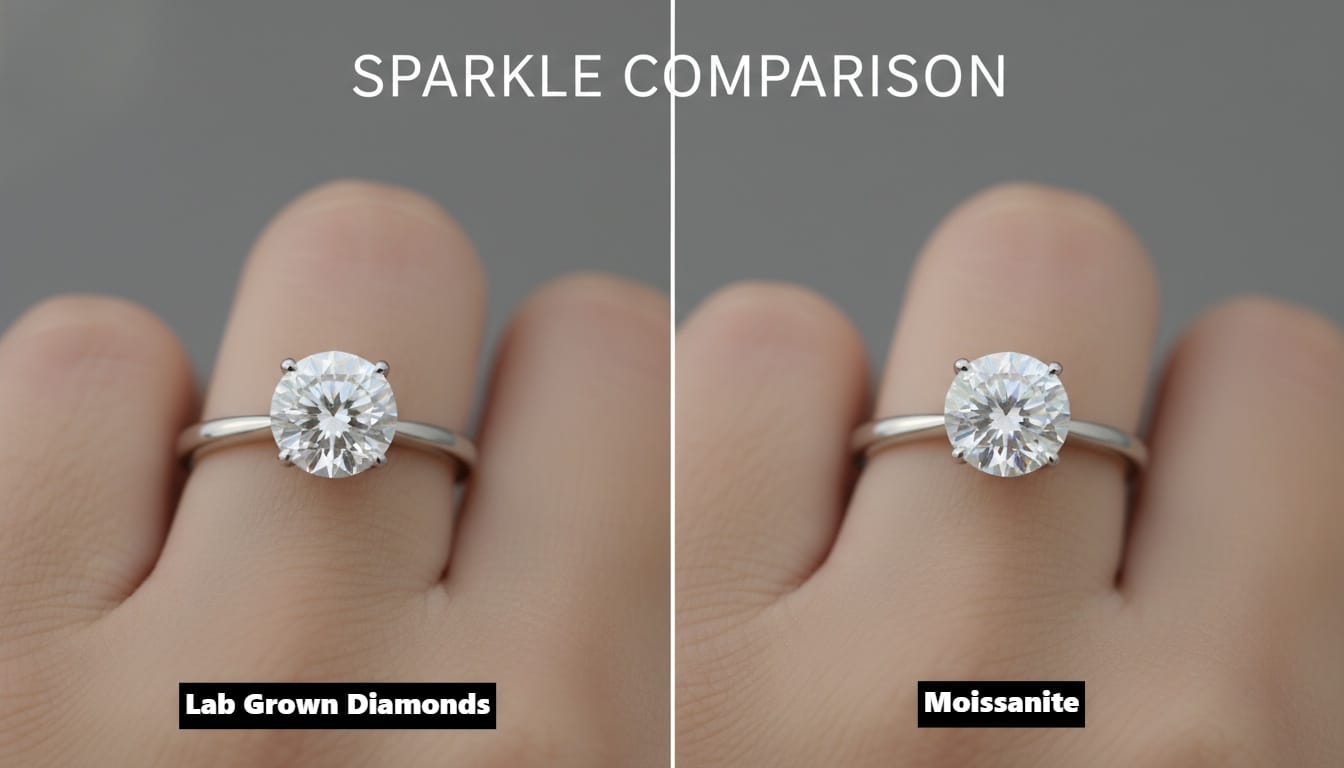
Key Difference 2: Sparkle, Fire, And Overall Look
Let us be honest. Indians love sparkle. Whether it is a solitaire ring or a tiny daily wear pendant, if it catches the light in a nice way, we are sold.
How lab diamonds look to the eye?
Lab grown diamonds look just like high quality mined diamonds:
- Refractive index around 2.42, which gives that crisp white brilliance.
- Balanced sparkle with both brilliance and controlled fire, but not an overly rainbow effect.
- If cut well, they offer that classic "diamond look" in all lighting, from mandap lights to office tubelights.
Since they are real diamonds, your lab diamond engagement ring or mangalsutra pendant will look exactly like a natural diamond piece.
How moissanite looks in real life?
Moissanite is often called more "sparkly" than diamond because of its optical properties.
- Refractive index roughly between 2.65 and 2.69, higher than diamond.
- Dispersion around two to two and a half times higher than diamond, which means more rainbow flashes.
- In strong light, especially in bigger stones, it can create a very colourful disco kind of effect some people love and others find too much.
For a one carat plus center stone in moissanite, the extra fire becomes quite noticeable compared to a diamond.
Which looks more expensive?
This part is subjective.
- If you want that classic, understated, luxury look that matches high end bridal sets and traditional Indian jewellery, lab diamonds usually feel more "expensive" to the eye.
- If you love maximum sparkle and do not mind colourful flashes, moissanite can look incredibly eye catching, especially in modern or minimalist designs.
In short, lab diamonds give you classic Bollywood red carpet vibes, while moissanite leans a bit more toward party light sparkle.
Key Difference 3: Hardness And Everyday Durability
Nobody wants a stone that looks tired after a few years, especially for pieces like engagement rings, mangalsutras, and anniversary bands you plan to wear daily.
Lab diamonds: Top of the hardness chart
Diamonds natural or lab grown are the hardest known natural material with a Mohs hardness of 10.
- Extremely resistant to scratching from everyday dust and contact.
- Maintain their polish and facet edges very well over decades.
- Perfect for heavy daily use in Indian conditions heat, sweat, pollution, and regular wear.
For long term durability and that "heirloom" feeling, diamonds still sit at the top.
Moissanite: Almost as hard, more than enough for daily wear
Moissanite scores around 9.25 on the Mohs scale, which is still harder than most gemstones used in jewellery.
- It easily resists scratching from normal household dust and everyday use.
- Only a few materials like diamond itself are harder, and you rarely encounter those in daily life.
- With basic care, moissanite jewellery can look new for many years.
For real world use, the difference between 9.25 and 10 is not huge for most people. Both stones are durable enough for engagement rings or Indian daily wear.
Key Difference 4: Price, Resale Value, And Perceived Status
Now comes the part that actually decides many Indian buying decisions.
Price comparison in simple terms
Broadly speaking:
- Lab grown diamonds are much cheaper than mined diamonds, often by 70 to 90 percent for similar quality.
- Moissanite is usually even more affordable than lab grown diamonds. Some guides estimate moissanite can cost a fraction of the price of a diamond of similar size.
That means with the same budget, you can:
- Buy a larger lab diamond compared to a natural diamond.
- Or go even larger with moissanite compared to both.
For budget conscious Indian buyers who still want a big solitaire look for engagements, roka, or anniversaries, this is a huge advantage.
Resale value and perception in India
This is where things get interesting.
- Lab grown diamonds are increasingly recognised as real diamonds, certified and graded like natural ones.
- In India, brands and retailers are actively pushing lab grown diamonds as a future facing, sustainable luxury option, and demand is rising among urban buyers.
- Some resale value exists, especially as awareness grows, though it is usually lower compared to high quality mined diamonds.
Moissanite, on the other hand:
- Generally has very limited resale value, since it is viewed more as a diamond alternative than a luxury gem in its own right.
- Many buyers think of it as a fashion or travel stone rather than an "investment" purchase.
In many Indian families, jewellery is still seen as emotional plus semi financial security. For those buyers, lab diamonds usually feel closer to their expectations than moissanite because they are still diamonds.
Key Difference 5: Certification, Trust, And Symbolism
Especially for engagement rings, wedding bands, or bridal sets, people in India care a lot about what the stone "means," not just how it looks.
Lab diamonds: Certified and easy to explain to family
Lab grown diamonds can be certified by major labs like GIA or IGI, just like natural diamonds.
- Detailed reports show the 4 Cs and confirm that it is a real diamond grown in a lab.
- Easier to convince parents and elders who may be skeptical of "fake stones" because you can show them proper certification and gemmology reports.
- Increasingly accepted by modern Indian couples who want sustainable yet aspirational jewellery.
Symbolically, a lab diamond engagement ring still says, "I am giving you a diamond."
Moissanite: Less documented, more niche
Moissanite also can come with some form of authenticity certificate, but it is not graded in the same universal way as diamonds.
- Fewer standardised grading labs for moissanite compared to diamonds.
- Most Indian relatives will probably hear the word and immediately ask, "To phir yeh diamond nahi hai kya"
- It is often perceived as a clever budget trick rather than a traditional symbol of status.
However, for couples who do not care much about log kya kahenge and simply want a beautiful stone at a friendly price, moissanite still makes a lot of sense.
Lab Diamonds vs Moissanite: 5 Key Differences At A Glance
Here is a quick side by side summary of the major factors.
| Factor | Lab grown diamond | Moissanite |
|---|---|---|
| Composition | Pure carbon, identical to natural diamond | Silicon carbide, different gemstone |
| Hardness | 10 on Mohs scale, hardest material | Around 9.25 on Mohs scale, still very hard |
| Sparkle style | Clean white brilliance, classic diamond look | More fire and rainbow flashes, high sparkle |
| Price level | Cheaper than mined diamonds but costlier than moissanite | Generally more affordable than both mined and lab diamonds |
| Resale and status | Seen as real diamond, some resale, rising demand in India | Limited resale, often viewed as diamond alternative |
How To Choose For Indian Occasions
Once you understand the differences, the real question is simple.
What is right for you and for your occasion
For engagement rings and proposals
If you are planning a proposal or engagement where the ring will be a lifetime symbol, think about:
- Family expectations: If your families are traditional and equate diamonds with status, a lab diamond may be much easier to explain than moissanite.
- Emotional value: Some couples feel emotionally happier knowing the stone is still a diamond, even if lab grown.
- Budget: If budget is tight but you still want a stunning center stone, moissanite can give you a larger size for the same money.
Many modern Indian couples are now choosing lab grown diamond engagement rings because they balance romance, sustainability, and social acceptance quite well.
For bridal sets, mangalsutra pendants, and family functions
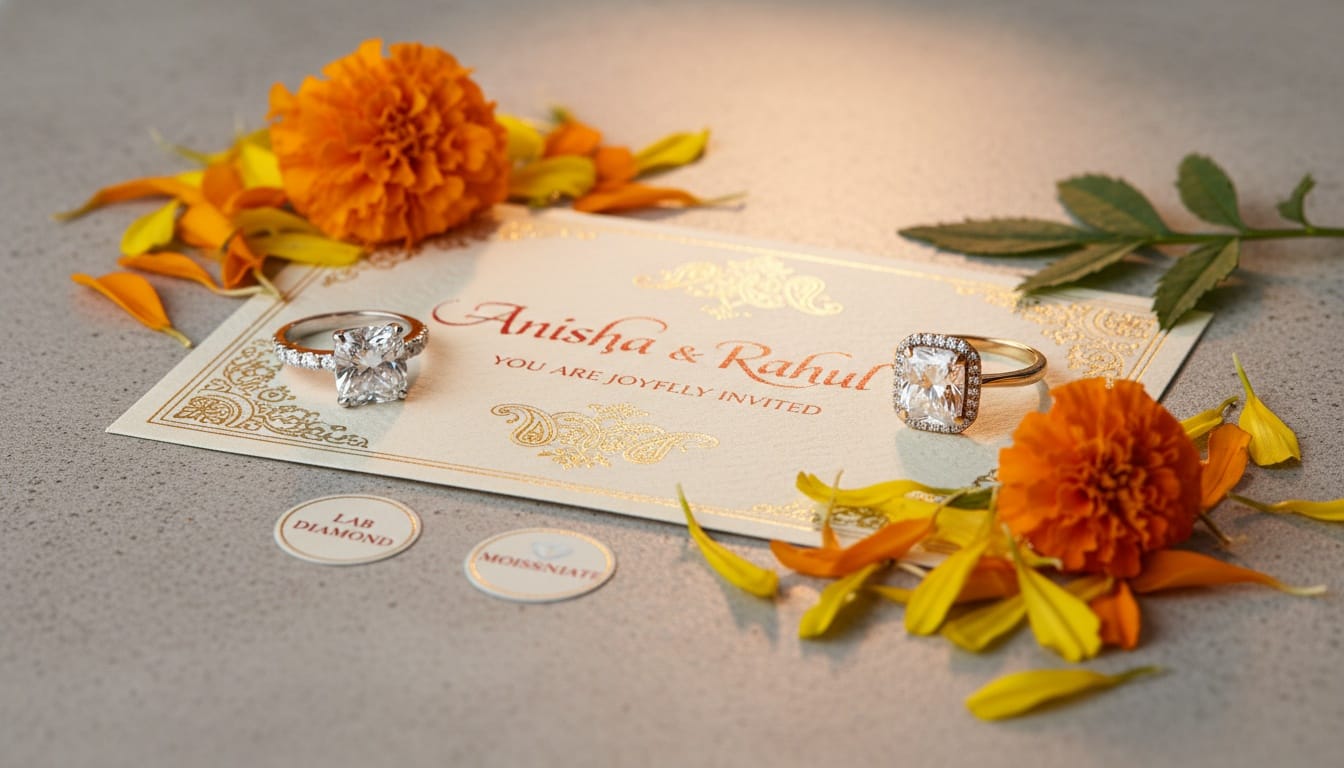
For jewellery that will be seen by a lot of relatives at shaadis and poojas, and possibly passed down:
- Lab grown diamonds work beautifully for mangalsutra pendants, bridal necklaces, bangles, and earrings because they look and behave like natural diamonds while being far more affordable.
- Moissanite can be a smart pick for larger statement pieces where you want showstopper sparkle without spending too much, for example cocktail rings or big chandelier earrings for sangeet.
You can even mix and match. Use lab diamonds for core sentimental pieces and moissanite for fun, trend driven fashion jewellery.
For everyday office, college, and casual wear
For daily wear studs, simple solitaires, stackable rings, or chains:
- Lab diamonds work perfectly if you want low maintenance, real diamond pieces that go from office to dinner to family outings.
- Moissanite is ideal if you tend to misplace jewellery or just want lots of variety at a lower cost.
Think of moissanite as the fashionable cousin of diamond that lets you experiment freely with designs, colours, and size.
Sustainability And Ethics: Which Is Kinder To The Planet
Younger Indian buyers, especially in metros, increasingly care about where their jewellery comes from.
- Lab grown diamonds avoid traditional mining and are often promoted as a lower impact alternative, though the exact footprint depends on the technology and energy source used.
- India has become a major hub for lab grown diamond production, combining local polishing expertise with modern technology.
- Moissanite is also lab created, so it similarly avoids large scale mining and is usually considered an ethical gemstone choice.
If your priority is cruelty free and more sustainable sparkle, both lab diamonds and moissanite are generally better than mined options. In that case, your decision can focus more on look and budget.
FAQs About Lab Diamonds vs Moissanite
Are lab grown diamonds real diamonds?
Yes, lab grown diamonds are real diamonds with the same chemical, physical, and optical properties as natural diamonds. They are made of pure carbon and score 10 on the Mohs scale, just like mined diamonds.
Is moissanite considered a fake diamond?
Moissanite is not fake. It is a genuine gemstone made of silicon carbide that naturally occurs in tiny quantities but is commercially grown in labs. It is often used as a diamond alternative because it looks similar from a distance, but it is a different stone.
Will people be able to tell if my stone is moissanite?
Most untrained people cannot easily tell the difference at a quick glance, especially in smaller sizes. Under strong light and in bigger stones, moissanite shows more rainbow coloured flashes and sometimes a slightly different colour tint compared to diamonds. A jeweller or gemmologist can usually tell the difference with tools.
Do lab grown diamonds have good resale value in India?
Resale for lab grown diamonds is still evolving. They usually do not hold value like very high end natural diamonds, but as awareness grows and brands focus on them, there is some secondary market interest. If investment is your top priority, mined diamonds or gold still dominate. If you want maximum look and ethical comfort for the price, lab diamonds shine.
Is moissanite safe for daily wear?
Yes. With a hardness around 9.25 on the Mohs scale, moissanite is highly resistant to scratching and is suitable for daily wear rings, pendants, and earrings. Just like any fine jewellery, it still benefits from gentle cleaning and basic care.
Which stone shines more in photos and videos?
Moissanite usually shows more dramatic sparkle and rainbow fire on camera, especially under ring lights or flash. Lab diamonds offer a more classic, elegant shine that photography also captures beautifully, but in a slightly subtler way.
Are lab diamonds and moissanite both good for men’s rings and kada designs?
Absolutely. For men’s bands, kada accents, or signet style rings, both stones work well due to their hardness and durability. Lab diamonds give a very premium traditional look, while moissanite can be a smart option if you want a bold design with minimal budget increase.