
Gold vs Silver: What Should You Buy on Akshaya Tritiya?
Most people buy blindly. Learn whether gold or silver is the smarter choice this Akshaya Tritiya. Compare value, volatility, usability, gifting, and budget tips to choose confidently.
Akshaya Tritiya has a way of making even the most practical people pause, look at a glittering display, and think, "Alright then, what's the smart buy this year?" Said to be an auspicious time for purchases and new beginnings, the festival is popularly linked with buying precious metals such as gold and silver. Rooted in the idea of "Akshaya," meaning something that doesn't diminish, many families treat the day as a symbolic reset button for prosperity and stability.
But here's the catch: the heart might whisper "go for gold," while the budget mutters "silver's not a bad deal," and the brain wants a plan that won't feel foolish a month later. Walking into this decision with a little clarity helps, especially when the goal is not just shiny shopping but a purchase that fits real life.
This guide keeps things grounded and practical, without killing the festive vibe. Whether the shopping list includes a simple coin, a wearable daily chain, a pair of earrings, or even silver accessories for the pooja room, the aim is the same: buy something meaningful, useful, and financially sensible.
Before we start, let me tell you about Eternz: a trusted jewelry marketplace featuring 300+ brands. Every piece comes with authenticity certification. They offer fast, same-day delivery in major cities, and a special "WELCOME20" discount for first-time buyers.
Akshaya Tritiya in one minute
Akshaya Tritiya falls on the third lunar day (Tritiya) of the bright half of the Hindu month of Vaishakha, and it's widely regarded as auspicious for investments and new ventures. A common tradition is purchasing gold jewellery, though many people also buy silver and other assets on the day. The core belief is simple: what is started or bought on this day is associated with lasting growth and positive outcomes.
Gold vs Silver: What Should You Buy on Akshaya Tritiya, really?
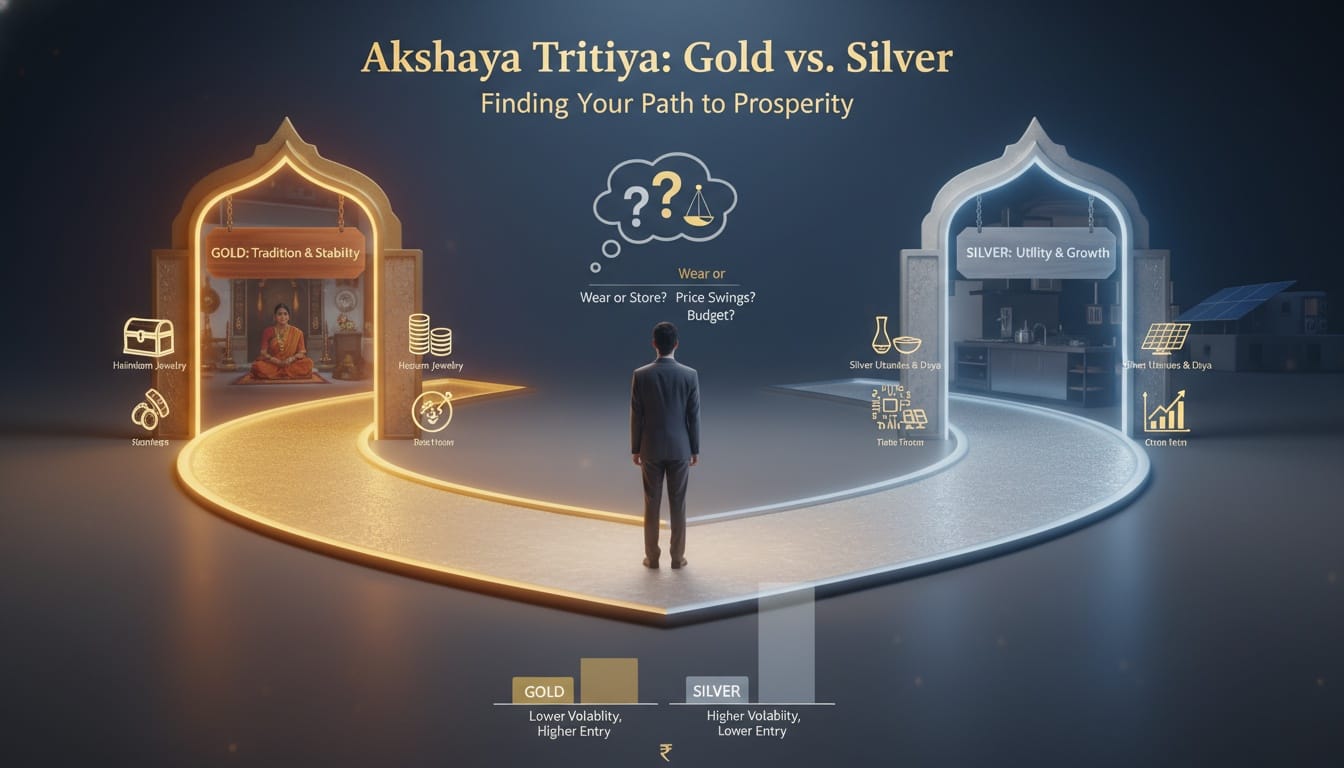
The honest answer is: it depends on what "buy" means in the first place. If "buy" means an emotional ritual, the choice can lean toward what feels most symbolic at home. If "buy" means a financial move, the choice depends on risk tolerance, time horizon, and how easily the metal can be sold later.
To keep the decision from turning into a coin flip, start with three simple questions.
- Is the priority tradition and gifting, or value and utility?
- Is the plan to wear it often, or store it and forget it?
- Is the buyer comfortable with price swings, or does steady matter more?
Answer those, and the "gold vs silver" debate starts behaving itself.
The quick comparison table
| Factor | Gold | Silver |
|---|---|---|
| Price behavior | Typically viewed as a lower-volatility precious metal compared with silver. | Often more volatile, influenced by industrial demand and a smaller, less liquid market. |
| Main demand drivers | Investment and safe-haven demand are commonly emphasized in gold narratives. | Mix of investment and industrial usage, including electronics and solar-related uses. |
| Practical usage at home | Jewellery, gifting, long-term holding | Jewellery, utensils, pooja items, décor pieces, gifting |
| Entry budget | Higher ticket size per gram | Lower entry point for meaningful quantity |
| Best fit for | Conservative buyers, long-term mindset, heirloom gifting | Budget-conscious buyers, utility-first buyers, higher risk appetite |
Why Gold Is Preferred on Akshaya Tritiya?
Gold carries a cultural "default setting" in India. It's associated with wealth, stability, and family milestones, and the buying ritual on Akshaya Tritiya often centers on gold jewellery. For many households, gold is also a practical form of portable value, because it can be worn, gifted, and sold when needed.
From an investment lens, gold is frequently discussed as a long-term hedge against inflation, even though short-term performance can vary. Academic research also explores gold's ability to hedge inflation across countries, including India, by examining whether gold prices keep pace with CPI over long periods.
When gold is the better pick
Sipping chai, staring at a spreadsheet, the "gold makes sense" verdict often shows up in these scenarios:
- Long-term holding, especially when stability matters more than upside.
- Heirloom gifting, such as a chain, bangles, or a classic coin for a child's future.
- A portfolio that already has plenty of high-volatility assets, and needs a calmer counterweight.
- A preference for items that can be worn daily, like a minimal pendant, studs, or a thin bracelet.
Gold Jewellery: Daily Wear vs Investment Value
Not all gold buying is "investment," and that's perfectly fine. Jewellery delivers a kind of daily return that a bar never will: it gets used. A well-chosen piece can become a signature, and in India's climate and work culture, lightweight pieces can be worn frequently without feeling like a production.
If the aim is to buy jewellery, the smart move is to buy pieces that feel timeless, not trend-chasing. Minimal designs in yellow gold, a clean chain, or versatile gold earrings can fit workwear, festive wear, and everything in between.
Does Gold Guarantee Returns or Inflation Protection?
Gold is often framed as protective, but it isn't a magic shield. Even the World Gold Council notes that gold can be a proven long-term inflation hedge, while short-term performance is less convincing. So if the plan is to buy today and sell next month, the mood should shift from "investment" to "timing gamble."
Why Silver Is a Good Option on Akshaya Tritiya?
Silver is the underdog that refuses to stay in the corner. It looks affordable relative to gold, it's deeply woven into Indian households through utensils and pooja items, and it has a real economic story because of industrial usage.
Unlike gold, silver demand is often described as a balance of investment and industrial consumption, including electronics and solar applications. This dual nature is also one reason silver can swing harder than gold, because it reacts not only to investor sentiment but also to industrial cycles.
Silver Price Volatility: Risks and Opportunities Explained
Multiple market explainers point out that silver can be more volatile than gold due to factors such as smaller market size, lower liquidity, and industrial demand sensitivity. BlackRock similarly notes silver's significant industrial linkage, with a large share of demand connected to electronics, solar panels, and semiconductors.
What does that mean?
- Silver can run fast in good times.
- Silver can trip in bad times.
- If nerves can't handle price swings, silver can feel like a roller coaster.
When silver is the better pick
Honestly, silver shines when practicality and quantity matter.
- A lower budget but a desire to buy something meaningful in decent volume.
- Utility purchases, such as a silver coin for gifting, a small bowl for rituals, or even a simple chain that can be worn daily.
- A buyer who understands volatility and is okay with bigger price moves.
- A household that already buys silverware or pooja accessories and wants to keep the tradition going.
Silver as a lifestyle purchase
Silver is not just "investment metal." It's also lifestyle metal.
- Pooja essentials: small kalash, diya, coins, idols.
- Home accents: minimalist bowls, candle holders, tiny décor pieces.
- Wearables: anklets, toe rings, stackable rings, oxidized earrings, chains.
The beauty is that silver allows experimentation. One can try a new aesthetic without spending a pretty penny. For deeper insights, explore why 925 sterling silver is perfect for everyday luxury in India.
Gold vs Silver: What Should You Buy on Akshaya Tritiya based on your goal
Goals matter because they stop the mind from spiraling into "but what if" territory. Choose the primary goal, then buy a metal that behaves like it.
Goal: A symbolic, auspicious purchase
If the goal is purely ritual and emotional, both metals work because the intention is what carries the day. Still, gold is the more common cultural default on Akshaya Tritiya, especially for jewellery buying.
Best fits:
- A small gold coin
- A thin gold chain or studs
- A silver coin if the budget is tighter
Goal: A wearable piece you'll actually use
If it'll sit in a locker forever, it may feel good for one day and forgettable later. For wearables, design matters more than "which metal is better."
A simple rule:
- Choose gold for evergreen daily-wear staples.
- Choose silver for playful, trend-friendly pieces and accessories.
Goal: A value-focused buy
Gold is often discussed as a strategic asset and an inflation hedge over the long term, though it is not guaranteed in the short term. Silver, on the other hand, can be more sensitive to industrial demand and therefore more volatile.
So the trade-off is straightforward:
- Gold: steadier narrative, slower drama.
- Silver: higher swings, potentially higher excitement, also higher stress.
To understand purity choices better, refer to our guide on 24k vs 22k vs 18k vs 14k gold: complete guide to choosing the right purity.
Goal: Gifting without guesswork
Gifts can go wrong in one second. Wrong size, wrong style, wrong vibe, and suddenly it's awkward.
Low-drama gift ideas:
- Gold coin in a clean, classic design
- Gold pendant with a simple motif
- Silver coin, especially for larger guest lists
- Silver accessories that don't need sizing, such as a small pooja diya or a minimalist bowl
How much should be allocated without overthinking it
Money decisions get emotional around festivals, and that's normal. Still, a few guardrails keep the purchase joyful, not regretful.
A simple budgeting checklist
Before stepping into a store or opening a digital app:
- Emergency fund first. A festival is not the time to borrow from peace of mind.
- Decide a fixed range, then stick to it.
- Keep making charges, taxes, and storage costs in view if buying jewellery.
- If buying for investment, prioritize coins or bars where applicable, and keep documentation safe.
The "two-bucket" trick
Not everything has to be either sentimental or financial. Split it.
- Bucket 1: A small auspicious buy, purely for the ritual.
- Bucket 2: A practical buy, based on budget and longer-term intent.
This approach reduces pressure and makes the decision feel intentional.
Form matters: jewellery, coin, bar, or digital?
Not all "gold" is the same, and not all "silver" buys behave the same when it's time to sell or repurpose.
Jewellery
Jewellery works best when the primary value is wearing and gifting. It can be resold, but pricing involves workmanship, making charges, and sometimes higher deductions depending on the buyback policy.
Coins and bars
Coins and bars are often chosen when the intent is clearer as "hold and sell later," because they avoid the large design cost component typical in jewellery. Still, purity, certification, and buyback terms matter. For value-focused buying, explore gold idols and coins.
Digital formats
Digital formats can offer convenience and smaller ticket sizes, but the experience is different: there's no physical ritual of holding the metal, and redemption rules vary by provider. If the family values the traditional feel of the day, physical buying often feels more aligned.
For a deeper dive into the financial trade-offs, check out Gold Coins or Jewellery: Which One Pays You Back Better?
Important Factors People Forget When Buying Gold or Silver
Here's where choices get interesting, because the best decision is usually hiding in the "small stuff."
Liquidity and resale comfort
Selling gold jewellery is common in India, but comfort depends on having bills, purity clarity, and understanding deductions. Silver items can also be sold, though resale value depends heavily on form, purity, and local market practice.
Storage and safety
Gold is compact and high value, so storage is a serious consideration. Silver takes up more space for the same "value," which can be a plus or a nuisance depending on the household.
Everyday utility
Silver has a strong utility angle in Indian homes, especially via utensils and ritual objects. Gold's utility tends to show up primarily through jewellery and gifting traditions.
A decision framework that won't make your head spin
Walking into Akshaya Tritiya purchases with a framework is like carrying an umbrella in Bengaluru. It may not stop the rain, but it keeps the chaos manageable.
Step 1: Choose the primary purpose
Pick one:
- Ritual and symbolism
- Wear and style
- Long-term value holding
- Gifting
Step 2: Choose the metal that matches your temperament
Prefer stability and fewer shocks: lean gold.
Comfortable with bigger swings and industrial-linked moves: consider silver.
Step 3: Choose the form that matches the purpose
For daily wear: jewellery
For storing value: coins or bars
For gifting broadly: smaller coins or silver items that don't require sizing
Step 4: Choose design like a minimalist
Dangling in the window display, the trendiest piece may look tempting, but timeless designs age better.
- If buying gold jewellery, choose classic lines, minimal motifs, and versatile sizing.
- If buying silver jewellery, experiment, but still keep at least one piece simple enough for repeat wear.
Common buying mistakes, and how to dodge them
Even smart buyers make silly mistakes during festive shopping because excitement takes the wheel.
- Buying for "investment" but choosing heavy, highly designed jewellery with high making charges.
- Ignoring buyback policies and documentation.
- Choosing a style that doesn't match actual daily life.
- Going all in on silver without accepting that it can be more volatile than gold.
A calmer approach: decide first, shop second.
Conclusion
Gold and silver both fit Akshaya Tritiya beautifully, but they play different roles in a real-world plan. Gold tends to suit long-term stability narratives and traditional gifting, and it is frequently discussed as a long-term inflation hedge even though short-term moves can vary. Silver can feel more accessible and more "usable," and its industrial-linked nature can bring sharper price swings, which can be rewarding or nerve-racking depending on temperament.
So, rather than asking which metal is "best," it's wiser to ask which metal matches the purpose. With a clear goal, a realistic budget, and a form that fits the intent, the purchase becomes more than a ritual. It becomes a choice that feels right on the day, and still feels right when the festival lights are long gone.
Frequently Asked Questions
1. Is Akshaya Tritiya only about buying gold?
Akshaya Tritiya is popularly associated with buying gold jewellery, but many people also buy silver and other assets on the day.
2. Why do people buy precious metals on Akshaya Tritiya?
The day is widely considered auspicious for new beginnings and investments, and the word "Akshaya" is linked with something that does not diminish, which supports the belief that purchases made then invite lasting prosperity.
3. Is silver more volatile than gold?
Several market explainers highlight silver's higher volatility, often linking it to a smaller market, lower liquidity, and sensitivity to industrial demand compared with gold.
4. Does gold always protect against inflation?
Gold is described by the World Gold Council as a proven long-term inflation hedge, while also noting that short-term performance can be less convincing.
5. What's better for gifting on Akshaya Tritiya, gold or silver?
Gold coins and simple gold jewellery are common gifting choices, while silver coins and utility items can work well for broader gifting budgets.
6. Is it smarter to buy coins than jewellery?
Coins can align better with a value-holding intent because jewellery pricing often includes making charges, while jewellery can be smarter when the goal is frequent wear and personal use.
7. How to choose if the budget is limited?
A smaller gold coin or a durable silver coin can preserve the auspicious intent, while leaving room in the budget for essentials and long-term goals.
8. What is the significance of buying silver idols or pooja items?
Silver pooja items such as kalash, diya, and idols are considered pure and auspicious for rituals. They combine spiritual value with the tangible benefit of owning a precious metal.
9. Can I wear silver jewellery daily without damage?
Yes, sterling silver can be worn daily, but it requires regular cleaning to prevent tarnish. For low-maintenance daily wear, stainless steel or gold may be better options.
10. How do I verify the purity of gold and silver bought online?
Look for BIS Hallmark on gold and 925 stamp on silver. Reputable platforms like Eternz provide authenticity certificates and detailed purity documentation for every purchase.