Origin of Rakhi: 7 Ancient Legends and Historical Stories
Explore the origin of Rakhi and the Krishna and Draupadi story through these ancient legends. Learn why this bond is celebrated today and read more now!
Raksha Bandhan is an ancient Indian festival that celebrates the deep bond of love and protection between brothers and sisters. The origin of Rakhi traces back thousands of years through sacred Hindu texts and historical events that show how a simple thread can create a lifelong promise. This festival happens on the full moon day of the Shravana month and serves as a reminder that family and loyalty are the strongest shields in the world.
The Meaning of the Sacred Thread
Raksha Bandhan means the bond of protection where a sister ties a thread on her brother’s wrist to pray for his long life. In return, the brother gives a gift and promises to stand by her through every difficulty. While it is mostly known as a sibling festival today, the ancient stories show that anyone could tie a Rakhi to seek help or offer protection.
Shop rakhis online at Eternz in 925 certified silver, BIS hallmarked gold, and designer styles from top brands, with fast delivery across India.
Not sure what to pick? Explore the complete Raksha Bandhan collection featuring Rakhis, gifts, hampers, jewellery, and more for brothers, sisters, bhabhi, and kids.
In ancient times, Rakhi was not just for siblings. It was a "Raksha Sutra" or a protective charm. Priests tied it to kings, and wives tied it to husbands before they went to war. The core idea is that the person wearing the thread is being shielded by the prayers of the person who tied it.
1. The Krishna and Draupadi Story: A Bond of Infinite Protection
The Krishna and Draupadi story is the most famous legend explaining why brothers are expected to protect their sisters at any cost. It began during a royal ceremony when Lord Krishna cut his finger while handling a sharp object or fighting an enemy. While others rushed for medicine, Draupadi immediately tore a strip from her expensive silk sari and tied it around his finger to stop the bleeding.
Touched by her quick action and love, Krishna promised to protect her whenever she was in trouble. This promise was kept during the public shaming of Draupadi in the royal court of the Kauravas. When they tried to pull away her clothing, Krishna used his divine powers to make her sari never-ending. This story shows that the value of a Rakhi is not in the material of the thread but in the heart of the person who ties it.
| Feature of the Story | Details |
|---|---|
| Main Characters | Lord Krishna and Princess Draupadi |
| The "Rakhi" | A torn piece of a silk sari |
| The Crisis | Krishna's bleeding finger |
| The Reward | Infinite protection during the Vastraharan |
| Moral | A small act of kindness leads to divine protection |
Notice that Draupadi and Krishna were not biological siblings. This teaches us that the spirit of Raksha Bandhan goes beyond blood relations. It is about the "chosen family" and the promises we make to those we care about.
2. King Bali and Goddess Lakshmi: A Lesson in Humility
The legend of King Bali and Goddess Lakshmi explains how the festival became a way to invite prosperity and safety into a home. After King Bali won over the three worlds, Lord Vishnu became his gatekeeper in the underworld as a reward for the King’s devotion. This left Goddess Lakshmi, Vishnu’s wife, very lonely in her heavenly home.
To get her husband back, Lakshmi disguised herself as a poor woman and went to King Bali. She tied a thread on his wrist and prayed for his well-being. When Bali asked what she wanted as a gift, she revealed who she was and asked for the return of Lord Vishnu. Bali, being a man of his word, honored the bond of the thread and let Vishnu go. Since then, it has been a tradition to tie Rakhi to seek protection and luck.
3. The Birth of Santoshi Mata: The Sister Ganesha Created
The story of Santoshi Mata describes how Lord Ganesha’s sons felt left out during Raksha Bandhan celebrations. Ganesha’s sister, Mansa Devi, used to visit him and tie a Rakhi on his wrist. Seeing this, Ganesha's two sons, Shubh and Labh, started crying because they did not have a sister to tie a thread on them.
To make his sons happy, Ganesha created a daughter from divine flames. This daughter was named Santoshi Mata, the Goddess of Satisfaction. Her birth allowed Shubh and Labh to celebrate the festival with their own sister. This legend highlights the emotional importance of having a sibling to share traditions with.
4. Yama and Yamuna: The Promise of Immortality
The story of Yama, the God of Death, and his sister Yamuna is one of the oldest historical Rakhi stories found in the Puranas. It is said that for many years, Yama did not visit his sister. When he finally went to see her, Yamuna was so happy that she prepared a feast and tied a thread on his wrist.
Yama was so moved by her love that he declared that any brother who receives a Rakhi from his sister on this day will be blessed with a long life. He also promised that such brothers would be protected from the fear of death. This is why the festival is seen as a way to pray for the health and longevity of brothers.
| Symbol | Meaning in Yama-Yamuna Story |
|---|---|
| The Thread | A shield against the end of life |
| The Feast | Sharing abundance and happiness |
| The Tilak | A mark of victory and protection |
| The River | Yamuna's eternal flow of love |
The river Yamuna is still worshipped today. People believe that bathing in its waters on holy days cleanses the soul. The bond between the river (sister) and death (brother) shows that love is more powerful than the end of life itself.
5. Alexander the Great and King Puru: A Queen’s Strategy
Historical records suggest that Rakhi played a role even in international politics during the invasion of India by Alexander the Great. In 326 BCE, Alexander’s wife, Roxana, was worried about her husband’s safety in the battle against the brave Indian King Puru (Porus). She had heard about the sacred tradition of the Rakhi thread.
Roxana sent a Rakhi to King Puru, asking him not to harm her husband on the battlefield. King Puru, following the code of the thread, respected the bond. During the heat of the battle, when he had the chance to strike Alexander, he saw the Rakhi on his own wrist and stopped. This story proves that the tradition was respected even by rival kings.
6. Rani Karnavati and Emperor Humayun: A Call for Help
The story of Rani Karnavati and Emperor Humayun is a famous example of how Rakhi was used to bridge different religions and cultures. In the 16th century, Rani Karnavati of Chittor was facing an invasion by the Sultan of Gujarat. Realizing she could not win alone, she sent a Rakhi to the Mughal Emperor Humayun.
Even though they were from different backgrounds, Humayun was touched by the gesture. He immediately set out with his army to protect his "sister." Although he arrived a bit late, he honored the bond by restoring the kingdom to Karnavati’s son. This story is taught in schools to show that a Rakhi creates a family bond that goes beyond religion.
Historians sometimes debate the exact details of this story, but its impact on Indian culture is huge. It teaches us that "Raksha" or protection is a duty that anyone can take up for someone who asks for help.
7. Lord Indra and Sachi: The First Raksha Sutra
In the most ancient Vedic times, the first "Rakhi" was actually not between a brother and sister. According to the Bhavishya Purana, the gods were losing a long war against demons. Lord Indra, the King of Gods, was worried about their defeat. His wife, Sachi, decided to help.
She prepared a sacred thread with her divine powers and tied it to Indra’s wrist. This thread gave him the strength and protection he needed to win the war. This original version of the story shows that the thread was meant to be a general charm for success and safety against evil. Over hundreds of years, this practice changed into the sibling festival we see today.
How to Celebrate Raksha Bandhan Traditionally
Celebrating Rakhi involves several small steps that make the day special. It is not just about the gift; it is about the ritual that strengthens the family connection. Here are the common steps followed in most Indian households:
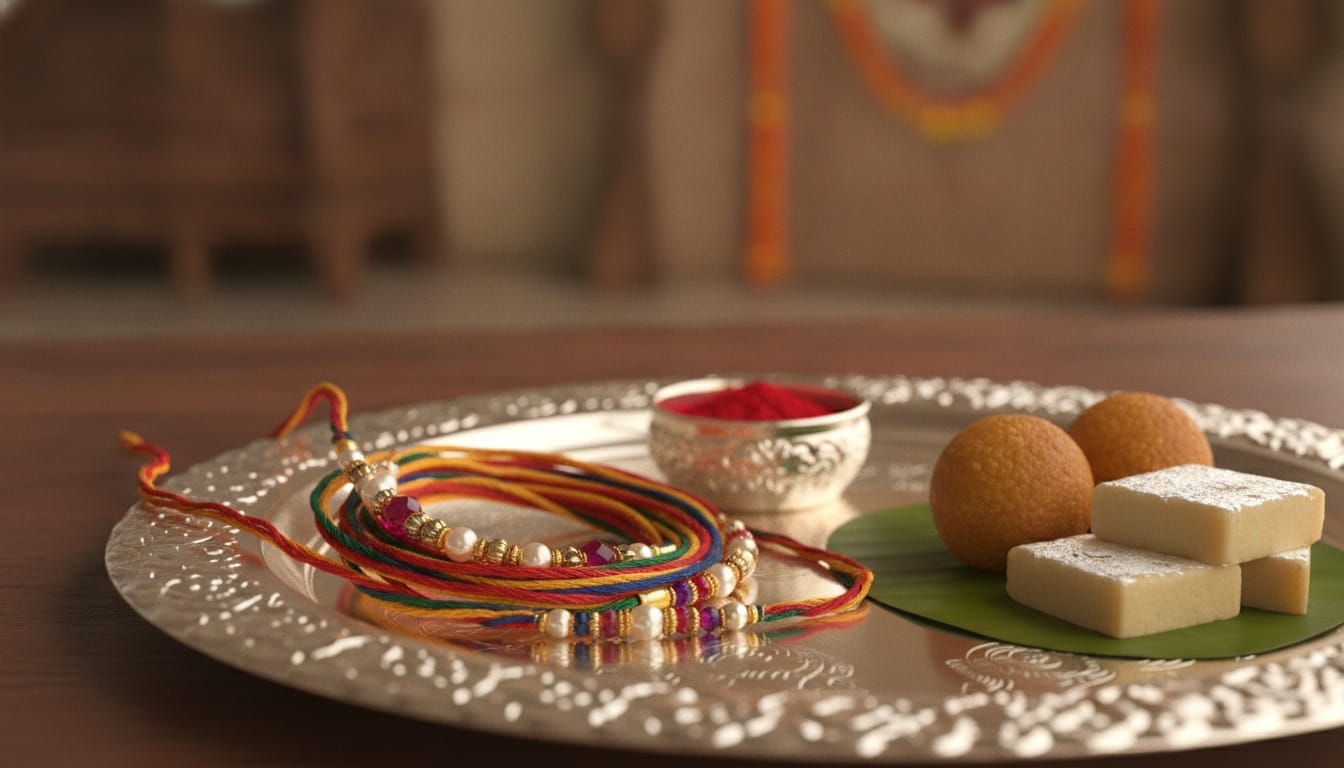
- Preparation: The sister prepares a "Thali" (plate) with a Rakhi, a diya (lamp), rice grains, and sweets.
- The Tilak: She applies a red mark on the brother’s forehead for good luck.
- The Thread: She ties the Rakhi on his right wrist while chanting prayers for his safety.
- The Sweetness: She feeds him a piece of sweet to signify a sweet relationship.
- The Vow: The brother gives her a gift and promises to protect her always.
| Ritual Item | What it Represents |
|---|---|
| Rakhi Thread | The unbreakable bond of love |
| Diya (Lamp) | Removing the darkness of troubles |
| Rice (Akshat) | Prosperity and growth |
| Sweets | The joy and happiness of family |
Modern Traditions and Global Reach
Today, Rakhi has moved beyond just simple threads. People now use designer Rakhis made of silver, gold, or even eco-friendly seeds. For siblings who live far apart, the digital world has made it easy to send Rakhis across the globe. You can now send a thread from one country to another with just a few clicks.
Even the roles have changed. In many modern families, sisters tie Rakhis to each other, or brothers tie them to sisters. This reflects the idea that protection is a two-way street. Anyone who protects you and cares for you can be your "Rakhi brother" or "Rakhi sister."
Why These Legends Still Matter Today
These seven legends are not just old stories; they are the foundation of how we treat our loved ones. They teach us about sacrifice, keeping our word, and looking beyond our differences. Whether it is Krishna helping Draupadi or a Queen asking an Emperor for help, the message is the same: kindness and protection are the greatest gifts.
By understanding the origin of Rakhi, we realize that the festival is a celebration of humanity. It tells us that no matter how hard life gets, there is always someone who has our back. The thread is a physical reminder of that spiritual support.
To understand how these legends shaped the festival we celebrate today, explore our complete guide to Raksha Bandhan history, rituals, and traditions.
The beauty of Raksha Bandhan is its simplicity. You do not need expensive jewelry or grand parties to celebrate it. A simple piece of string is enough to carry the weight of a lifelong promise.
Finding the Perfect Rakhi and Gift
Choosing a Rakhi today is an expression of the brother’s personality. Some prefer simple cotton threads, while others like something more permanent like a bracelet. When looking for high-quality gifts and authentic jewelry to mark this special occasion, it is important to choose brands that understand the value of tradition and modern style.
For those looking to make this Raksha Bandhan truly unforgettable, Eternz offers a curated collection of jewelry from over 400+ trusted brands. Whether you are looking for a silver Rakhi or a special gift for your sister, you can find something authentic and beautiful.
Eternz provides an authenticity certification for all its products, so you know you are getting the real deal. If you are unsure how a piece will look, you can use their "Virtual Try-on" feature to see it on yourself before buying. For those in a hurry, same day delivery is available in major cities including Bengaluru, Delhi, Noida, and Mumbai. Use the code "ETERNZ300" to get a discount on your first order and start a new tradition of elegance.
Final Thoughts on the Spirit of Rakhi
Raksha Bandhan is a bridge between the past and the future. By following the ancient legends of Krishna, Bali, and Karnavati, we keep our culture alive. At the same time, by adapting the festival to our modern lives, we make sure it stays relevant for the next generation. It is a day to stop, say thank you to our siblings, and remember that we are never truly alone as long as we have this bond.
Frequently Asked Questions
1. What is the significance of the Krishna and Draupadi story in Raksha Bandhan?
In this legend, Draupadi tied a piece of her sari on Lord Krishna's wounded finger. Krishna, moved by her gesture, promised to protect her, later saving her during the Vastraharan.
2. How did King Bali and Goddess Lakshmi influence the origin of Rakhi?
Goddess Lakshmi tied a thread on King Bali's wrist to ask for the return of her husband, Lord Vishnu. This story highlights the festival as a way to invite prosperity and safety.
3. Are there any historical Rakhi stories involving international figures?
Yes, history records that Roxana, wife of Alexander the Great, sent a Rakhi to King Puru to ensure her husband's safety, a bond the Indian King respected in battle.
4. What is the origin of the first Raksha Sutra according to mythology?
According to the Bhavishya Purana, Sachi, the wife of Lord Indra, tied a protective thread on his wrist to grant him strength and protection during a divine war against demons.
5. Why is Raksha Bandhan celebrated on the full moon day of Shravana?
Raksha Bandhan is observed on the full moon day (Purnima) of the Hindu month of Shravana. Ancient Hindu traditions associate this day with protective rituals and the tying of sacred threads, making it an auspicious occasion for celebrating bonds of care and protection.
6. Is Raksha Bandhan only celebrated between biological brothers and sisters?
No. The festival has evolved beyond biological sibling relationships. Many legends, including those of Krishna and Draupadi and Lakshmi and King Bali, show that Rakhi can symbolize protection, affection, and mutual respect between people who are not related by blood. Modern celebrations often include cousins, friends, and other meaningful relationships.
7. What is the difference between Rakhi and Raksha Sutra?
A Raksha Sutra is a sacred protective thread used in Vedic rituals and religious ceremonies. A Rakhi is a specific form of Raksha Sutra tied during Raksha Bandhan to symbolize love, protection, and commitment between siblings and loved ones.
8. Which is the most popular legend associated with the origin of Rakhi?
The most widely known Raksha Bandhan legend is the story of Lord Krishna and Draupadi. Their bond demonstrates that even a small act of compassion can create a lifelong promise of protection, making it one of the most cherished stories connected to the festival.