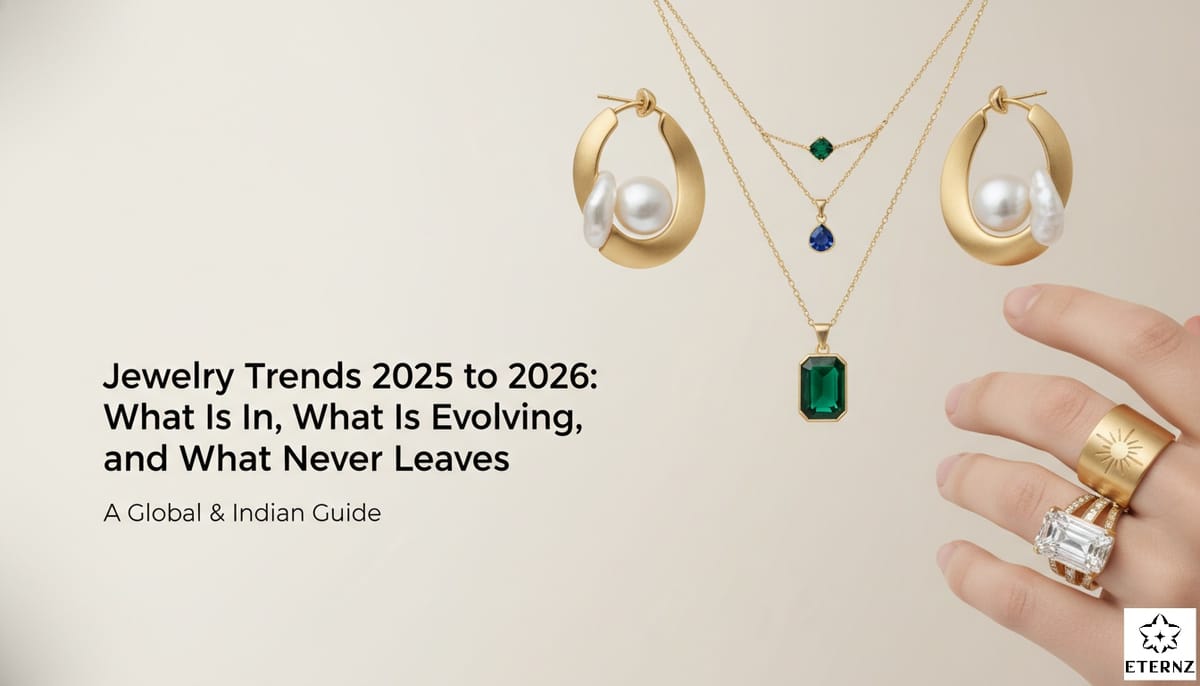
Jewelry Trends 2025 to 2026: What Is In, What Is Evolving, and What Never Leaves
Explore the top jewelry trends 2025 to 2026. From colored gemstones and baroque pearls to lab-grown diamonds, discover which styles to invest in and enjoy now!
TL;DR: The Quick Look at 2025-2026 Jewelry
- The Big Shift: Colored gemstones (Emerald, Sapphire, Amethyst) are replacing the "all-diamond" look.
- Pearls Reborn: Forget the round strands; baroque shapes and mixed metals are the new standard.
- India's Movement: Lightweight gold (18K) for office wear and lab-grown diamond mangalsutras are dominating.
- The "Forever" Pieces: Gold studs, hoops, solitaires, and jhumkas remain the safest investments.
- Smart Strategy: Spend your main budget on timeless constants and use smaller amounts for seasonal trends.
What We Cover
- Why 2025 to 2026 is a particularly interesting moment for jewelry trends
- The three trend categories: what is in, what is evolving, and what never leaves
- Global jewelry trends driving demand right now
- Indian jewelry trends: what is changing and why
- The timeless pieces that belong in every wardrobe regardless of trend
- Invest vs enjoy: how to spend with the trend cycle in mind
- Quick reference trend guide
- FAQs
Why 2025 to 2026 is a Turning Point for Jewelry
The jewelry market in 2025 to 2026 is not following the simple maximalism-minimalism pendulum that has governed trend cycles for decades. Something more interesting is happening.
Two aesthetics are growing simultaneously: bold, expressive, maximalist jewelry driven by social media and a collective desire to be seen, and quiet luxury fine jewelry driven by a preference for quality over quantity and permanence over trend. These are opposite impulses, and both are growing at the same time.
The result is a market where a woman in the same city might be buying a bold sculptural statement earring for Saturday and a slim diamond pendant for Monday, and both decisions feel equally current. This dual-track trend environment is the context for everything that follows.
Understanding both tracks, and where you personally sit between them, is the most useful thing this guide can give you before any trend list.
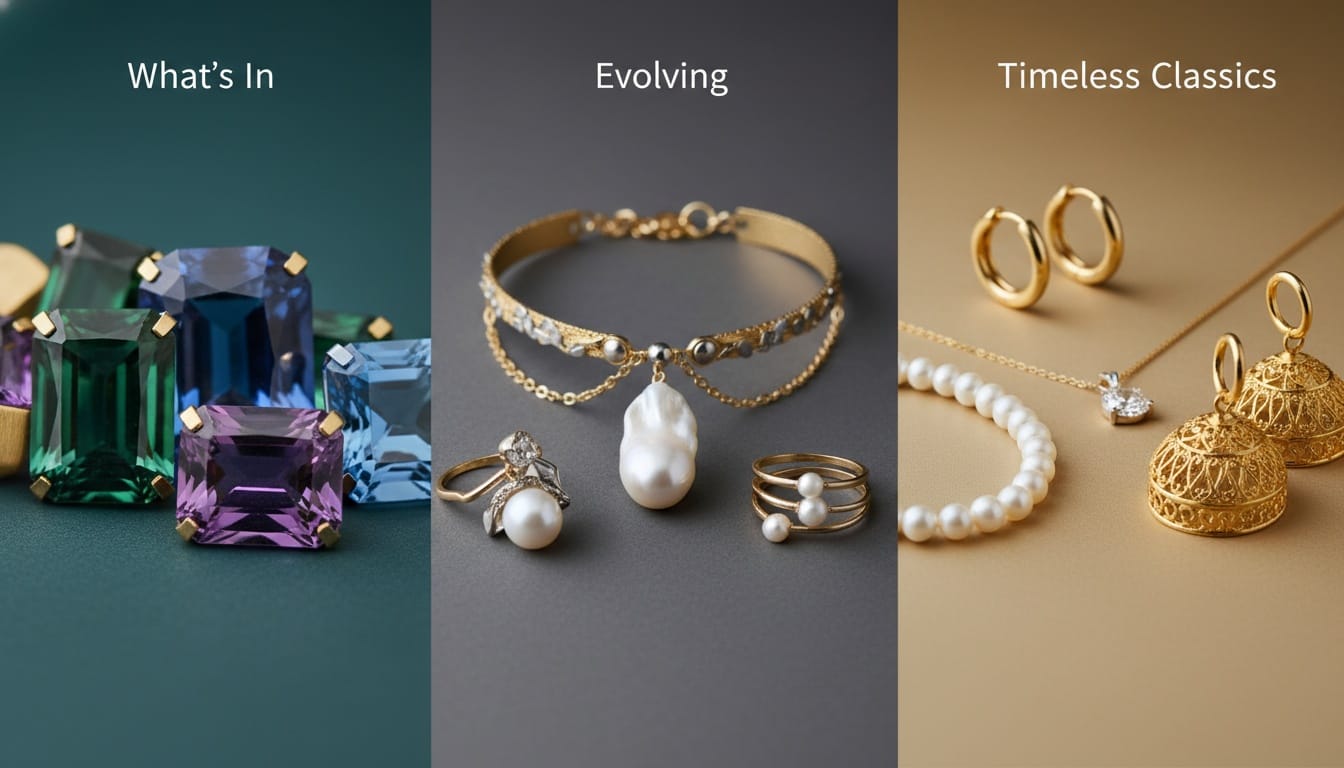
Track One: What Is In Right Now (2025-2026)
These are the jewelry trends with the highest current momentum. They are widely visible across runways, social media, e-commerce, and retail. Some will evolve into something more lasting. Others will peak and pull back. The guide to handling each one is in the invest-vs-enjoy section at the end.
1. Colored Gemstones Are Leading
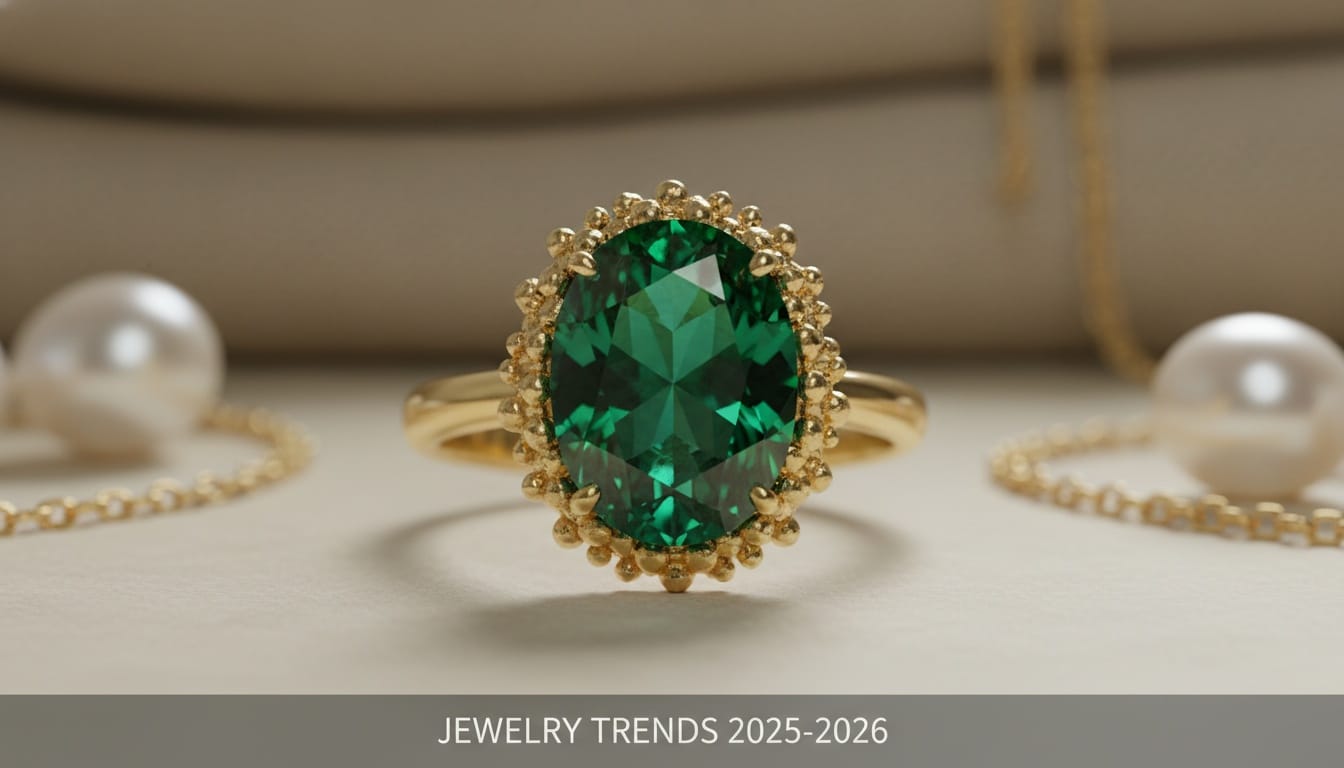
Rich greens, deep blues, and stunning purples are leading the gemstone moment in 2026, with green gemstones particularly prominent in yellow gold settings that feel both timeless and distinctly modern.
This shift away from all-diamond toward colored stone jewelry is the most significant design movement in fine jewelry in the last decade. Emerald, sapphire, amethyst, tourmaline, and rubellite are appearing in earrings, rings, and pendants at every price point, from genuine stones in fine jewelry to high-quality CZ and synthetic alternatives in fashion jewelry.
Why this trend has staying power: Colored gemstones are not a new idea. They were dominant before the diamond industry established the all-diamond engagement ring as the cultural standard in the mid-20th century. Their return reflects a broader desire for personal expression over convention, which is a durable cultural shift, not a passing aesthetic preference.
Best entry points for this trend: Emerald or blue sapphire drop earrings in gold settings, a gemstone pendant in your preferred color, or a colored stone ring as an alternative to an all-diamond design.
2. Pearls in Every Form Except the Traditional Strand
Pearls are one of the clearest examples of a timeless material being refreshed by contemporary styling. In 2026, pearls are popular but no longer about single strands of identical pearls. Designers are using various sizes and shapes in a single piece, contrasting them against other materials and gemstones, including misshapen baroque pearls.
Pearl chokers, pearl-and-chain combinations, baroque pearl drop earrings, and single pearl pendant necklaces on thin chains are all performing strongly. The pearl has moved from grandmother's jewelry to one of the most versatile and sought-after materials across every age group.
For the Indian market: Pearl jhumkas and pearl mangalsutras have been culturally significant for decades. The contemporary pearl trend actually validates what Indian jewelry has understood for centuries: that pearls suit every skin tone and every occasion.
3. Sculptural and Statement Earrings
Oversized tailoring and dramatic necklines in fashion are making space for bold collar necklaces, sculptural earrings, and chunky cuffs in jewelry.
Sculptural earrings, pieces with architectural forms, abstract shapes, or three-dimensional construction, are one of the strongest earring trends running through 2025 into 2026. They sit at the intersection of art and jewelry and have moved from editorial fashion into mainstream fine and fashion jewelry.
What makes them wearable: The best sculptural earrings are lightweight despite their visual scale. Hollow metal construction and resin-backed designs create bold visual presence without the physical weight that makes large earrings uncomfortable for daily wear.
4. Layered Chains and Curated Stacking
Fashion editors have embraced the layered chain moment, mixing lengths, link styles, and metal finishes to create a curated effect that appears collected over time rather than purchased as a set.
Stacking is not new, but the approach has matured. The current version is more intentional and less maximalist than the stacking trend of the early 2010s. The goal is a look that appears assembled thoughtfully over years rather than purchased as a coordinated set.
This applies equally to necklaces (two to three chains at different lengths), rings (stacking rings across multiple fingers), and bracelets. Anklet stacking, as covered separately on Eternz, follows the same curated logic.
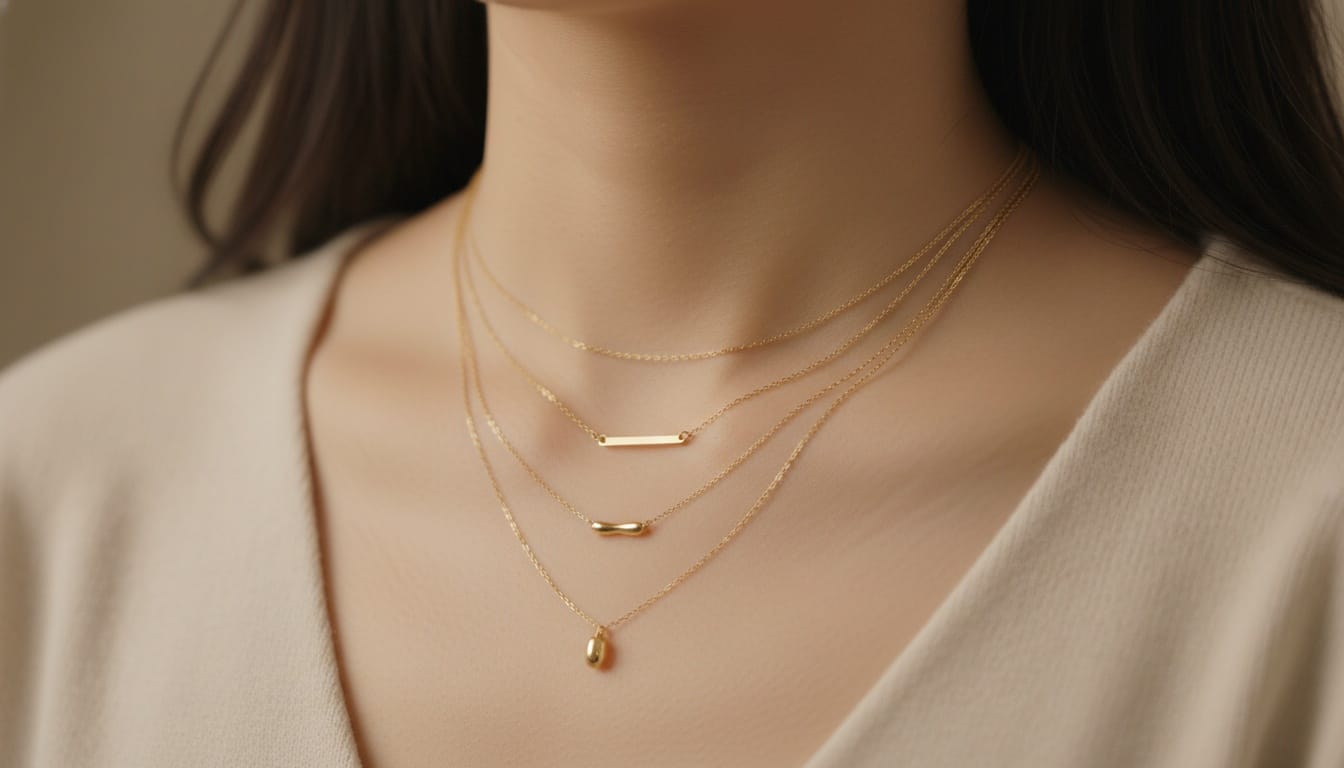
If you're just getting started, this necklace layering guide for 2026 walks you through length combinations, metal mixing, and how to avoid the tangled mess most people worry about.
5. Personalized and Meaningful Jewelry
In 2026, the most resonant jewelry tells an individual story. Name necklaces, custom engravings, and birthstone jewelry transform beautiful objects into meaningful keepsakes, going beyond trends to become modern heirlooms.
The demand for personalized jewelry has accelerated significantly, driven partly by social media (personalized pieces photograph exceptionally well) and partly by a genuine cultural shift toward jewelry with personal meaning rather than generic luxury.
Initial pendants, birthstone earrings, coordinate-engraved bracelets, and date-stamped rings are all high-demand categories across every price point.
6. Heirloom and Vintage-Inspired Designs
Heirloom jewels are trending once more, with antique burnished-gold settings, Art Deco designs, and post-modern silhouettes all gaining momentum. Taylor Swift's vintage-inspired engagement ring singlehandedly brought the spotlight back to ornate and decorative designs in 2025.
The heirloom trend is significant for Indian jewelry specifically because it validates the heritage craft revival already underway. Polki, kundan, and temple jewelry are being reappraised not as old-fashioned but as genuinely irreplaceable craft traditions that no mass-produced contemporary piece can replicate.
7. Gender-Fluid and Unisex Jewelry
Unisex signet rings, adjustable cuffs, and minimalist chain designs are leading the gender-fluid jewelry trend, with titanium and ceramic materials popular for their versatility and wearability.
Men's jewelry is one of the fastest-growing segments in the global jewelry market. Gold chains, karas, signet rings, and earrings for men are all growing in demand, driven by a broader cultural acceptance of jewelry as a personal expression tool regardless of gender.
In the Indian context: Men wearing gold and silver kadas, chains, and earrings has a long cultural history across many communities. The current trend is not introducing this to India. It is making it more visible and more widely accepted across demographics that had moved away from it.
Track Two: What Is Evolving
These trends from 2024 to 2025 have not peaked. They are maturing into something more refined and potentially more lasting.
Chokers: Chokers are still very much in style in 2026, though they are evolving to meet other rising jewelry trends, including pearl chokers and more refined interpretations. The velvet-and-chunky-chain choker of the 1990s revival has given way to slim diamond-set chokers, pearl chokers, and delicate gold close-fitting chains. This maturation toward refinement suggests the choker is moving from trend toward lasting wardrobe piece.
Maximalism: The maximalist aesthetic that surged in 2025, driven partly by TikTok, is sticking around in 2026 but in more mature interpretations. These lasting trends demonstrate that truly resonant design has a lasting impact across multiple seasons. The implication is that the boldest maximalist pieces are past their peak, while thoughtful, high-quality statement jewelry continues to grow.
Celestial motifs: Celestial motifs including stars, moons, and sunbursts are still present but are being paired with futuristic settings and cleaner lines, less whimsical and more refined. The trend is maturing rather than fading.
Indian Jewelry Trends 2025 to 2026
The Indian jewelry market has its own trend dynamics that run parallel to, but distinct from, global western trends. These are the three shifts with the most momentum right now.
Lightweight Gold for Daily Wear
The most commercially significant trend in Indian jewelry is the shift from heavy traditional gold toward lightweight, wearable designs for everyday use. Working women, particularly in urban professional environments, want pieces that can go from an office meeting to a family dinner without switching.
Lightweight gold jhumkas, slim gold chains with minimal pendants, and delicate gold bangles at 18K rather than 22K are all growing in this segment. The cultural shift here is meaningful: gold is no longer reserved for festivals and occasions. It is a daily accessory for a growing segment of Indian women.
Lab-Grown Diamonds Making Diamond Jewelry Accessible
Lab-grown diamonds are chemically, optically, and physically identical to mined diamonds. They are graded on the same 4C standards (cut, clarity, color, carat). The price difference ranges from 60 to 80 percent lower than equivalent mined diamonds.
In India, this has opened the diamond jewelry market to a significantly broader income segment. Lab-grown diamond mangalsutras, stud earrings, and pendants are growing at a rate that is reshaping the accessible fine jewelry category.
The practical implication: A budget that would have purchased a very small mined diamond stud can now buy a noticeably larger lab-grown diamond in the same quality grade. For everyday jewelry and gifting, this is a genuine value shift worth understanding.
Before you buy, it helps to understand exactly how lab-grown diamonds compare to natural and mined stones — the differences in grading, origin, and resale value are worth knowing.
Heritage Craft Revival: Polki, Kundan, and Meenakari
Globally, the heirloom trend is pushing consumers toward vintage and artisan jewelry. In India, this manifests as a renewed and growing appreciation for heritage craft techniques. Polki (uncut diamond), kundan (uncut gemstone in gold foil), and meenakari (enamel on gold) are all seeing increased demand, particularly in the bridal and premium festive segments.
Designers like Sabyasachi have spent two decades building the cultural case for these craft traditions as high-value, aspirational choices. The market has responded. Brides who ten years ago would have chosen contemporary diamond-and-gold bridal sets are increasingly choosing polki or kundan sets as more distinctive, more personal, and more culturally meaningful choices.
If you're deciding between the two for a bridal or festive purchase, this detailed breakdown of polki vs kundan covers the craft differences, pricing logic, and which one holds value better over time.
What Never Changes: The Timeless Constants
Trends are seasonal. The constants are structural. These five categories have existed at the center of every jewelry wardrobe through every trend cycle for the last hundred years and will continue to do so.
1. Gold stud earrings: Diamond, pearl, or plain gold ball studs have not experienced a single period of irrelevance in recorded jewelry history. They remain the most purchased earring type globally year after year.
2. Hoop earrings in gold or silver: Archaeologically present since 2500 BCE, culturally relevant across every decade of the 20th and 21st centuries, and currently at their highest search volume in years. Hoops are not a trend. They are a category.
3. Solitaire diamond jewelry: Whether in earrings, pendants, or rings, the solitaire diamond remains the fine jewelry benchmark against which all other designs are measured. No trend cycle has displaced it.
4. Pearl jewelry at every price point: From freshwater pearl studs to South Sea pearl strands, pearl jewelry has been relevant in Indian and global jewelry without interruption for thousands of years.
5. Gold jhumkas (Indian market): The jhumka has maintained its structural design for over 1,600 years across the Indian subcontinent. It adapts in material and embellishment level across every era, but the bell-shaped form has never been replaced.
These five are not just investment-safe choices. They are the foundation of any jewelry wardrobe, and building them before spending on trend pieces is always the right order.
Invest vs Enjoy: How to Spend With the Trend Cycle in Mind
The most practical application of trend knowledge is knowing where to spend and where to save.
Invest (spend more, expect long wear):
- Colored gemstone earrings in genuine stones and gold settings: the gemstone trend is building toward something more lasting, and a well-made piece will carry forward
- Pearl jewelry in any form: pearls are in their strongest cultural moment in decades and the trend is maturing rather than peaking
- Personalized pieces with genuine meaning: name, date, birthstone. These transcend trend entirely
- Any of the five timeless constants listed above
Enjoy for the season (buy at an appropriate price point, wear fully, move on):
- The boldest, most maximalist sculptural earring designs: buy the fashion version rather than committing a fine jewelry budget to the peak of a trend
- Heirloom-inspired vintage replicas: beautiful for the moment, but the specific trend will evolve
- Gender-fluid unisex pieces at the fashion jewelry tier before committing to fine versions
- The most extreme versions of any current trend
The general rule: The further a trend is from peak, the safer the investment. A colored gemstone earring that felt early two years ago is now a sound purchase. The most-talked-about, most-viral piece of the moment is the one to buy inexpensively.
If you want to explore jewelry across all of these trend categories in one place, Eternz brings together 350+ brands including Giva, Palmonas, and Kushal's, covering everything from contemporary lab-grown diamond mangalsutras and pearl drop earrings to heritage polki and kundan bridal sets.
Quick Reference: 2025 to 2026 Jewelry Trends
| Trend | Status | India Relevance | Invest or Enjoy |
|---|---|---|---|
| Colored gemstones | Peak and building | High (emerald, sapphire in gold) | Invest |
| Baroque and reinterpreted pearls | Peak and maturing | High (pearl jhumkas, mangalsutras) | Invest |
| Sculptural statement earrings | Peak | Moderate | Enjoy (fashion tier) |
| Layered chains and stacking | Maturing | High (necklace, anklet stacking) | Invest |
| Personalized jewelry | Growing | High (name necklaces, birthstone) | Invest |
| Heirloom and vintage-inspired | Growing | Very high (polki, kundan revival) | Invest |
| Gender-fluid unisex jewelry | Growing | High (men's chains, karas) | Enjoy (fashion tier first) |
| Chokers (refined versions) | Maturing | High (Indian choker sets) | Invest |
| Lightweight gold daily wear | Growing (India-specific) | Very high | Invest |
| Lab-grown diamonds | Growing fast | High (mangalsutra, studs) | Invest |
| Heritage craft revival | Growing (India-specific) | Very high | Invest |
Conclusion
The jewelry trends of 2025 to 2026 reward one approach above all others: intention over impulse.
The dual-track nature of this trend moment, maximalism and quiet luxury growing simultaneously, means there is no single "right" direction. The right direction is the one that suits your life, your aesthetic, and your budget.
The timeless constants belong in your wardrobe before any trend does. Gold studs, hoops, pearls, and jhumkas carry you through every fashion cycle without becoming dated. Build those first.
Then, use the invest-vs-enjoy framework to engage with trends intelligently. A genuine colored gemstone in a gold setting is worth spending on because the trend is building toward permanence. The most viral sculptural earring of the moment is worth enjoying at a fashion price point and replacing when the aesthetic moves on.
Trends tell you what the world is interested in right now. The constants tell you what has always been worth owning. Both belong in a well-built jewelry wardrobe. The skill is knowing which is which.
FAQs
1. What jewelry is trending in 2025 to 2026?
Colored gemstones, reinterpreted pearls, sculptural statement earrings, layered chains, personalized pieces, and heirloom-inspired designs are the dominant global trends. In India, lightweight gold for daily wear, lab-grown diamonds, and heritage craft revival (polki and kundan) are the most significant market shifts.
2. Are pearls still in style in 2026?
Yes, and more so than in recent years. Pearls in 2026 are not about traditional uniform strands. Baroque shapes, mismatched sizes, pearl chokers, and pearl-and-chain combinations are all performing strongly across fashion and fine jewelry.
3. What jewelry never goes out of style?
Gold stud earrings, hoop earrings, solitaire diamond jewelry, pearl jewelry, and gold jhumkas (in the Indian market) have remained relevant without interruption through every trend cycle. These are the foundation pieces of any jewelry wardrobe.
4. Are lab-grown diamonds a good choice in 2026?
Yes. Lab-grown diamonds are chemically identical to mined diamonds, graded on the same 4C standards, and cost 60 to 80 percent less. For everyday jewelry and accessible fine jewelry categories like mangalsutras and stud earrings, they represent genuine value.
5. What is the quiet luxury jewelry trend?
Quiet luxury in jewelry refers to understated, high-quality pieces that signal refinement without obvious branding or bold embellishment. Think slim gold chains, single diamond pendants, and minimal gold studs chosen for material quality rather than visual drama. It is the opposite aesthetic to maximalist statement jewelry, and both trends are growing simultaneously in 2025 to 2026.
6. What Indian jewelry trends are growing right now?
Three trends with the most momentum: lightweight gold for professional daily wear, lab-grown diamonds making diamond jewelry accessible to a wider income segment, and a heritage craft revival driving premium demand for polki, kundan, and meenakari bridal and festive jewelry.
7. Should I follow jewelry trends or stick to timeless pieces?
Build your wardrobe on the timeless constants first: studs, hoops, a pendant, and (for Indian wear) jhumkas. Then engage with trends using the invest-vs-enjoy framework: spend on trends that are building toward longevity (colored gemstones, pearls, personalized pieces), and buy the boldest trend-specific pieces at fashion price points rather than fine jewelry budgets.