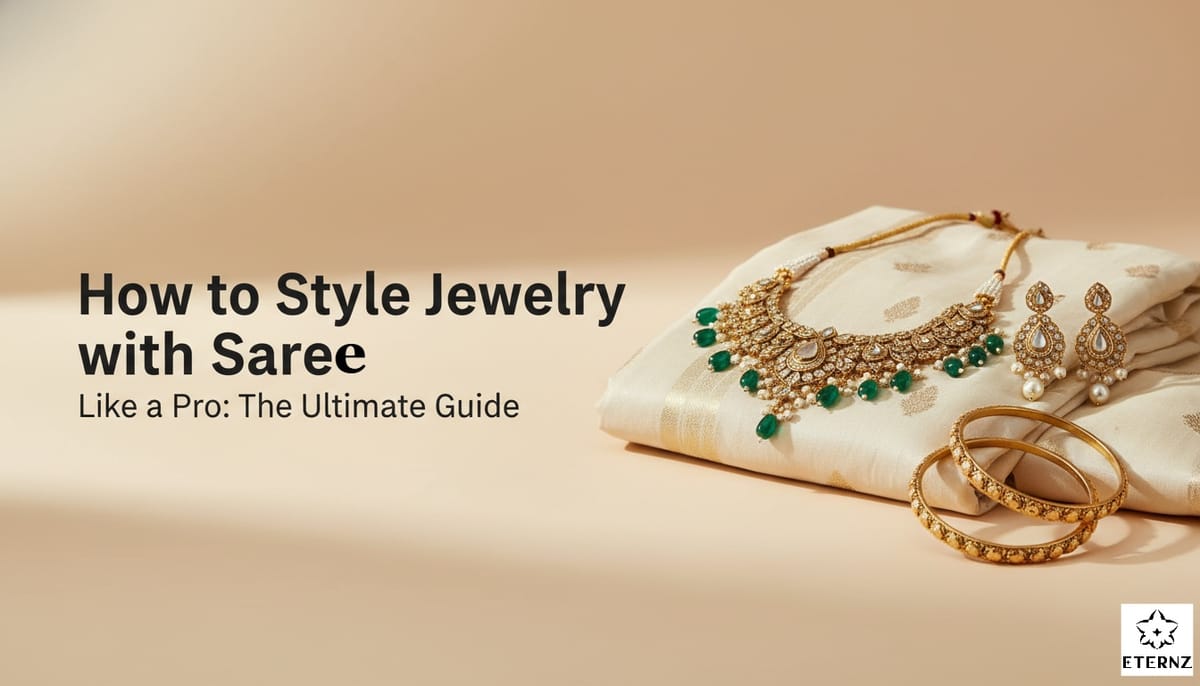
How to Style Jewelry with Saree Like a Pro in 2026
Learn how to style jewelry with a saree by fabric, blouse neckline, color, and occasion. Covers silk, Banarasi, cotton, chiffon, and bridal looks with a quick-reference table.
TL;DR
- One principle governs every saree jewelry decision: match the visual weight of your jewelry to the visual weight of your saree fabric.
- Heavy fabrics (Banarasi, Kanjeevaram, Paithani) need bold, rich jewelry. Light fabrics (chiffon, georgette, cotton) need minimal, delicate pieces.
- Your blouse neckline decides your earring choice, not the saree itself. Always start there.
- The “one hero piece” rule: choose either a statement necklace or bold earrings. Never both at the same time.
- Gold suits warm and rich fabrics. Silver and oxidised metals suit light, casual, and handloom sarees. Pearls suit almost every fabric.
- Occasion is the final filter: the same saree worn to an office, a puja, and a wedding needs three completely different jewelry approaches.
What We Cover
- The one principle that makes every jewelry decision easier
- How to read your saree before picking any jewelry
- Jewelry guide by fabric: silk, Banarasi, cotton, chiffon, georgette, handloom, net
- Why your blouse neckline is the real starting point
- Saree color to jewelry color: a practical pairing guide
- Jewelry by occasion: office, festive, wedding, casual
- The one hero piece rule and how to apply it
- Common saree jewelry mistakes and how to avoid them
- Quick reference table
- FAQs
Knowing how to style jewelry with a saree becomes straightforward once you understand one principle: match the visual weight of your jewelry to the visual weight of your fabric. Heavy, rich fabrics carry heavy, rich jewelry. Light, breezy fabrics carry minimal, delicate pieces. When this balance is off, the jewelry either disappears into the fabric or overpowers it, and neither looks intentional.
This single rule explains why temple jewelry looks right with a Kanjeevaram and wrong with a chiffon. It explains why oxidised silver suits a cotton saree but looks out of place on a Banarasi. Once you understand this logic, you stop memorising combinations and start reading your saree directly.
That reading starts with fabric. Everything else, neckline, color, occasion, builds on top of it.
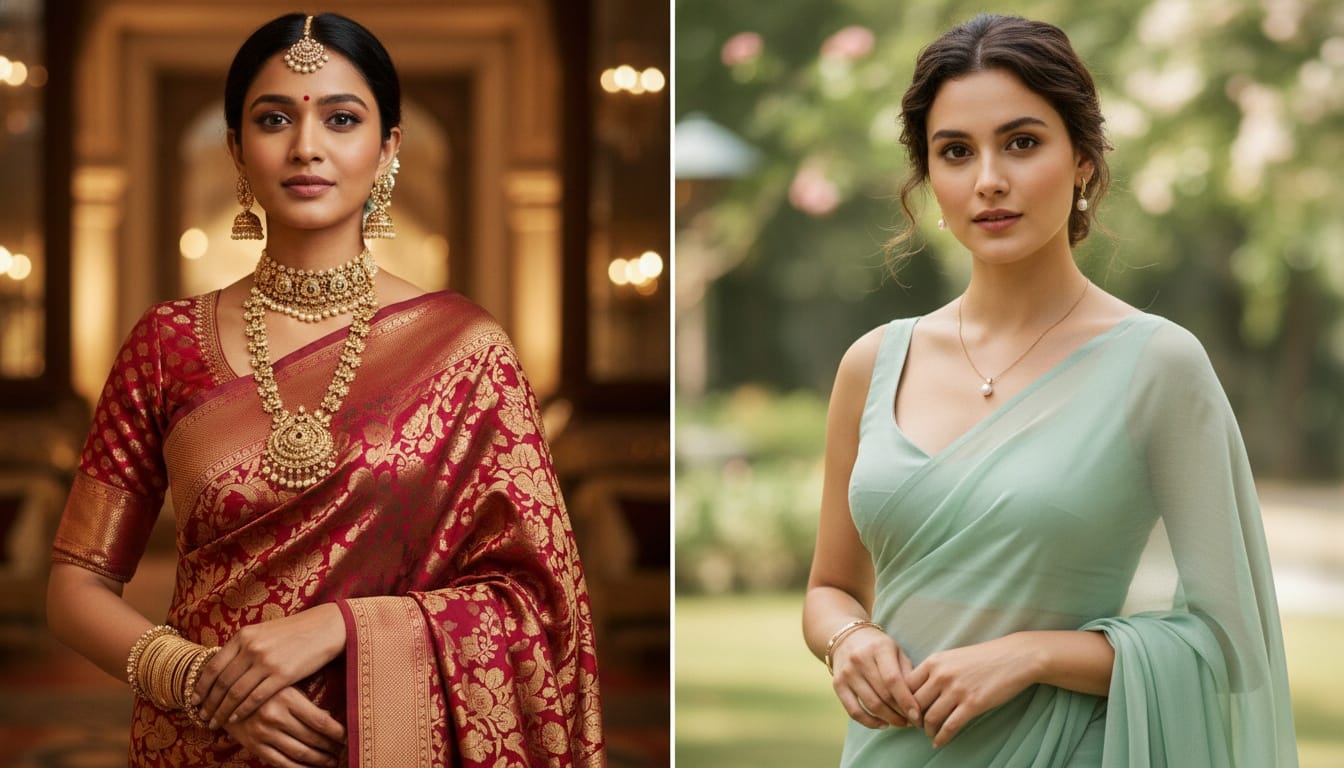
Saree Fabric Guide: How Fabric Determines Your Jewelry Choice
The fabric of your saree tells you the weight, richness, and structure of jewelry it can carry. Before picking any piece, look at the fabric in your hands and ask: is this heavy or light? Rich or understated? Structured or flowing?
Here is how each major saree fabric reads and what it calls for.
1. Styling Jewelry with Silk Sarees
Silk sarees, whether Kanjeevaram, Mysore silk, or Paithani, have a rich, structured weight that demands equally rich jewelry. Delicate pieces disappear against the depth of silk. Bold, traditional jewelry matches its gravity.
Best jewelry for silk sarees:
- Gold temple jewelry sets with goddess or peacock motifs
- Kundan or polki necklaces and chandbali earrings
- Long layered gold chains (haar or rani haar style)
- Gold bangles or kadas in pairs or multiples
- Jhumkas with stone detailing
What to avoid: Oxidised silver, delicate minimal chains, and contemporary geometric earrings. These styles read as too casual against the formality of silk.
The pairing logic: Silk has inherent grandeur. The jewelry should match that level, not contrast it downward.
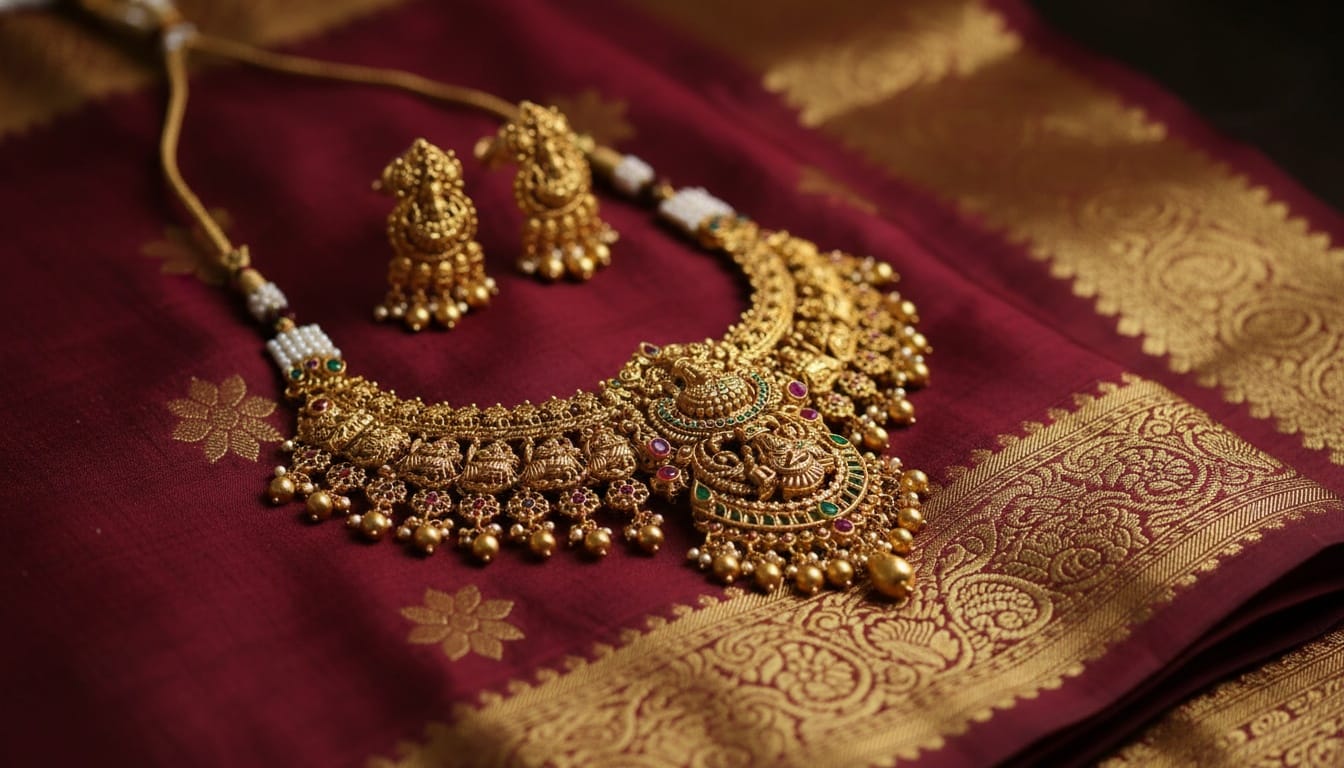
2. Styling Jewelry with Banarasi Sarees
Banarasi sarees are among the heaviest and most embellished saree fabrics, with intricate zari work that already carries significant visual weight. This means the jewelry job is to complement the existing richness, not compete with it.
Best jewelry for Banarasi sarees:
- Kundan sets: the flat-stone setting of kundan echoes the flat, woven surface of Banarasi zari beautifully
- Polki choker or layered necklace with matching jhumkas
- A single statement maang tikka worn with minimal earrings
- Pearl drops or pearl jhumkas for a softer, regal look
- Gold bangles that echo the gold zari in the saree border
What to avoid: Heavy stone necklace plus heavy earrings plus heavy bangles all at once. Banarasi already carries maximum visual richness. Adding more creates clutter. One bold jewelry piece is enough here.
The pairing logic: Let the saree lead. Your jewelry supports, not competes.
3. Styling Jewelry with Chiffon and Georgette Sarees
Chiffon and georgette are soft, flowing fabrics with no inherent structure or embellishment weight. They move, drape, and breathe. The jewelry for these fabrics must be light enough to let that movement remain the visual focus.
Best jewelry for chiffon and georgette sarees:
- Delicate gold chains with a small pendant
- Pearl studs or small pearl drops
- Slim gold or silver hoops (20 to 30mm)
- Long slim danglers that complement the fabric’s flow
- A single statement earring, no necklace at all, which is often the strongest choice
What to avoid: Heavy kundan sets, oversized jhumkas, multiple stacked bangles. These anchor fabrics visually and fight against the lightness that makes chiffon and georgette so elegant.
The pairing logic: Light fabric + heavy jewelry creates visual imbalance. Keep the same register as the fabric.
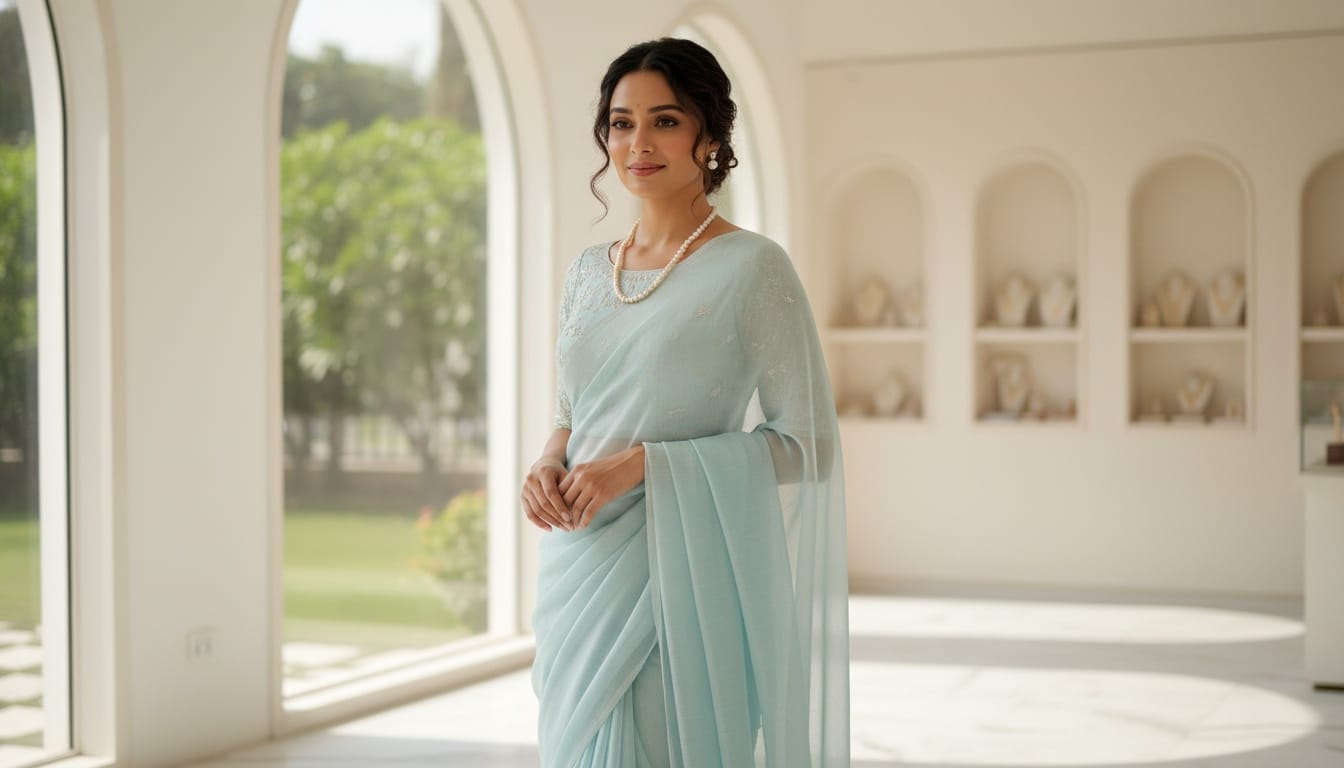
4. Styling Jewelry with Cotton Sarees
Cotton sarees are the most versatile saree fabric: casual, breathable, and worn across the widest range of contexts from daily wear to cultural events. The jewelry should match this versatility without being generic.
Best jewelry for cotton sarees:
- Oxidised silver jhumkas or studs: this is the most natural pairing for cotton
- Terracotta or clay jewelry for handcrafted, artisanal cotton sarees
- Thread jewelry and fabric earrings for printed cotton sarees
- Simple gold studs or small gold hoops for office cotton sarees
- Beaded necklaces for a casual, festive touch
What to avoid: Heavy bridal sets and elaborate kundan jewelry. Cotton is an everyday fabric. It carries everyday jewelry, not occasion jewelry.
The pairing logic: Cotton’s simplicity is its strength. Jewelry that matches that simplicity enhances it. Jewelry that fights it looks out of context.
5. Styling Jewelry with Handloom Sarees (Tussar, Linen, Khadi)
Handloom sarees carry an earthy, textured quality that traditional gold or silver sets can overwhelm. These fabrics respond best to jewelry that echoes their craft sensibility.
Best jewelry for handloom sarees:
- Oxidised silver chokers or earrings
- Dhokra brass jewelry with its distinctive handcast look
- Simple antique gold pieces with matte finish
- Minimal pendant chains in silver or gold
- Tribal-inspired earrings that share the handcrafted quality of the fabric
What to avoid: Shiny, polished fine jewelry. High-gloss gold and diamond pieces clash aesthetically with the organic, matte quality of handloom textiles.
The pairing logic: Handloom and handcrafted jewelry belong to the same aesthetic universe. Keep them in the same register.
6. Styling Jewelry with Net and Organza Sarees
Net and organza sarees are sheer, delicate, and often heavily embellished with embroidery, sequins, or stone work. The jewelry must navigate the fact that the saree itself is often already doing significant decorative work.
Best jewelry for net and organza sarees:
- Statement earrings with no necklace, especially if the saree has a heavily embellished border or pallu
- Diamond or CZ studs and drops that add sparkle without bulk
- Slim gold or pearl necklace if the saree is plain or lightly embellished
- Elegant ear cuffs or climbers for a contemporary net saree look
What to avoid: Heavy, layered jewelry sets. Net and organza are already visually busy. Adding more embellishment creates a look that feels overdone rather than styled.
Blouse Neckline: The Real Starting Point for Earring Selection
Here is the detail most saree styling guides miss entirely: your earring choice is decided by your blouse neckline, not the saree fabric. The blouse neckline is the frame around your face and neck. The earrings sit inside that frame.
This is the same principle that governs all earring choices. In the context of a saree, it means two women wearing identical sarees but different blouses need different earrings.
Here is how the blouse neckline changes the earring:
- Deep V blouse neckline: Long jhumkas or chandbalis that follow the downward visual line of the V. The earring extends the neckline’s direction rather than interrupting it.
- Round neck blouse: Chandbalis or medium drop earrings that add the vertical length the round neckline lacks. The earring compensates for what the neckline does not provide.
- Boat neck blouse: Long, slim chandelier drops or pearl danglers that add vertical movement to counteract the wide horizontal neckline.
- High neck or mandarin collar blouse: Bold statement jhumkas or structured earrings that sit above the collar and draw the eye upward.
- Sweetheart neckline: Chandbalis or long polki drops that fill the wide open frame of the sweetheart cut.
The necklace then follows: Once the blouse neckline and earring are established, the necklace is chosen to fill the remaining space, if any space needs filling. A deep V with long earrings may not need a necklace at all. A round neck with chandbalis needs a choker or short necklace to complete the look.
Saree Color to Jewelry Color: A Practical Pairing Guide
The color of your saree determines the metal tone and stone color that works best. This is not about matching exactly. It is about creating a coherent color relationship between fabric and metal.
Here is a practical color guide:
- Red and maroon sarees: Gold is the most reliable choice. Kundan with red stones, polki with gold, and ruby or garnet accents all carry forward the warmth of the color. Avoid silver, which creates a temperature clash with red’s warmth.
- Green sarees: Gold with green stone accents (emerald, peridot, green onyx) mirrors the saree’s tone. Temple jewelry with green stone inlays is a classic pairing.
- Blue sarees: Silver-toned jewelry, white stone pieces, and pearl necklaces suit blue’s cool clarity. Light blue sarees in particular look stunning with layered pearl necklaces and silver jhumkas.
- Yellow and mustard sarees: Gold jewelry is safest. Avoid silver, which can look washed out against warm yellow tones.
- Pink and blush sarees: Rose gold and pearl jewelry create a soft, harmonious look. Kundan with pink stones extends the palette beautifully.
- White and off-white sarees: The most versatile base for jewelry. Gold, silver, pearls, and colored stones all work. A single bold colored stone necklace against a white saree creates one of the cleanest looks in Indian styling.
- Black sarees: Gold creates the highest-contrast look. Diamond or CZ jewelry creates a formal, contemporary statement. Both are strong choices.
- Multicolor and printed sarees: Pull one dominant color from the print and carry it into your jewelry. A saree with a red and gold border pairs with red stone earrings and gold bangles that echo the border rather than compete with it.
The One Hero Piece Rule: Balancing Your Saree Jewelry
The single most common saree jewelry mistake is wearing too many statement pieces at once. A statement necklace plus bold jhumkas plus stacked bangles plus a maang tikka produces a look that is visually busy rather than beautifully adorned.
The one hero piece rule is simple: choose one piece to lead the look. Everything else supports it.
- If the necklace is the hero: Keep earrings small. Studs, small jhumkas, or pearl drops. Let the necklace own the focal point near the face and neckline.
- If the earrings are the hero: Skip the necklace entirely or wear a very slim, close-fitting chain. Long chandbalis or large jhumkas need open space around the neck to be seen properly.
- If the maang tikka is the hero: Keep both earrings and necklace understated. A statement maang tikka is a strong enough focal point on its own.
When to use all three: Only for bridal styling, where the expectation is maximum adornment across the entire look. Even then, each piece should belong to the same jewelry set so the look reads as coordinated rather than layered randomly.
Jewelry by Occasion: Adapting Your Saree Look
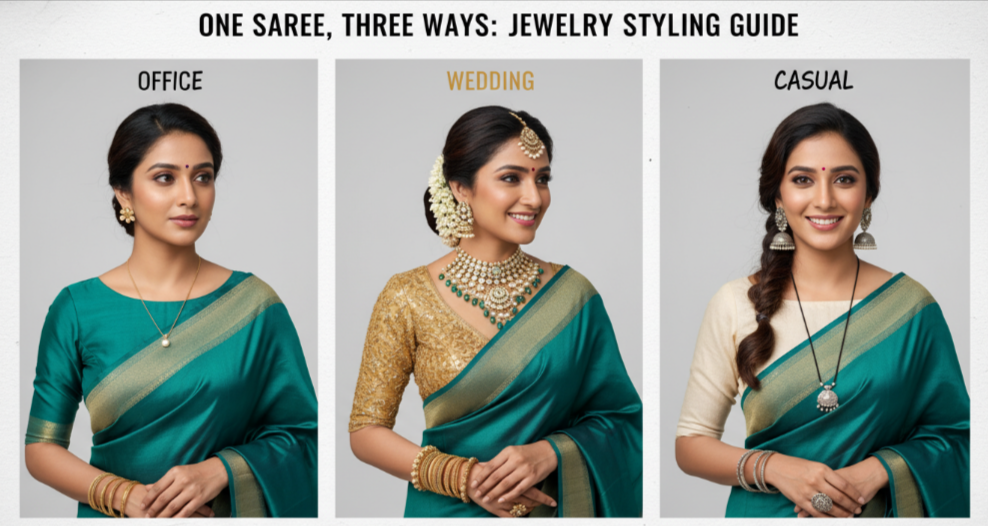
Occasion is the final filter. The same cotton saree worn to an office, a Navratri celebration, and a casual outing each needs a completely different jewelry approach.
- Office and daily wear saree: Keep jewelry polished and minimal. Small gold studs or pearl studs, one thin gold chain or mangalsutra, two to three bangles maximum. The goal is put-together, not adorned.
- Festive occasions (Diwali, Navratri, Puja, Eid): Move up one register from daily. Jhumkas in place of studs, a choker or short necklace in place of a plain chain, a full bangle stack in place of two. Match the richness of the jewelry to the occasion’s energy.
- Wedding (as a guest): Full jewelry appropriate to the fabric. If wearing silk, reach for the kundan or polki set. If wearing chiffon, choose one statement earring and a slim necklace. The wedding occasion calls for the richest version of whatever your fabric can carry.
- Bridal: Start with the blouse neckline. Build upward from there. Always check weight before committing: bridal events are long. Any earring above 20 grams per piece becomes a physical consideration across a full day.
- Casual outings: The most experimental context. Cotton or chiffon sarees with oxidised silver, terracotta, or thread jewelry all work here. Let personality lead over tradition.
Quick Reference: Saree Fabric and Jewelry at a Glance
| Saree Fabric | Best Jewelry | Best Metal | Avoid |
|---|---|---|---|
| Kanjeevaram / Mysore Silk | Temple jewelry, kundan, gold jhumkas | Gold | Minimal silver, delicate chains |
| Banarasi | Kundan choker, polki set, pearl drops | Gold | Heavy sets on all three pieces at once |
| Chiffon / Georgette | Delicate chain, pearl studs, slim drops | Gold or silver | Heavy kundan sets, large jhumkas |
| Cotton | Oxidised silver, terracotta, small gold studs | Silver / Oxidised | Bridal sets, heavy stone necklaces |
| Handloom (Tussar, Linen) | Dhokra, oxidised silver, antique gold | Matte gold / Silver | High-gloss fine jewelry |
| Net / Organza | Statement earrings, CZ drops, slim chain | Gold or silver | Layered heavy sets |
| Paithani | Gold temple jewelry, pearl jhumkas | Gold | Contemporary geometric jewelry |
Common Saree Jewelry Mistakes and How to Avoid Them
Even well-chosen individual pieces can fail if these four errors are present.
- Choosing jewelry before looking at the blouse neckline. The blouse neckline is the frame your earrings sit in. Choosing earrings without checking the neckline produces the single most common visible mismatch in saree styling.
- Wearing heavy jewelry with light fabric. A heavy kundan set on a chiffon saree pulls the look downward and fights the fabric’s natural movement. Match the weight.
- Matching metal exactly to saree border color when it creates competition. If your saree has a heavy gold border and you add a heavy gold necklace, both elements compete for the same zone. Slightly lower the jewelry richness to let the border read clearly.
- Using the same jewelry set for every saree. One set cannot suit every fabric, color, and occasion in your saree wardrobe. Build even a minimal jewelry collection with the fabric variety in mind.
If you want to explore jewelry for every saree type in one place, Eternz brings together 350+ brands including Giva, Palmonas, and Kushal’s, covering everything from lightweight daily-wear silver to bridal kundan and polki sets.
Conclusion: Mastering Saree Jewelry Styling
Every saree jewelry decision comes back to the same three questions. What is the fabric weight? What does the blouse neckline call for? What does the occasion demand?
Answer those three in order and the right jewelry becomes clear before you open a single drawer or browse a single page. The fabric tells you how rich to go. The neckline tells you how long to go. The occasion tells you how bold to go.
Apply the one hero piece rule on top of those three and the look is always balanced, always intentional, and always styled rather than simply dressed.
Frequently Asked Questions (FAQs)
1. What jewelry should I wear with a silk saree?
Gold temple jewelry, kundan sets, polki necklaces, and chandbali earrings work best with silk sarees. The rich weight of silk needs equally rich jewelry. Minimal or silver jewelry looks too understated against a heavily structured silk fabric.
2. Which jewelry looks best with a Banarasi saree?
Kundan or polki jewelry matches the heritage weight of Banarasi best. Apply the one hero piece rule: wear either a statement necklace or bold earrings, not both, since the saree already carries significant visual richness through its zari work.
3. What jewelry should I wear with a chiffon saree?
Delicate gold chains, pearl studs, slim drop earrings, or a single statement earring with no necklace. Chiffon is lightweight and flowing. Heavy sets overpower it. Let the fabric lead and use minimal jewelry to complement its movement.
4. Can I wear silver jewelry with a saree?
Yes. Silver and oxidised silver suit cotton, handloom, chiffon, and georgette sarees naturally. They look out of place on heavy silk and Banarasi fabrics, where gold is the more harmonious metal. Match the metal tone to the fabric’s warmth and weight.
5. What earrings should I wear with a saree?
Your blouse neckline decides your earring choice. Deep V blouse: long jhumkas or chandbalis. Round neck: chandbalis or medium drops. Boat neck: long slim drops. High neck: bold jhumkas or structured pieces. The saree fabric then tells you how rich the earring should be.
6. What is the best jewelry for a bridal saree?
Start with the blouse neckline to determine earring length and style. Then layer the necklace and maang tikka in the same jewelry set for visual cohesion. Kundan, polki, and temple jewelry in gold are the most traditional bridal choices. Always check earring weight before committing for a full-day event.
7. How do I style jewelry with a cotton saree for the office?
Keep it minimal: small gold studs or pearl studs, one thin chain or mangalsutra, and two to three slim bangles. The goal is polished and professional rather than adorned. Oxidised silver jhumkas work well if the office environment allows for a more expressive look.